
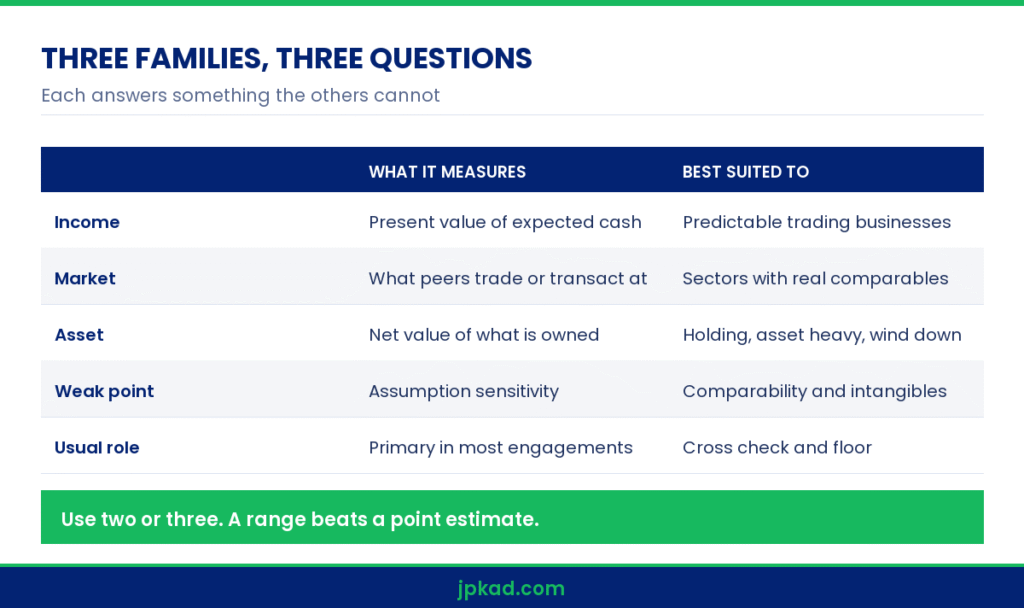
Three families of valuation methods cover almost every engagement. One values future cash, one values the business against its peers, and one values what it owns. Choosing between them is not a matter of taste. Each rests on assumptions that either hold for the business in front of you or do not. This guide explains what each method measures, where it breaks, and why a credible report almost always uses more than one. Our note on investor checks on a business sets the wider context.
Key Takeaways
- Discounted cash flow is the most complete method and the most sensitive to assumptions, so it belongs with a sensitivity table rather than a single figure.
- Market multiples are fast and negotiable, but comparability is the weak point in India, where listed peers dwarf the private company being valued.
- The asset approach sets a floor for a trading business and becomes the primary method only in asset heavy or wind down situations.
The Income Approach: Valuing What the Business Will Earn
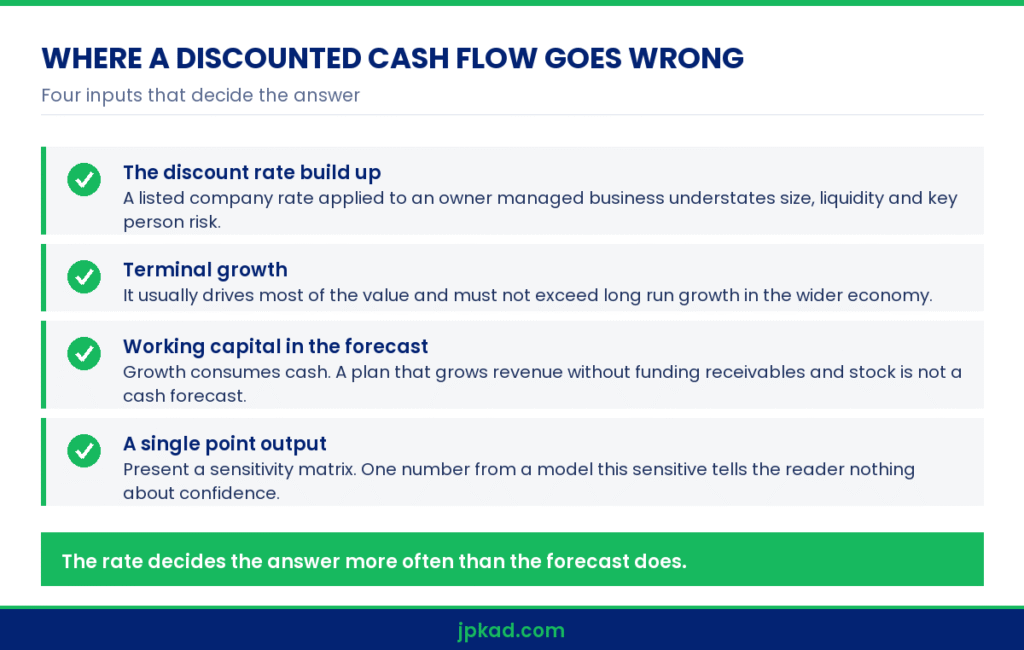
A discounted cash flow values a business as the present worth of the cash it is expected to generate. You forecast free cash flow for an explicit period, estimate a terminal value for everything beyond it, and discount both back at a rate that reflects the risk of that cash actually arriving.
Owners focus on the forecast. The discount rate decides the answer. A rate built for a listed multinational, applied to an owner managed business in Kerala, understates risk badly. The build up has to add premiums for size, for illiquidity, and for company specific risks such as customer concentration or dependence on one person for pricing and relationships.
Terminal value routinely accounts for the majority of the total. That is uncomfortable but not wrong, because most of a going concern’s value genuinely lies beyond any five year window. It does mean the long term growth assumption deserves as much scrutiny as the first year forecast, and it should never exceed the long run growth rate of the wider economy.
Working capital is the input owners forget. Growth consumes cash before it produces any. A forecast that grows revenue without funding the receivables, the stock and the supplier terms that come with it is a profit forecast wearing the costume of a cash forecast, and it will overstate value every time.
Because small input changes move the output so much, a single number from a discounted cash flow is close to meaningless. Present a matrix across a plausible range of growth and discount rates. If the resulting range is unhelpfully wide, that is a finding about the business rather than a failure of the method.
This approach suits businesses with reasonably predictable cash generation and a plan somebody other than the founder has tested. It suits pre revenue companies poorly. Where the historical accounts cannot be relied on, it does not suit the business at all until they can.
The Market Approach: Valuing Against Comparable Businesses
The market approach takes a multiple observed elsewhere and applies it to the subject company. The multiple can come from listed peers or from completed transactions in the same sector. Both sources are useful and both need adjustment before they mean anything.
Listed comparables are easy to find and hard to use well. A listed company is larger, more diversified, better governed and vastly more liquid than a private company in the same industry. Applying its multiple without discounting for size and marketability produces a figure no buyer in the market will pay.
Transaction comparables are closer in character but harder to source in India, because private deal terms are rarely disclosed in enough detail to be useful. Where a figure is available, check what it was a multiple of, and check whether the price included debt. Our note on numbers an investor tests first examines that distinction further.
The multiple also has to match the metric. Revenue multiples suit businesses where profitability is deliberately immature but growth is proven. Operating profit multiples suit established manufacturers and service firms. Applying a software revenue multiple to a contract manufacturer is the single most common error we correct in owner prepared valuations.
Adjustments are where the judgement sits. Size, marketability, control, growth differential and margin differential all justify moving away from the observed multiple, and each adjustment should be stated and reasoned rather than bundled into one unexplained discount.
Used properly, the market approach is a discipline check rather than a primary answer. It tells you whether the number your model produced is one that anybody in the market would recognise as plausible.
The Asset Approach: Valuing What the Business Owns
The asset approach restates the balance sheet at current values and takes the net. Property is marked to current worth, plant is assessed on condition and remaining useful life, receivables are provided against on recoverability, and liabilities including unrecorded ones are brought into the reckoning.
For a profitable trading business this produces a floor rather than a value. If a going concern is worth less than the sum of its parts, the rational course is to break it up, and that conclusion is itself useful information for a board to have in front of it.
It becomes the primary method in three situations. Holding companies, where the value genuinely is the assets held. Asset heavy businesses such as real estate or infrastructure vehicles. And companies being wound down, where future cash flow is not the relevant question.
The difficulty is intangible value. Brand, customer relationships, assembled workforce and process know how rarely appear on an Indian small business balance sheet, so an asset approach that ignores them will understate a services firm severely. That is a reason to use a different method, not a licence to invent an intangible figure.
Unrecorded liabilities cut the other way and are just as important. Disputed tax demands, employee dues, guarantees given for group companies and warranty obligations all reduce net asset value and are commonly missing from the books of owner managed businesses.
Where the approach earns its place in every engagement is as a cross check. If your income based figure sits below net asset value, something in the forecast needs revisiting before the report leaves the office.
Building a Range and Defending It
A finished valuation should present a range with a reasoned view inside it. Where the methods converge, say so and narrow the range. Where they diverge, explain why rather than averaging them, because the average of two badly founded numbers is not a better number.
Weighting is a judgement and it must be disclosed. A report that says it weighted income at seventy and market at thirty, and explains that choice, can be challenged on its reasoning and defended on the same basis. One that quietly blends methods cannot be tested at all.
Reconciliation is the step that separates a professional report from a spreadsheet. Walk the reader from the highest figure to the lowest and account for the difference in plain language. Buyers, boards and assessing officers all read that section first, and many read little else.
Normalising adjustments to earnings need the same treatment. Owner remuneration above or below market, personal expenses run through the business, one off legal costs and non recurring gains all change the figure the multiple is applied to. List every adjustment with its rationale. Buyers challenge the list, and an undocumented add back is simply conceded.
Keep the working papers. Sources for each comparable, the derivation of the discount rate, and the basis for every adjustment. If the valuation is later questioned, the file is what defends it, and reconstructing a file after the fact is neither possible nor convincing. The Indian tax summary maintained by PwC is a reasonable public starting point for the tax assumptions that feed the model.
Finally, state what the report is not. Scope limitations, the valuation date, information relied on without independent verification and the purposes for which the report may be used all belong in it. A clearly bounded report is more useful, not less.
Conclusion
The three valuation methods are tools rather than rival theories. Income tells you what the cash is worth, market tells you what others pay for similar cash, and assets tell you where the floor sits. Use at least two, present a range, disclose your weighting and keep the file that supports it. JPKAD prepares valuations for fundraising, transactions, tax and disputes. Contact our team to discuss which basis your situation requires.
Frequently Asked Questions
Which valuation method is most accurate?
None on its own. The income approach is the most theoretically complete but the most assumption sensitive. Accuracy comes from applying two or three methods and reconciling the difference between them.
What discount rate should a small Indian business use?
One built up from a risk free rate with premiums added for equity risk, size, illiquidity and company specific factors. A listed company rate applied to a private business understates risk considerably.
Why is terminal value so large?
Because most of a going concern’s worth genuinely lies beyond the explicit forecast period. That is normal, but it makes the long term growth assumption the most closely examined input in the whole model.
Can I value my business on a revenue multiple?
Only where the sector genuinely trades on revenue, typically when growth is proven but profitability is still immature. Applying one to an established manufacturer produces a figure no buyer will accept.
What is the difference between enterprise value and equity value?
Enterprise value covers the whole business regardless of how it is funded. Equity value is what shareholders receive after debt and other claims. Confusing the two is a frequent and costly error.
Does the asset approach work for a services firm?
Poorly as a primary method, because the value sits in relationships and people rather than on the balance sheet. It still earns its place as a floor and as a cross check on the income figure.
How many comparables do I need?
Enough that no single outlier drives the result, and close enough in size and business model to be meaningful. A small set of genuinely comparable companies beats a long list of loosely related ones.
Should the valuation be a single number or a range?
A range with a reasoned view inside it. A point estimate from a model this sensitive suggests a precision that the underlying data does not support.
What records should I keep after a valuation?
The full working file: comparable sources, the discount rate build up and every normalising adjustment. If the number is challenged, the file is the defence. See our note on accurate records driving business success.