
Two businesses in the same sector with identical profit can transact at very different prices. The difference is the multiple, and the multiple is not a market constant. It is the sum of a buyer’s judgements about durability, risk and effort. This guide sets out what actually moves the multiple in an Indian small and mid market investor checks on a business, and which of those factors an owner can change.
Key Takeaways
- The multiple prices durability and risk, not size alone, which is why two firms with the same profit can be worth very different amounts.
- Customer concentration, owner dependence and undocumented arrangements are the three discounts most Indian SMEs carry, and all three are fixable.
- Improving the quality of the earnings figure often adds more value than improving the earnings themselves.
What the Multiple Is Really Pricing
A multiple is shorthand for a discounted cash flow the buyer has not written down. When someone offers a given multiple of operating profit, they are expressing a view on how long that profit will persist, how fast it will grow, how much capital it will absorb, and how likely it is to disappear.
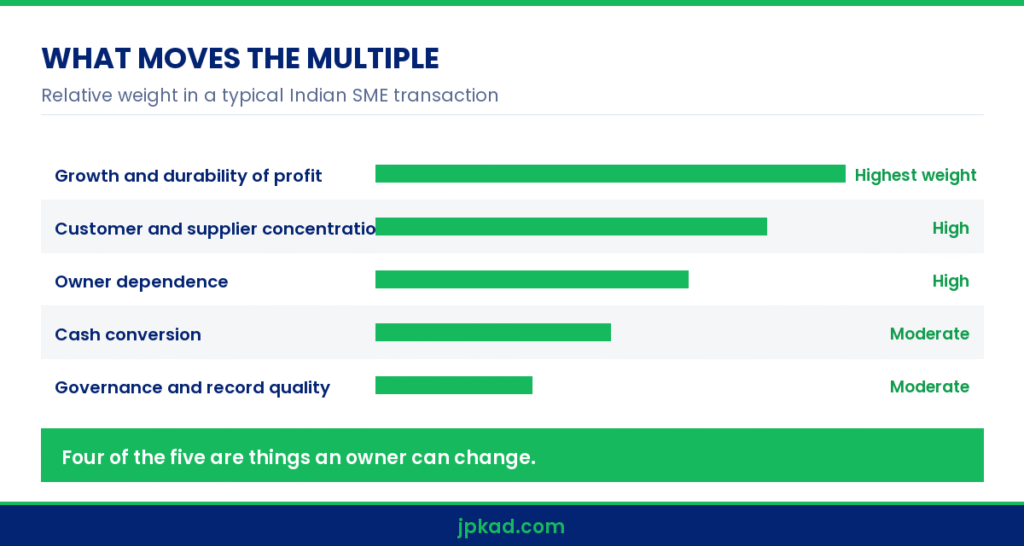
That is why growth moves the multiple so strongly. A business growing steadily is being bought for a longer stream of larger cash flows. A flat business is being bought for the current stream and little else. The gap between the two is much wider than most owners expect.
Capital intensity works in the opposite direction. Two businesses with the same operating profit are not equally valuable if one has to reinvest most of it in plant and working capital to stand still. Buyers look at cash conversion, and a low conversion rate compresses the multiple regardless of headline profitability.
Risk is the third lever and the one owners underestimate. Anything that could remove a large part of the profit quickly, whether a single customer, a single supplier, a licence, or a single person, is priced. The buyer is not being pessimistic. They are pricing the range of outcomes rather than the expected one.
Finally, the multiple prices effort. A business that will need eighteen months of management attention to stabilise is worth less than one that runs itself, even at the same profit, because the acquirer’s own scarce resource is attention.
None of these judgements is written down in the offer. They are compressed into a single number, which is why negotiating the multiple in the abstract is unproductive. The useful conversation is about the underlying judgements: show the buyer why the profit is durable, why the concentration is lower than it looks, and why the business will run without you.
The Three Discounts Most Indian SMEs Carry
Customer concentration is the first and the most common. Where a large share of revenue sits with two or three customers, the buyer prices the risk that those relationships were personal to the seller. The discount applies even where the relationships are decades old, because the buyer cannot verify loyalty that has never been tested by a change of ownership.
The remedy is partly commercial and partly documentary. Broadening the base takes years. Converting informal relationships into written contracts with notice periods and renewal terms takes months, and it measurably reduces the discount because it changes what the buyer is buying.
Owner dependence is the second. Where the owner holds the pricing knowledge, the supplier terms and the customer relationships personally, the buyer is purchasing a person who is about to leave. Promoting a second layer of management, documenting how decisions are made, and visibly stepping back from day to day trading are what shift this.
Record quality is the third and the cheapest to fix. Where management accounts do not reconcile to statutory accounts, where statutory registers disagree with filings, and where related party transactions have no written terms, the buyer applies a discount for uncertainty on top of any specific issue found. Our note on accurate records driving business success covers the basics.
All three discounts compound. A business with concentrated customers, a dominant owner and untidy records is not discounted three times independently. It is placed in a different category of buyer altogether, usually one paying an asset based price.
There is a fourth discount worth naming because it is entirely self inflicted. Businesses that cannot produce timely monthly management accounts are treated as opaque. When a buyer has to wait three weeks for last month’s numbers, every subsequent request is assumed to be equally slow, and the process loses momentum at exactly the point where momentum is worth most.
Improving the Earnings Figure Itself
The multiple is applied to a number, and that number is negotiated as hard as the multiple is. Buyers start from statutory profit and adjust. Sellers should arrive with the adjusted figure already prepared and evidenced, because the party that defines the starting point usually keeps most of it.
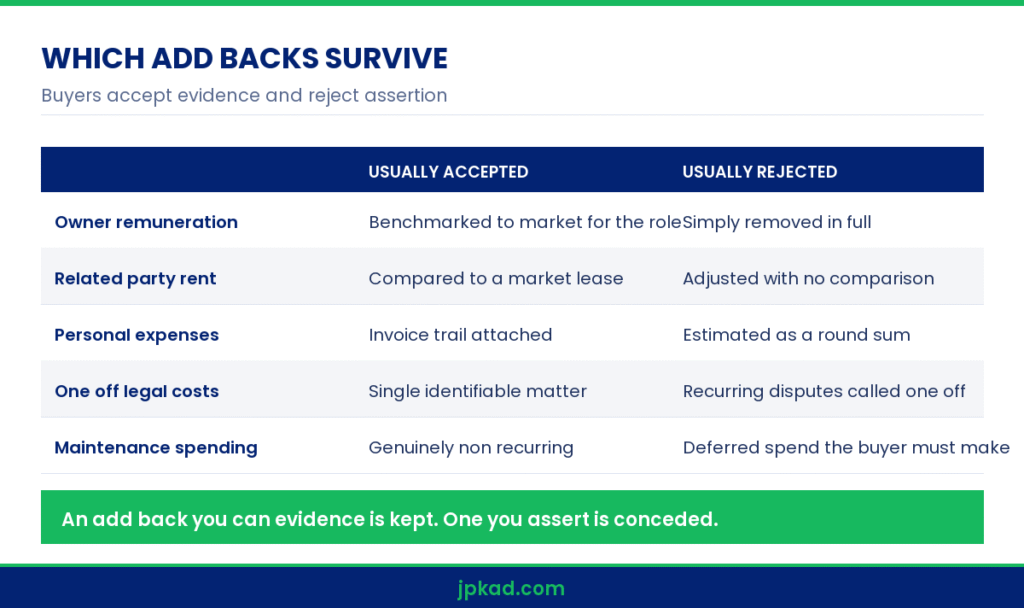
Legitimate normalising adjustments are common in owner managed businesses. Remuneration above or below a market rate for the role. Personal vehicles, travel or family salaries run through the company. Rent paid to a related party above or below market. Genuine one off costs such as a single litigation or a relocation.
Each adjustment needs evidence, not assertion. A market salary benchmark, an invoice trail, a lease comparison. Buyers accept evidenced adjustments as a matter of routine and reject asserted ones as a matter of routine, and the difference across a full list is often material.
Be careful with adjustments that are really deferred costs. Removing maintenance capital expenditure, understating provisions, or stretching supplier payments improves the current figure and creates a problem that surfaces in diligence. Buyers rebuild working capital and capital expenditure trends, and the pattern is visible.
Sustainability is the test a buyer applies to every line. A cost that a new owner will still incur is not an add back, whatever the seller calls it. Applying that test yourself before the process starts saves the credibility you will need for the adjustments that are genuine.
Documentation of the earnings base matters as much as the base itself. Where revenue recognition policy is inconsistent between periods, or where the trial balance does not tie to the statutory accounts without unexplained journals, the buyer discounts the whole figure rather than adjusting a line. The Indian corporate tax summary published by PwC is a useful reference when a foreign buyer is assessing how those numbers translate.
Sector Patterns and Where Kerala Businesses Sit
Different sectors trade on different metrics and at different levels. Recurring revenue businesses command the highest multiples because the revenue is contracted and visible. Manufacturers sit lower and are heavily influenced by capital intensity and order book visibility. Distribution and trading sit lower again because margins are thin and switching costs are low.
Professional and personal services are the hardest case. Value often walks out at the end of the day, so buyers pay close to net asset value plus a modest goodwill component unless the firm has genuinely institutionalised its client relationships.
Regional factors matter too. Many Kerala and South Indian businesses are family held, conservatively financed and reluctant to document informal arrangements. The conservative balance sheet helps. The documentation habit hurts, and it is the single most correctable regional pattern we see.
Buyer type changes the answer as much as sector does. A strategic buyer with synergies to realise can pay more than a financial buyer applying a return requirement, and a competitor buying capacity can pay more than either. Running a process that reaches more than one category of buyer is often worth more than any operational improvement.
None of this is a substitute for a proper valuation. Sector benchmarks tell you which conversation you are in. They do not tell you what your business is worth, and owners who negotiate from a benchmark alone tend to discover the gap late.
Timing across the cycle is the last variable. Selling into a strong order book with visible forward revenue is materially different from selling after a flat year, even where the underlying business is identical. Owners who can choose their moment should treat the decision as part of the valuation exercise rather than separate from it.
Conclusion
The multiple in a corporate valuation is a judgement about durability, risk and effort, and most of what shapes it is inside the owner’s control. Broaden the customer base, document the informal, build a second layer of management, and arrive with an evidenced earnings figure. Start twelve to eighteen months out and the improvement is real rather than cosmetic. Talk to JPKAD about a valuation readiness review.
Frequently Asked Questions
What multiple should my business expect?
It depends on sector, growth, concentration and record quality rather than on a market constant. Benchmarks tell you which conversation you are in. Only a proper valuation tells you where inside it you sit.
Does customer concentration always reduce value?
Almost always, even where relationships are long standing, because loyalty that has never survived a change of ownership cannot be verified. Written contracts with notice periods reduce the discount.
How do I reduce owner dependence?
Promote a second layer of management, document how pricing and supplier decisions are made, and visibly step back from day to day trading well before you go to market.
Are add backs to profit accepted by buyers?
Evidenced ones usually are. Benchmark the owner salary, attach the invoice trail for personal costs, compare related party rent to market. Asserted adjustments are conceded in negotiation.
Can I improve the multiple in six months?
Partly. Documentation, contracts and record quality respond quickly. Customer diversification and reducing owner dependence take considerably longer, which is why preparation should start early.
Do family owned businesses get valued differently?
The conservative balance sheet common in family firms helps. The reluctance to document informal arrangements hurts, and that is the more correctable of the two patterns.
Should I sell to a strategic or a financial buyer?
Whoever pays best for the risk you are transferring. Strategic buyers can pay for synergies a financial buyer cannot, which is why reaching both categories is usually worth more than any single improvement.
Is EBITDA the right measure for my sector?
For established manufacturers and service firms, usually. Recurring revenue businesses often trade on revenue instead, and asset heavy businesses may be assessed on net asset value.
Where should I start?
With a readiness review that scores each discount and puts a timeline against fixing it. See our advisory practice page and our note on disciplined financial planning.