
Executive Summary
Related party transactions had been running through this Kerala family group for more than a decade before anyone tested them against Section 188. Three companies and a partnership traded with each other constantly. Premises were shared, staff moved between entities, and one company funded another whenever working capital was tight.
None of it was concealed. Every arrangement was known to the family, discussed openly, and reflected in the accounts of each entity.
What did not exist was the approval trail the Companies Act requires. No board had considered these arrangements as related party transactions, because nobody had labelled them that way.
JPKAD & Associates was engaged after a lender asked for the register of contracts during a facility review, and the register turned out to be thin.
Work covered identification, testing against the two statutory gates, approval of what needed approving, and the disclosure that follows in the board report.
- Two gates decide the treatment, whether the transaction is in the ordinary course and whether it is at arm’s length.
- Transactions passing both gates still need recording, and those failing either need approval before they are entered into.
- Omnibus approval suits recurring arrangements, and it has to be set with real limits rather than open ended ones.
- An interested director does not participate in the vote, and the minute has to show that.
- Form AOC 2 reports the arrangements that were not at arm’s length or not in the ordinary course.
Do your group companies trade without written approval? Explore our company law work.
Client Overview
The client is a Kerala family group with three private limited companies and a partnership firm. Interests span manufacturing, distribution and property, with the same family holding the equity across all of them.
The operating company manufactures and sells. A second company owns the premises it occupies. A third holds a distribution arrangement covering part of the state.
Directors overlap substantially. Two brothers sit on all three boards, and their spouses hold shares in two of the companies.
Transactions between the entities are constant. Rent, job work, shared administrative staff, inter corporate funding and the occasional sale of materials all move between them.
Each company files its accounts on time and is audited. The difficulty was never the recording of transactions, it was the authorisation that should have preceded them. Putting those arrangements on paper is part of our contractual documentation work.
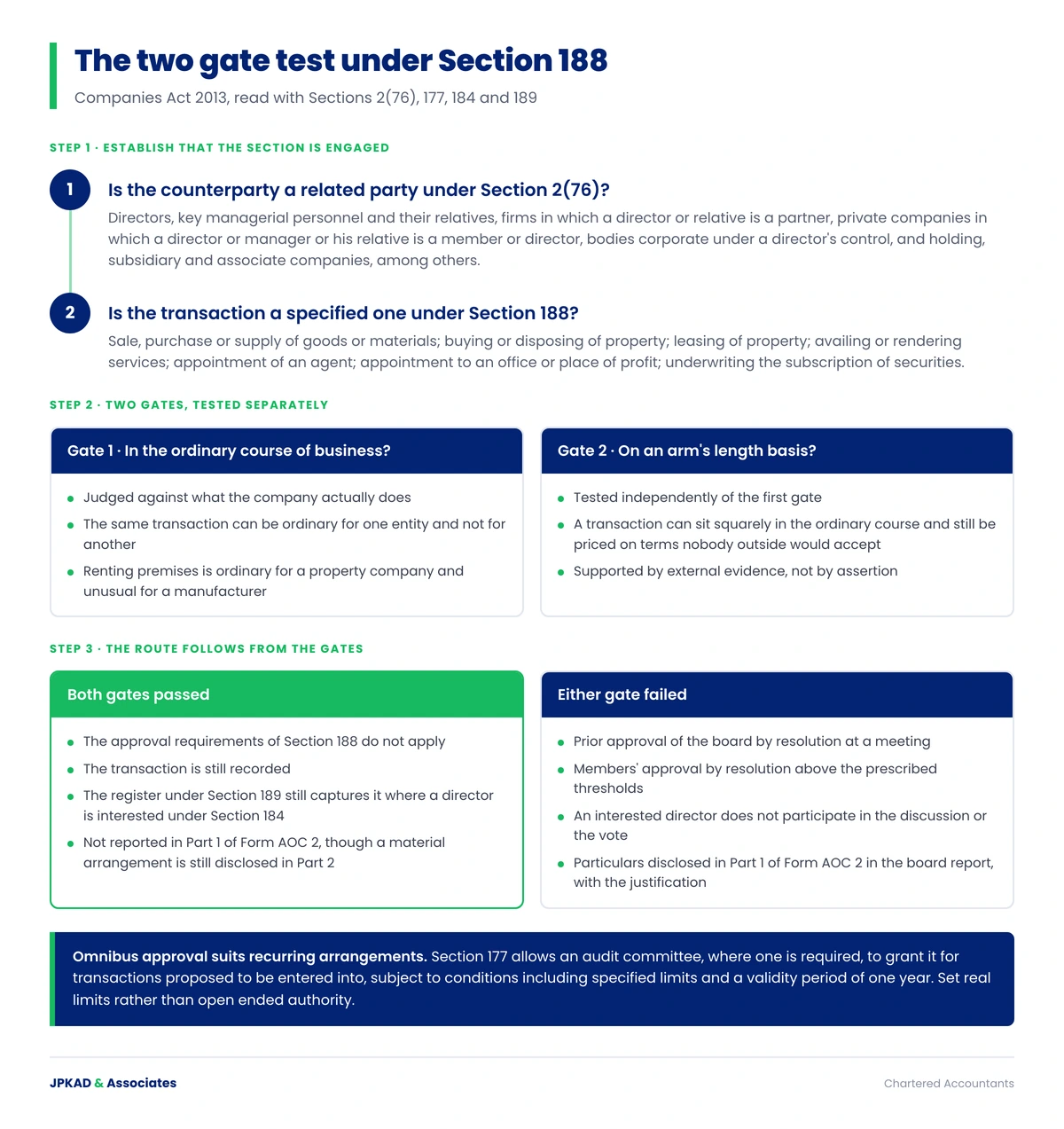
Both gates open, and it is a recording exercise. Either one closed, and approval comes first.
Business Challenges
Nothing had been hidden and nothing had been improperly priced, so far as the family was concerned. The problem was that nobody had ever tested that belief against the statute, and the record showed no evidence of it either way.
Four problems had to be worked through before the position could be regularised.
Which arrangements counted as related party transactions?
More of them than the directors expected, because the definition reaches beyond the obvious sales and purchases between the companies.
The lease of premises from the property company was one. So was the job work arrangement, the administrative staff shared across entities, and the distribution agreement.
Section 2(76) reaches directors, their relatives, firms in which a relative is a partner and companies in which a director is a member, which caught the partnership firm as well.
The directors had been thinking about the three companies. The definition covered the partnership, two spouses and a supplier owned by a brother in law.
Why did the ordinary course question matter so much?
Because it is the first of the two gates, and a transaction that passes both gates does not need approval under Section 188 at all.
Ordinary course is judged against what the company actually does, so the same transaction can be ordinary for one entity and not for another.
Renting premises is ordinary for the property company and unusual for the manufacturer, which meant the two sides of one arrangement were assessed differently.
None of this had ever been documented, so even the arrangements that clearly passed had nothing on file to show that anyone had considered the question.
Was the pricing actually at arm’s length?
In several cases yes, and the family could explain why, though explanation and evidence are different things when an auditor or a lender asks.
The rent had been set years earlier and never revisited, so it had drifted from market simply by standing still while the market moved.
Inter corporate funding carried no interest at all, which is difficult to describe as an arm’s length term between two separate companies.
Job work rates had been agreed informally between brothers, and no comparison against an outside provider had ever been made or recorded.
What was missing from the record?
Board minutes showed no consideration of these arrangements as related party transactions, so no approval could be evidenced.
The register of contracts in which directors are interested existed in name but had not been maintained with any consistency.
Directors had not been recording their interests formally at the first board meeting of each year, as Section 184 requires.
The board report carried no disclosure in Form AOC 2, because the question of whether anything required disclosure had never been asked.
Is your register of contracts current? Read more about our company law matters and compliances.
Business Objectives
The family wanted the position corrected without disrupting how the group actually operates. The arrangements were commercially sensible and they needed to continue, on terms that could be defended and evidenced.
What did the group need to establish first?
A complete map of related parties across all four entities, built from the statutory definition rather than from the family’s own sense of who is connected.
A list of every arrangement between those parties, including the informal ones that had never been treated as arrangements by anybody.
An assessment of each arrangement against both gates, recorded with reasons, so the treatment could be justified rather than asserted.
And a view on which arrangements needed repricing before they could sensibly be approved and allowed to continue.
Why not simply approve everything?
Because approving a transaction that is not at arm’s length does not make it arm’s length, it makes it an approved transaction that requires disclosure.
Some arrangements were better repriced, which moved them through both gates and out of the approval and disclosure requirement entirely.
Others could not sensibly be repriced and were approved deliberately, with the reasons minuted and the disclosure prepared.
Treating approval as a formality would also have missed the point of the exercise, which was to make the group’s dealings defensible rather than merely documented. Why that paperwork matters is set out in our note on why contractual documentation matters in corporate governance.
What defined success for the related party transactions review?
Arrangements tested and recorded against both gates, with the reasoning on file rather than in somebody’s memory.
Approvals in place where approval is required, taken at properly constituted meetings with interested directors abstaining and the minutes showing it.
A register of contracts maintained currently, with director interest disclosures made at the start of each year as the Act requires.
And disclosure in the board report covering what genuinely requires disclosure, prepared from the same underlying records rather than drafted separately.
Want arrangements that survive a lender’s review? Explore our approach.
Solution Strategy
Identification came first, then testing, then repricing, then approval, then disclosure. Running approval before repricing would have meant approving terms the group intended to change within weeks.
Every conclusion was written down with its reasoning, because the value of this exercise lies almost entirely in being able to show the question was asked.
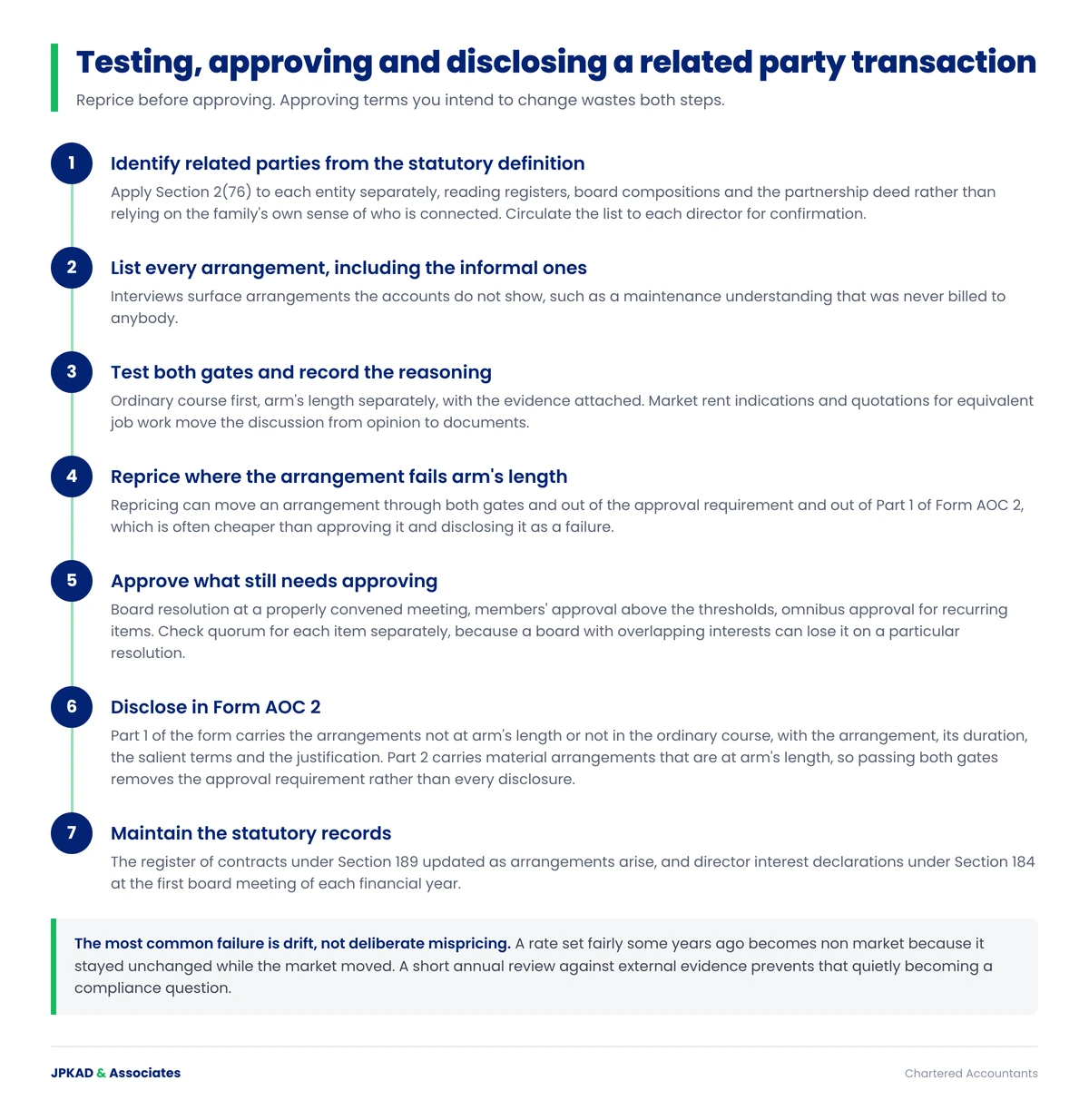
Reprice before approving. Approving terms you intend to change wastes both steps.
How were related parties identified?
By applying Section 2(76) to each entity separately, since a party related to one company in the group is not automatically related to another.
Shareholding registers, board compositions and the partnership deed were read rather than relying on the family’s description of the structure.
Relatives were mapped against the statutory definition, which produced two connections the directors had not considered at all.
The resulting list was circulated to each director for confirmation, since a director knows his own interests better than any adviser can establish them.
How were arrangements tested against the two gates?
Each arrangement was assessed for ordinary course first, judged against the objects and the actual activity of the entity entering into it.
Arm’s length was then assessed separately, because a transaction can sit squarely in the ordinary course and still be priced on terms nobody outside would accept.
Evidence was gathered for the arm’s length assessment, including market rent indications for comparable local premises and quotations for equivalent job work.
The conclusion on each gate was recorded with the evidence attached, so that a later reader can follow the reasoning rather than take it on trust.
How were the arrangements repriced?
Rent was reset to a rate supported by comparable local evidence, which moved that arrangement through both gates and out of the approval requirement.
Inter corporate funding was documented with written terms and an interest rate, since funding between separate companies on no terms at all is difficult to defend.
Job work rates were tested against outside quotations and adjusted where the difference could not be explained by volume or by the nature of the work.
Where repricing was not practical, the arrangement was left as it stood and routed deliberately towards approval and disclosure instead.
How was the approval process handled?
Through properly convened board meetings, with the arrangements presented individually rather than as a single omnibus item covering everything.
Interested directors did not participate in the discussion or the vote on their own arrangements, and the minutes record that explicitly.
Where thresholds required it, members’ approval was obtained by resolution, with the explanatory statement setting out the particulars.
Recurring arrangements were routed through omnibus approval where that was available, with stated limits and a validity period rather than open ended authority.
How was disclosure prepared?
By identifying which arrangements were not at arm’s length or not in the ordinary course, since those are the ones Form AOC 2 reports.
Particulars were drafted to state the arrangement, the duration, the salient terms and the justification for entering into it.
Arrangements that passed both gates were not reported in that form, and the file records why each of them was excluded.
The company’s legal advisers reviewed the wording before it went into the board report, since the disclosure sits in a statutory document.
Have your group terms drifted from market by standing still? Read more about our corporate finance advisory.
Records and Tools Used
This was a documentation exercise almost entirely. The transactions were recorded accurately in every set of accounts, and what was missing sat in the statutory records rather than the financial ones.
Which records established the relationships?
Registers of members and registers of directors for each of the companies, read alongside the partnership deed governing the firm.
Board compositions across all four entities, which is what produces the overlapping directorships the definition turns on.
Shareholding held by relatives, traced through the registers rather than assumed from the family’s own account of who owns what.
Declarations of interest from each of the directors, obtained in the form that Section 184 contemplates and properly dated when they were given.
What evidence supported the arm’s length assessment?
Comparable rental evidence for similar commercial premises in the same locality, obtained from agents rather than estimated internally.
Written quotations from unrelated job work providers for equivalent processes and volumes, retained with the assessment.
Lending rates available to each company from its own bankers, used as a reference point for the inter corporate funding terms.
Price lists and invoices for materials sold between the entities, compared against what unrelated customers had been charged for the same goods in the same period.
How are the statutory records now maintained?
The register of contracts under Section 189 is updated as arrangements are entered into rather than reconstructed before a filing.
Director interest declarations are collected at the first board meeting of each financial year, and whenever an interest changes during it.
Approvals and their supporting assessments are filed together, so an approval can be read alongside the evidence that justified it.
A standing schedule lists every recurring arrangement with its approval basis, its limits and the date its authority expires.
Implementation Process
The engagement ran across roughly eleven weeks. Identification and testing took the first five, repricing and negotiation took three, and the approval and disclosure steps followed the board calendar rather than any timetable of ours.
The family’s own understanding of who was related turned out to be the least reliable input, which is why the statutory definition was applied from scratch.
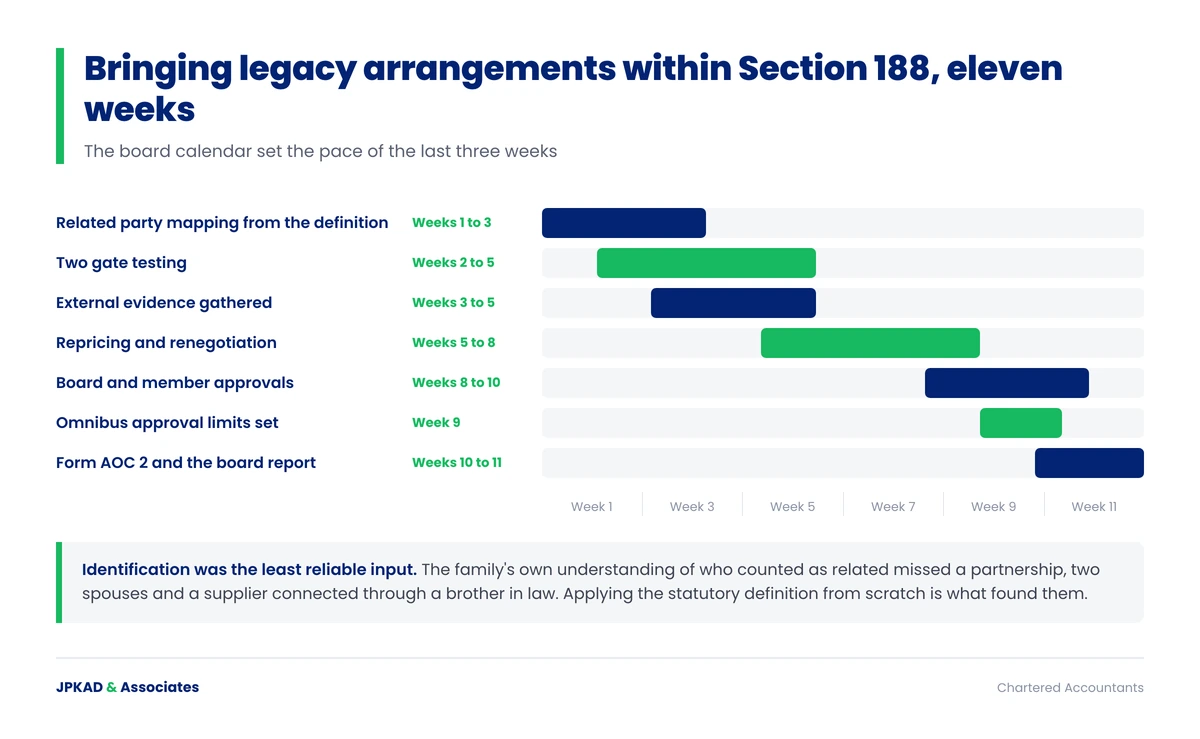
Eleven weeks, and the board calendar set the pace of the last three.
How was the mapping exercise conducted?
Through registers and deeds first, then through structured interviews with each director covering their own interests and those of their relatives.
A checklist was used rather than an open question, because open questions produce the obvious companies and miss the firm a spouse is a partner in.
Two relationships surfaced that way, including a supplier connected through a brother in law that nobody had considered related at all.
Each director confirmed the final list in writing, which also satisfied part of the disclosure obligation the Act imposes on them.
How were the difficult assessments resolved?
The rent was the hardest, because the family regarded it as fair and the comparable evidence suggested it had fallen behind the market.
That was resolved by obtaining independent rental indications rather than by argument, which moved the discussion away from opinion.
The interest free funding was the clearest failure of the arm’s length gate, and the directors accepted that quickly once it was put plainly.
The distribution arrangement took longest, since ordinary course was genuinely arguable and the conclusion was finely balanced either way.
How were the board meetings run?
Each arrangement was tabled with its assessment attached, so directors were approving something they could read rather than a description.
Interested directors left the discussion of their own arrangements, and the minutes record who was absent for which item.
Quorum was checked for each item separately, because a board with substantial overlapping interests can lose quorum on a particular resolution.
Resolutions stated the terms being approved rather than approving an arrangement in general, which is what makes the approval meaningful later.
How was the position carried into reporting?
Form AOC 2 was prepared for the arrangements requiring disclosure, with the particulars and the justification drafted for each.
The board report was updated to carry that disclosure, and the auditors were briefed on the exercise and its conclusions.
The register of contracts was brought fully up to date, and it is now maintained as arrangements arise rather than in the week before a deadline.
The lender received the register it had asked for, which was the question that started the whole exercise.
Need arrangements approved before the next board meeting? Explore how we can help.
Business Results
Results are described as direction of change rather than in figures. Company law outcomes depend on the facts and on the view taken by the board and the auditors, and figures would suggest a measurability that does not apply here.
This is what the group reported once the first full cycle had been completed.
What changed about the approval position?
Every arrangement between group entities has been tested against both gates, with the conclusion and its evidence recorded on file.
Approvals are in place where approval is required, taken at properly convened meetings with interested directors abstaining and the minutes showing it.
Recurring arrangements run under omnibus approval with stated limits, so routine dealing does not need a fresh resolution every time.
The register of contracts is current, and the lender’s original question can now be answered from the file within a day.
What changed about the commercial terms?
Rent now reflects local market evidence, which moved that arrangement through both gates and removed it from the approval requirement.
Inter corporate funding carries written terms and an interest rate, so it reads as a loan between two companies rather than as an undocumented transfer.
Job work rates were tested against outside quotations, and the differences that remained can be explained by volume and specification.
The commercial substance of the group did not change at all. What changed is whether the terms can be evidenced to somebody outside the family.
What changed about governance?
Directors now declare their interests at the first board meeting of each financial year, which had previously happened only sporadically and often late.
New arrangements are assessed before they are entered into rather than being discovered during a review afterwards.
Board papers now carry the full assessment alongside the proposal itself, so that directors approve terms they have actually read and seen.
The auditors also have a clearer basis for their own reporting on these matters, which shortened the year end discussion considerably. Our case study on internal financial controls in a first reporting year covers the control side of the same governance question.
What changed for the family?
The brothers understand that an arrangement everyone agrees is fair still needs evidence that it is, particularly when a lender or an auditor asks.
They also see that the definition of a related party is wider than family sentiment, and it reached a supplier nobody had thought about.
Decisions about intergroup dealings now happen at board level rather than in conversation, which felt formal at first and then simply became normal.
Succession planning became easier as a side effect, because the arrangements between entities are now documented rather than understood.
Want group dealings that can be evidenced? Speak to us about a related party review.
Lessons Learned
Nothing in this exercise suggested wrongdoing. It showed a group that had grown through informal trust between brothers, operating under a statute that asks for something other than trust.
What surprised the group most?
How far the definition of a related party reaches, particularly through relatives and through firms in which a relative is a partner.
That passing both gates removes the approval requirement entirely, which meant repricing was often cheaper than approving and disclosing.
That rent set fairly years ago had become non market simply by remaining unchanged while everything around it moved.
That interest free funding between two separate companies is very difficult to describe as an arm’s length arrangement, however normal it felt.
What worked better than expected?
Applying the statutory definition from scratch rather than starting from the family’s own view of who counts as connected.
Obtaining independent rental and job work evidence. It moved a sensitive conversation away from opinion and towards documents.
Repricing before approving anything. Approving terms that the group already intended to change would have meant running the same process twice over.
Tabling each arrangement with its assessment attached, so directors approved something they had read rather than a one line description.
What would be done differently next time?
Interests would be declared and mapped annually as a matter of routine, which makes the identification step almost automatic.
Terms between group entities would be reviewed periodically, since drift is what turned fair arrangements into non market ones.
New arrangements would be assessed before they begin, while the terms are still being settled and an adjustment costs nothing to make.
The omnibus approval limits would have been set at the start of the financial year rather than midway through it.
What should other Kerala family groups review?
Map related parties from the statutory definition rather than from family understanding, and include firms in which relatives are partners.
Ask when terms between your group entities were last reviewed, because arrangements drift from market by standing still.
Read the register of contracts in which directors are interested, and see whether it reflects what has actually been happening.
Establish whether any funding moves between the group companies without written terms, since that is usually the clearest arm’s length failure of all. Registers and approvals of this kind sit inside our company law matters and compliances work.
Frequently Asked Questions
1. What is a related party transaction under the Companies Act?
It is a transaction of a type specified in Section 188, entered into with a party related to the company under Section 2(76). Specified transactions include sale or purchase of goods, leasing of property, availing or rendering services, and appointment to an office or place of profit. The definition of a related party is wider than most families assume.
2. What are the two gates in Section 188?
The first is whether the transaction is in the ordinary course of business, judged against what the company actually does. The second is whether it is on an arm’s length basis. Where a transaction passes both, the approval requirements in Section 188 do not apply, although it is still recorded and remains subject to the register of contracts.
3. What happens if a transaction fails one of the gates?
Prior approval of the board by resolution at a meeting is required, and approval of the members by resolution where the transaction exceeds the thresholds in the rules. The approval must come before the transaction is entered into. Arrangements failing either gate are also reported in the board report through Form AOC 2.
4. Can an interested director vote on the resolution?
No. A director who is interested in a related party transaction does not participate in the discussion or the vote on that resolution. The minutes should record that clearly. In a family group with overlapping directorships this also raises a quorum question, which needs checking for each item separately rather than for the meeting as a whole.
5. What is omnibus approval and when does it help?
Where an audit committee is required, it may grant omnibus approval for related party transactions proposed to be entered into, subject to conditions. It suits recurring arrangements, so routine dealing does not need a fresh resolution each time. The approval should carry specified limits and a validity period rather than being open ended.
6. What does Form AOC 2 report?
It reports particulars of contracts or arrangements under Section 188 in the board report, covering those not at arm’s length and those not in the ordinary course. Particulars include the arrangement, its duration, the salient terms and the justification for entering into it. Arrangements passing both gates are not reported in that form.
7. Is interest free funding between group companies a problem?
It is difficult to describe as an arm’s length arrangement, because two unrelated companies would not ordinarily lend to each other on no terms at all. Documenting the funding with written terms and a reference rate usually resolves the question. Other provisions may also apply to loans depending on the parties involved.
8. How often should terms between group entities be reviewed?
Periodically, and annually is a sensible rhythm. The most common failure is not deliberate mispricing but drift, where a rate set fairly some years ago becomes non market because it stayed unchanged while the market moved. A short annual review against external evidence prevents that quietly becoming a compliance question.
9. What is the register of contracts?
Section 189 requires a register of contracts or arrangements in which directors are interested, kept in the prescribed form. It should be maintained as arrangements arise rather than reconstructed before a filing or a lender review. Directors also disclose their interests under Section 184 at the first board meeting of each financial year.
10. How long does it take to regularise a position like this?
This engagement ran about eleven weeks. Identification and testing took roughly five, repricing and renegotiation took three, and approvals followed the board calendar. Groups with fewer entities and clearer existing records move considerably faster. The pace is usually set by evidence gathering and by when the board can properly meet.
Conclusion
Related party transactions became a problem for this Kerala group not because anything was concealed but because nothing was recorded. Three companies and a partnership had traded with each other for more than a decade on terms the family considered fair, and no board had ever tested that belief against Section 188 or written down the answer. A lender asking for the register of contracts was what made the gap visible. The two gates did most of the analytical work. Where an arrangement sat in the ordinary course and could be shown to be at arm’s length, it needed recording rather than approving, which is why repricing the rent turned out to be cheaper than approving and disclosing it. Where a gate genuinely could not be passed, as with funding that carried no interest at all, the arrangement was documented, approved deliberately and disclosed. What surprised the family most was the reach of the definition, which caught a partnership, two spouses and a supplier connected through a brother in law. If your group companies trade with each other, the questions worth asking this month are when those terms were last compared against anything external, and whether your register of contracts would survive being handed to a lender. JPKAD & Associates advises family groups on company law compliance and governance, and you can read more through the contact page.
This case study is published for general information only. Client identity and commercially sensitive details have been withheld. Outcomes are described qualitatively, without figures, because company law positions depend on the facts, on the constitutional documents and on the view taken by the board and the auditors. Legal drafting was handled by the company’s legal advisers. Nothing here is professional advice on any specific matter.