
Choosing between audit firms in thrissur is a procurement decision that most businesses make on price and then regret.
The differences that matter are independence, capacity during the statutory season, sector familiarity and how the
engagement is actually staffed. This page sets out how to evaluate a practice, what the engagement letter should say,
and what drives the fee. Our note on
finding a chartered accountant near you in Thrissur
covers the wider search.
Key Takeaways
- Independence is a threshold question rather than a preference. A firm preparing your accounts cannot audit them.
- Capacity during the statutory season is the single most predictive factor in whether an audit runs well.
-
The fee is built from expected hours, and an unusually low quotation is a statement about how few hours the firm
intends to spend.
What Actually Distinguishes One Practice From Another
Independence comes first and it is binary. A firm that maintains your books, prepares your financial statements or
provides certain other services cannot also express an audit opinion on them. Ask the question explicitly and get the
answer in writing, because the consequence of getting it wrong falls on the company as well as the firm.
Capacity is the strongest practical differentiator. Indian statutory deadlines cluster, so every audit practice is
busiest at the same moment. A firm that has accepted more engagements than it can staff will send juniors, arrive
late, and ask for the same schedule three times. Ask how many audits the office handles in the peak period and who
specifically will be on yours.
Sector familiarity shortens everything. An auditor who has audited manufacturers understands work in progress and job
costing without a tutorial. One who has audited exporters understands the documentation behind refund claims. That
knowledge reduces both the time taken and the number of unhelpful questions.
Partner involvement is worth testing directly. Ask how many hours of partner time the engagement carries and when the
partner will actually visit. In smaller practices the answer is usually good. In larger ones it varies considerably
and it makes a real difference to the quality of the observations you receive.
Continuity matters over the medium term. A firm that fields a different team every year spends the first week
relearning the business, and you pay for that week. Ask about staff retention rather than only about credentials.
Finally, ask for references from businesses of your size in your sector, and actually call them. The useful question
is not whether they were satisfied but what went wrong and how the firm handled it.
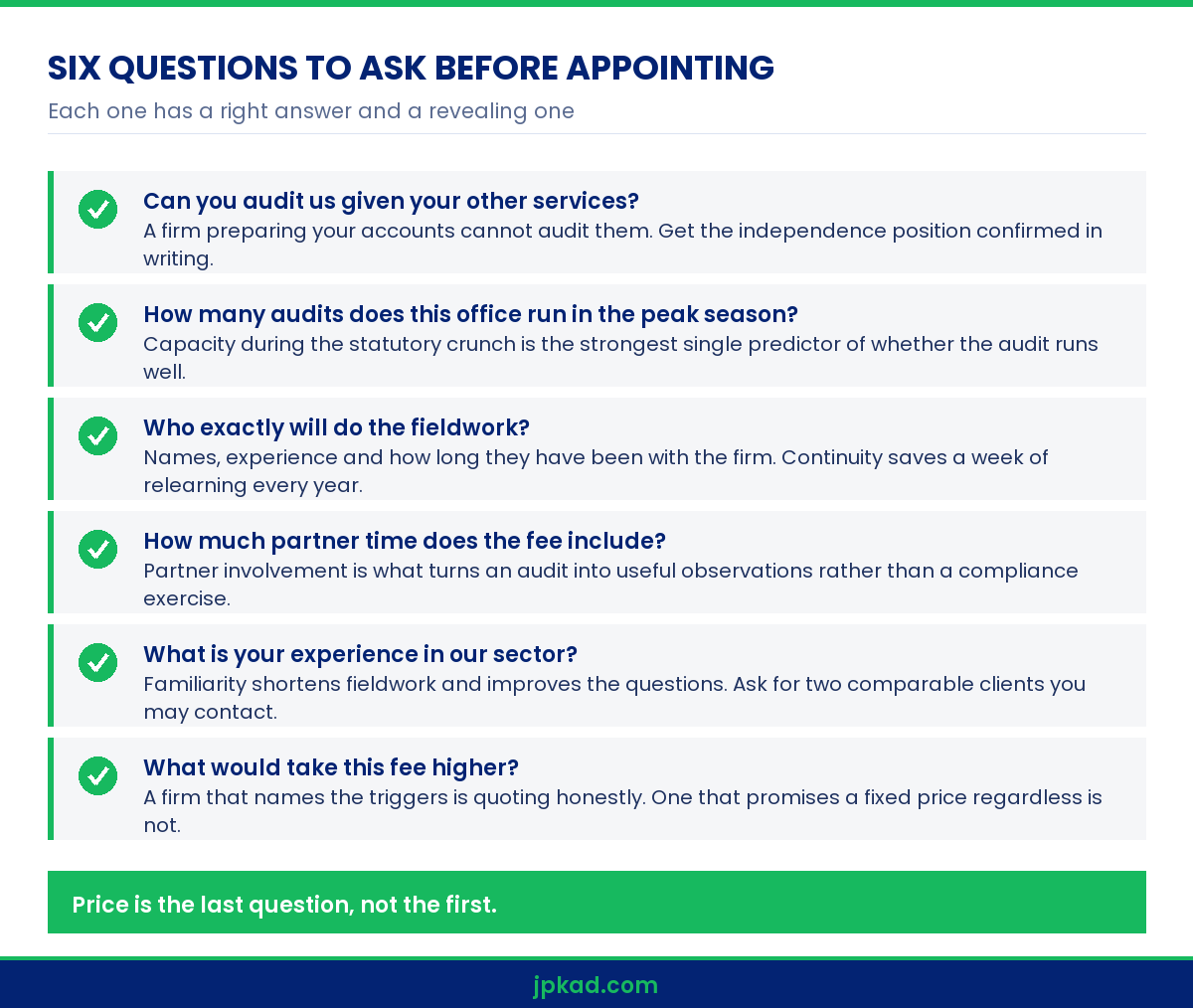
What to ask at the proposal stage.
Scope, Engagement Letter and Timetable
The engagement letter is the contract and it is worth reading properly. It should state the scope, the reporting
deadline, the fee basis, what the firm will provide and what the company must provide, and what happens if the
timetable slips because records are not ready.
Scope should distinguish clearly between the statutory audit and anything else. Tax audit, certification work and any
advisory services are separate engagements with separate independence considerations, and bundling them into one
letter obscures both the fee and the boundary.
The timetable should be agreed at appointment rather than negotiated in the last month. A planning meeting, a schedule
request list with dates, a fieldwork window, a review period and a signing date. Businesses that agree this in writing
at the start almost never miss the statutory deadline.
The schedule request list deserves attention because it is where most delay originates. Ask for it early, confirm you
can produce every item, and flag anything that will be difficult before the audit starts rather than during it.
Agree how queries will be handled. A single point of contact on each side, a shared query log with dates, and a rule
that verbal answers are confirmed in writing. Audits go slowly when four people are answering the same question
differently.
Finally, the letter should say who owns the working papers and how long records are retained. That matters if you
change firms later, and changing firms is considerably easier when the position was settled at the outset. Our note on
optimising compliance systems in a chartered accountant firm
covers the surrounding calendar.
How Audit Fees Are Actually Built
An audit fee is an estimate of hours multiplied by rates, adjusted for risk and for what the firm thinks you will pay.
Understanding the hours side is what lets a business control the cost, because most of the hours are within the
client’s influence.
Record quality is the largest variable. Where control accounts reconcile monthly, where the trial balance ties to the
statements without unexplained journals and where supporting documents are filed and retrievable, fieldwork is short.
Where they are not, the auditor moves from testing controls to testing transactions and the hours multiply.
Readiness is the second. Schedules provided before fieldwork begins cost a fraction of the same schedules assembled
while an audit team waits. Firms price repeat engagements partly on how the previous year went, so a well run audit
reduces next year’s quotation.
Complexity is the third and it is mostly outside your control. Multiple locations, group consolidation, foreign
currency, related party transactions and any regulated activity all add genuine work. A firm that does not price for
these is either inexperienced or intending not to do them.
Be suspicious of an unusually low quotation. It is a statement about how few hours the firm intends to spend, and the
shortfall appears later as a rushed review, a late report or an issue that was not found. Compare quotations on hours
and staffing rather than on the total.
Ask what would take the fee higher and get the answer in writing. A firm that names its triggers specifically is
quoting honestly. One that offers a fixed price regardless of what it finds has not thought about the engagement.
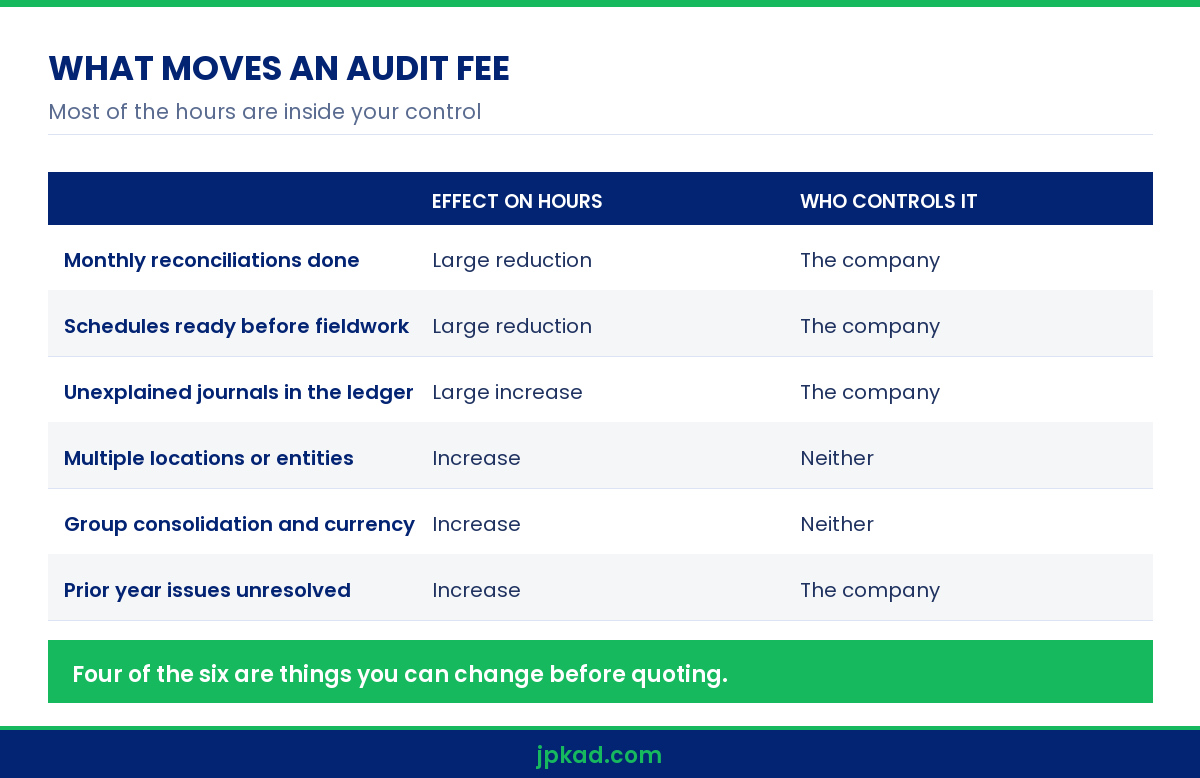
The main drivers behind an audit quotation.
Working Well With the Firm You Appoint
The businesses that get most from their auditors treat the relationship as a working one rather than as an annual
inspection. That starts with giving the firm the real picture, including the parts that are untidy, because an auditor
who discovers a problem is slower and more expensive than one who was told.
Hold the planning meeting seriously. Walk through what has changed in the business during the year, any new
activities, any disputes, any significant contracts and any change in systems. Every one of those affects the audit
approach and none of them is visible from the ledger alone.
Nominate one person to own the audit internally, with enough authority to get answers from other departments. Audits
that are owned by nobody drift, and the cost of that drift is charged back in the following year’s fee.
Read the management letter and act on it. Those observations are the cheapest advice a business receives all year, and
closing them measurably shortens the next audit. Our note on
how a corporate advisor helps businesses avoid penalties
covers the wider discipline.
Review the appointment periodically without churning for its own sake. A firm that has audited a business for many
years knows it well, which is valuable, and may also have stopped looking hard, which is not. A considered review
every few years is healthier than either automatic reappointment or frequent change.
Where the business is growing into new territory, tell the firm early. Crossing a threshold, opening a second
location, taking foreign investment or starting to export all change what is required, and advance notice is what
keeps the response proportionate.
Finally, plan for the possibility of change. Keep your own copy of every schedule provided, every reconciliation
prepared and every signed report, filed by year and independently of the firm’s systems. A business that can hand a
complete history to a new auditor changes firms in weeks. One that cannot spends a year rebuilding comfort over
opening balances, and pays a premium for the privilege. The professional framework behind all of this is maintained by
the Institute of Chartered Accountants of India, and for foreign owned entities
the
Indian corporate tax administration summary
is a useful companion reference.
Conclusion
Evaluate audit firms in thrissur on independence, capacity, staffing and sector fit, and treat price as the final
filter rather than the first. Then manage the engagement actively: agree the timetable in writing, prepare schedules
before fieldwork, and act on the management letter. JPKAD has audited businesses across Thrissur and Kerala since
2014. Contact our audit team to discuss an appointment.