
Executive Summary
The MSME payment rule cost this Kerala manufacturer a deduction before anybody in the business understood that it applied. Purchases had always been made on the credit terms the market offered, usually sixty days and sometimes longer, and those terms had never been questioned by anyone on either side of the transaction.
Section 43B(h) of the Income Tax Act changed what those terms mean for tax. A sum payable to a micro or small enterprise is deductible only in the year it is actually paid.
The company discovered this during return preparation, when an adjustment appeared that nobody had budgeted for and nobody could immediately explain.
JPKAD & Associates was engaged to establish which suppliers were actually covered, quantify the position, and build a control so the same thing would not recur.
Work covered supplier classification, purchase terms, payment controls and the reporting that sits alongside. Classification turned out to be the whole exercise.
- The MSME payment rule disallows a deduction until payment is actually made to a micro or small supplier.
- Only micro and small enterprises are covered. Medium enterprises and traders fall outside it.
- Supplier status comes from the Udyam certificate, not from the supplier’s size as anyone guesses it.
- The window is fifteen days without a written agreement and forty five days with one, and it cannot be extended beyond that.
- A vendor master that records Udyam status is the control. Everything else is downstream of it.
Has an unexpected disallowance appeared in your computation? Explore our taxation work.
Client Overview
The client manufactures fabricated products at a unit in Kerala, supplying contractors and industrial customers across the state and beyond. It is a closely held company run by two working directors.
Its supplier base runs to several hundred names, weighted towards raw material and component suppliers, with a long tail of small job work and consumable vendors.
Payment practice followed the market. Larger suppliers were paid to agreed terms, and smaller ones were often paid when cash allowed, which is common in the trade.
Finance is a controller and three accounts staff, using accounting software that handles purchase, payables and payment in one ledger.
The vendor master held names, addresses, bank details and tax registration numbers. It recorded nothing at all about whether a supplier was a registered micro or small enterprise. Keeping a vendor master fit for this purpose is part of our bookkeeping and data entry work.
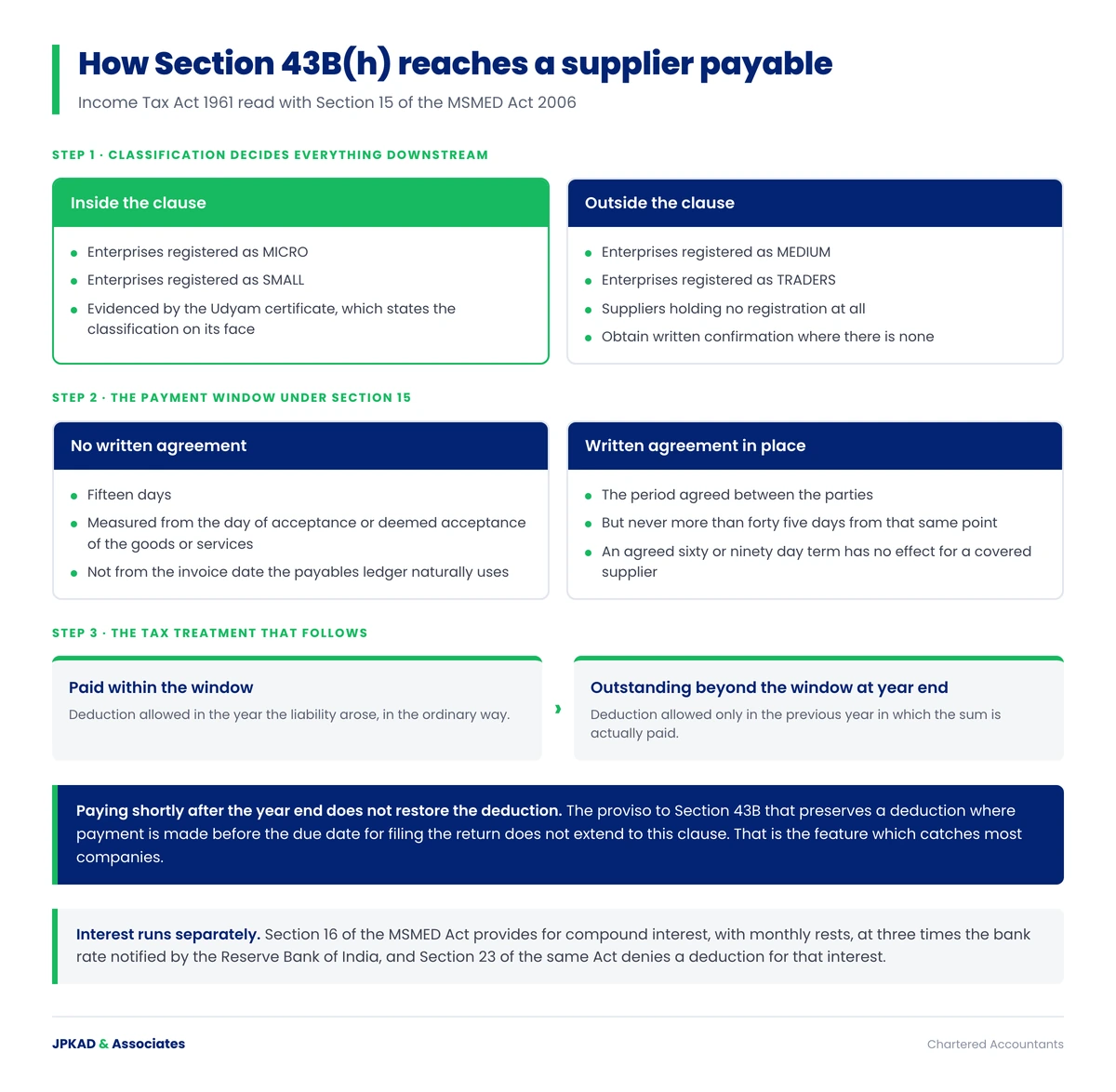
Classification first. Every other question depends on that answer.
Business Challenges
The company had not behaved badly. It had bought on the terms its market uses, paid its suppliers in the ordinary way, and never been asked to record something the law now turns on.
Four problems had to be solved, and the first one governed all of the others.
Why did a deduction disappear when the expense was genuine?
Because Section 43B(h) changes the timing of the deduction rather than questioning the expense itself. The purchase is real and the cost is real.
Where a sum payable to a micro or small enterprise is outstanding beyond the period allowed under Section 15 of the MSMED Act, the deduction moves to the year of actual payment.
The relief available under the other clauses of Section 43B, where payment before the return filing date preserves the deduction, does not extend to this clause.
So an amount unpaid at the year end stays disallowed for that year even if it is settled soon afterwards, which is the feature that surprises most companies.
Which suppliers were actually covered?
Nobody knew, and that was the real problem. The vendor master recorded no classification at all, so the population could not even be identified.
Only micro and small enterprises fall within the clause. Medium enterprises are outside it, and so are suppliers registered as traders.
Assumptions about size proved unreliable in both directions. Two substantial suppliers were registered as small, and several very modest ones held no registration at all.
Some invoices carried a Udyam number and most did not, so the information existed in fragments across documents nobody had ever collected systematically.
What was wrong with the purchase terms?
Most purchases ran on unwritten understandings. Where there is no written agreement the payment window under Section 15 is fifteen days, not the sixty everyone assumed.
Where a written agreement exists the period can be extended by agreement, but it cannot exceed forty five days from acceptance in any circumstances.
Several purchase orders did specify sixty or ninety day terms, which does not help, because an agreed period beyond the statutory ceiling has no effect for this purpose.
The company had therefore been operating on terms that were commercially normal and, for covered suppliers, outside what the provision allows.
What else followed from the same gap?
Interest under Section 16 of the MSMED Act runs on delayed payment to a covered supplier, at a compounded rate tied to the bank rate.
That interest is itself denied as a deduction under Section 23 of the same Act, so it is a cost that cannot be relieved against tax.
Companies also report outstanding dues to micro and small suppliers beyond forty five days in a half yearly return, and that filing had not been made.
Disclosure in the financial statements had been given in general terms, because the underlying data to make it specific did not exist.
Does your vendor master record Udyam status? Read more about our taxation services.
Business Objectives
The directors wanted three things. An accurate position for the year under assessment, a control that prevents the same disallowance recurring, and purchase terms that reflect what the law actually permits.
What did the company need to establish first?
A classified vendor master, because every other question in the exercise depends on knowing which suppliers are micro or small and which are not.
An accurate ageing of payables to those suppliers as at the year end, measured from acceptance rather than from invoice date.
A computation of the amount properly disallowed, so the return reflected the correct position rather than an estimate made under time pressure.
And a view on the interest exposure under the MSMED Act, which the directors had not known existed until the review began.
Why were purchase terms addressed alongside the computation?
Because computing a disallowance without changing anything simply guarantees the same computation next year, with a larger figure attached.
The payment window is a legal ceiling rather than a negotiating position, so purchase orders promising sixty days were misleading everyone who read them.
Aligning the documented terms with what the law allows also made the payment run easier to operate, since staff no longer had to reconcile two different answers.
It changed the cash conversation as well, because paying covered suppliers sooner has a real working capital consequence the board had to plan for. The wider planning question is covered in our note on tax planning strategies for small businesses in Kerala.
What defined success under the MSME payment rule?
A vendor master carrying verified classification for every active supplier, refreshed on a stated cycle rather than captured once and left.
A payables ledger that flags covered suppliers automatically, so the payment run reflects the statutory window without anybody remembering to check.
A year end position that can be computed from the system rather than reconstructed by hand from invoices and correspondence.
And the half yearly return filed on time, with financial statement disclosure drawn from the same underlying data rather than written in general terms.
Want the control rather than the annual surprise? Explore our approach.
Solution Strategy
Classification came first and everything else followed from it. The sequence was supplier status, then ageing, then computation, then terms, then the control that makes it repeat correctly.
No supplier was classified on assumption. Each one was classified on a document or recorded as unconfirmed, because a guess in the vendor master is worse than a blank.
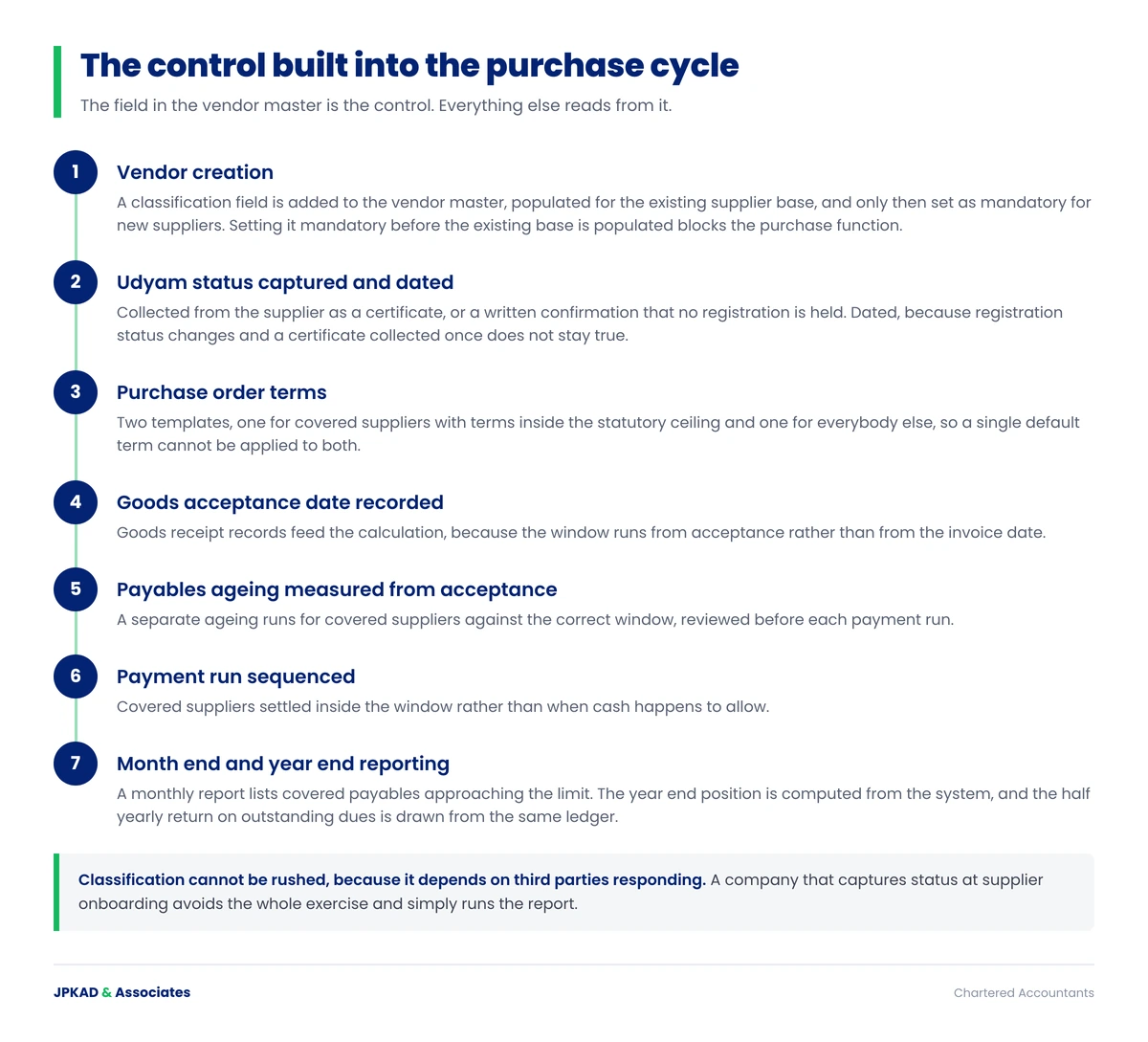
The field in the vendor master is the control. Everything else reads from it.
How were suppliers classified?
By collecting the Udyam registration certificate from each active supplier, since that certificate states the classification and is the evidence the position rests on.
A written request went to every active vendor asking for the certificate or a confirmation that the supplier holds no registration.
Responses were recorded against the vendor master with the certificate attached, and the classification stated on the certificate was used rather than any description in correspondence.
Suppliers who did not respond were followed up twice and then flagged as unconfirmed, which the company treats conservatively until the position is settled.
How was the covered population narrowed?
By separating micro and small registrations from medium ones, because medium enterprises sit outside the clause entirely.
Suppliers registered as traders were identified separately, since the registration extends to them for other purposes rather than for this provision.
That narrowing mattered more than anyone expected. A large part of the initial population simply fell away once the certificates were actually collected and read.
What remained was a defined list of covered suppliers, which is the population every subsequent calculation is run against.
How was the payment window applied correctly?
By measuring from the day of acceptance or deemed acceptance of the goods, rather than from the invoice date that the ledger naturally uses.
Where no written agreement existed the fifteen day period applied, which covered most of the smaller purchases the company makes.
Where a written agreement existed the agreed period applied, capped at forty five days regardless of what the document said.
Goods receipt records were brought into the calculation so that acceptance could be evidenced rather than inferred from when the invoice was booked.
How were purchase terms brought into line?
Standard purchase order wording was redrafted so that terms for covered suppliers sit inside the statutory ceiling rather than beyond it.
Two separate templates now exist, one for covered suppliers and one for everybody else, which prevents a single default term being applied to both.
Buyers were briefed on why the terms differ, since a purchasing team that does not understand a rule will negotiate around it in good faith.
Existing arrangements with significant covered suppliers were renegotiated on terms both sides could operate, rather than changed unilaterally.
How was the control built into the payment cycle?
By adding a classification field to the vendor master and making it mandatory before a new supplier can be created in the system.
The payables ageing now runs separately for covered suppliers, measured against the correct window, and it is reviewed before each payment run.
A month end report lists covered payables approaching the limit, which turns an annual reconstruction into a routine operational check.
Responsibility sits with the controller, with the purchase function owning the certificate collection, so neither side assumes the other is doing it.
Are your purchase orders promising terms the law does not allow? Read more about our accounting and financial reporting.
Records and Tools Used
The work needed records that existed and records that did not. The certificates had to be collected from outside the business, and the acceptance dates had to be pulled from a system nobody had used for this purpose.
Which records established supplier status?
Udyam registration certificates collected directly from suppliers, which state the classification and the date of registration on their face.
Supplier correspondence confirming that no registration is held, retained so that an unregistered position can be evidenced rather than assumed.
Invoices carrying a Udyam number, used as a prompt to chase the certificate rather than as the evidence itself.
A dated record of when each classification was captured, because registration status can change and a certificate collected once does not stay true forever.
How was the ageing actually computed?
From goods receipt records rather than from invoice dates, since the statutory window runs from acceptance or deemed acceptance of the goods.
Purchase orders were examined to establish whether a written agreement existed, because that determines whether fifteen or forty five days applies.
The payables ledger was then re aged on that basis for covered suppliers, which produced a materially different picture from the standard ageing report.
Differences between the standard ageing and the recomputed one were listed and explained, since the two reports now coexist and staff use both.
What does the reporting cycle involve?
A half yearly return reporting outstanding dues to micro and small suppliers beyond forty five days, with the reasons for delay.
Financial statement disclosure of amounts due to micro and small enterprises, including interest, drawn from the same underlying ledger rather than compiled separately.
A year end computation of the amount falling within the clause, prepared from the system and reconciled to the payables ledger.
Supporting certificates and the classification record are retained alongside, since the position depends on evidence about third parties rather than on the company’s own books. Reporting of this kind sits alongside the work described in our note on reducing business risk through tax consulting.
Implementation Process
The engagement ran across roughly nine weeks, and most of that time was spent waiting for suppliers rather than doing analysis. Certificate collection is the slowest part and it cannot be compressed by effort alone.
The first week established the covered population in principle, and the following six were spent turning that into evidence.
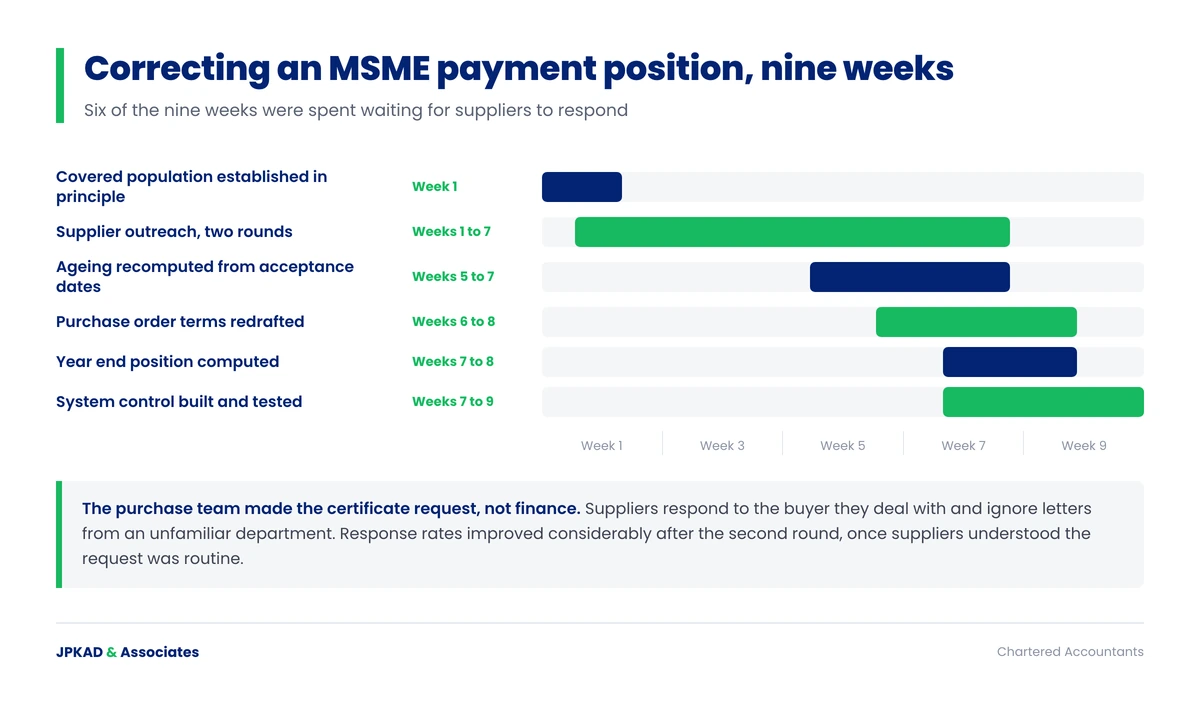
Six of the nine weeks were spent waiting for certificates.
How was the supplier outreach run?
Through a written request sent to every active vendor, explaining plainly why the certificate was needed and what would happen without it.
The purchase team made the approach rather than finance, because the suppliers know the buyers and a request from an unfamiliar department gets ignored.
Response rates improved considerably after the second round, once suppliers understood the request was routine rather than a prelude to a dispute.
Several suppliers had let their registration lapse or had never updated it after their turnover changed, which produced its own conversations.
How was the year end position computed?
By running the recomputed ageing across the covered population as at the year end, measured from acceptance under the correct window.
Each covered balance was tested individually where the amount was significant, rather than relying on the report total alone.
The resulting disallowance was reconciled to the draft computation so the directors could see exactly what had changed and why.
The interest position under the MSMED Act was computed separately and disclosed, since it is a liability rather than a tax adjustment.
How was the system change made?
The classification field was added to the vendor master first, then populated from the collected certificates, then made mandatory for new vendors.
Making it mandatory before populating it would have blocked the purchase function, so the sequence was deliberate rather than incidental.
The covered payables report was built and tested against a month already closed, which exposed two errors in how acceptance dates were being read.
Both were corrected before the report went live, and the finance team ran it in parallel with the old ageing for one cycle.
How were the directors kept informed?
With a short written position at the end of the classification phase, setting out the covered population and the likely scale of the issue.
That note allowed the board to plan for the cash effect of paying covered suppliers sooner, which is a real consequence rather than a paper one.
A second note at completion recorded the computation, the interest exposure and the controls now in place.
The directors also received a plain explanation of why paying just after the year end does not restore the deduction, since that had been assumed.
Need the position computed before the return goes in? Explore how we can help.
Business Results
Results are described as direction of change rather than in figures. Tax outcomes depend on the facts, on the evidence retained and on the view taken by the assessing authority, and figures would suggest a precision that is not available.
This is what the company reported after the first full cycle under the new control.
What changed about the tax position?
The amount falling within the clause is now computed from the system at each year end rather than estimated during return preparation under time pressure.
The covered population is defined by evidence, so the computation rests on certificates rather than on assumptions about which suppliers are small.
A significant part of the originally assumed population fell outside the clause once the certificates were read, which changed the position materially.
Timing of the deduction is now something the board can plan around, because the position is visible through the year instead of at the end of it.
What changed about how the company buys?
Purchase orders for covered suppliers carry terms that sit inside the statutory ceiling, so the document and the law now say the same thing.
Buyers ask about registration status when they onboard a supplier, which is when the information is easiest to obtain.
Payment runs are sequenced so covered suppliers are settled within the window, rather than being paid when cash happens to allow.
Some supplier relationships improved as a result, because small vendors noticed being paid promptly and said so.
What changed inside the finance function?
A covered payables report runs monthly, listing balances approaching the limit, which replaced an annual reconstruction from invoices.
The vendor master cannot accept a new supplier without a classification, so the data quality problem does not rebuild itself quietly over time.
The half yearly return is prepared from the same ledger that drives the tax computation, rather than being compiled separately each time.
Financial statement disclosure is now specific and supported, instead of being written in general terms because the data was unavailable.
What changed for the directors?
They understand that the provision changes the timing of a deduction rather than the validity of an expense, which was the initial confusion.
The cash effect of the payment window is now part of working capital planning rather than an unpleasant discovery at the year end.
The interest exposure under the MSMED Act is understood, including the point that it cannot be deducted against tax.
Supplier terms are treated as a compliance matter as well as a commercial one, which had not previously been the case.
Want the position visible through the year? Speak to us about a supplier classification review.
Lessons Learned
None of this needed a difficult reading of the statute. It needed the company to know something about its suppliers that it had never had any reason to record.
What surprised the company most?
That paying shortly after the year end does not restore the deduction, because the relief available under the other clauses does not extend to this one.
How unreliable assumptions about supplier size turned out to be, in both directions, once the certificates were actually collected and read.
That the window runs from acceptance of the goods rather than from the invoice date the payables ledger naturally works to.
That agreeing sixty day terms in a purchase order achieves nothing for a covered supplier, since the statutory ceiling overrides the agreement.
What worked better than expected?
Having the purchase team make the certificate request. Suppliers respond to the buyer they deal with and ignore letters from an unfamiliar department.
Recording unconfirmed suppliers as unconfirmed rather than guessing. A blank is honest and a wrong classification propagates through every later calculation.
Testing the covered payables report against a closed month before going live, which exposed two errors in how acceptance dates were read.
Separating medium enterprises and traders early, because the covered population shrank substantially and the remaining work became manageable.
What would be done earlier next time?
Classification would be captured at supplier onboarding, when the relationship is new and the supplier has every reason to cooperate.
Goods receipt dates would be used in the ageing from the outset, rather than being introduced after the first computation proved unreliable.
Purchase order templates would have been split before the classification exercise, so new orders were already correct while the rest was underway.
The board would have been given the cash planning note sooner, since the working capital effect took longer to absorb than the tax one.
What should other Kerala manufacturers review?
Establish whether your vendor master records Udyam classification at all, because without that field the population cannot even be identified.
Read the certificates rather than assuming size, since substantial suppliers are sometimes registered small and modest ones often hold no registration.
Compare your standard purchase terms against the statutory window, remembering that an agreed period above the ceiling has no effect for covered suppliers.
Look at whether the half yearly return on outstanding dues has been filed, as it is frequently missed by companies that are otherwise compliant. Getting the ledger structure right first is part of our accounting and financial reporting work.
Frequently Asked Questions
1. What does Section 43B(h) actually do?
It allows a deduction for a sum payable to a micro or small enterprise only in the year the payment is actually made, where the amount is outstanding beyond the period allowed under Section 15 of the MSMED Act. The expense remains genuine. What changes is the year in which it becomes deductible against income.
2. Which suppliers does the MSME payment rule cover?
Enterprises registered as micro or small under the MSMED Act. Medium enterprises fall outside the clause. Suppliers registered as traders are treated as outside it for this purpose, because that registration extends to other benefits rather than to this provision. Classification is evidenced by the Udyam certificate rather than by an assumption about size.
3. Is it fifteen days or forty five days?
Both, depending on the arrangement. Where there is no written agreement, payment is due within fifteen days of acceptance or deemed acceptance of the goods or services. Where a written agreement exists the period may be extended by agreement, but it can never exceed forty five days from that same point, whatever the document says.
4. Does paying before the return filing date preserve the deduction?
No, and this is the feature that catches most companies. The proviso to Section 43B that allows a deduction where payment is made before the due date for filing the return does not apply to this clause. An amount outstanding at the year end stays disallowed for that year even if it is settled shortly afterwards.
5. How do we confirm whether a supplier is registered?
Ask for the Udyam registration certificate, which states the classification on its face. Some suppliers print the number on their invoices, which is a useful prompt but not evidence in itself. Where a supplier holds no registration, obtain written confirmation of that, so an unregistered position can be evidenced rather than assumed.
6. When does the payment period start running?
From the day of acceptance, or deemed acceptance, of the goods or services rather than from the invoice date. That distinction matters because payables ledgers naturally age from the invoice. Goods receipt records usually provide the evidence, and bringing them into the ageing calculation often changes the position materially.
7. Is interest payable on a late payment to a covered supplier?
Section 16 of the MSMED Act provides for compound interest at three times the bank rate notified by the Reserve Bank of India on amounts paid beyond the appointed day. Section 23 of the same Act denies a deduction for that interest, so it is a cost that cannot be relieved against taxable income.
8. What is the half yearly return about?
Companies report outstanding dues to micro and small suppliers beyond forty five days, together with the reasons for the delay, in a return filed twice a year. It is a separate obligation from the tax position and is frequently missed by companies that are otherwise compliant, usually because the underlying supplier data does not exist.
9. Can purchase terms be agreed beyond forty five days?
Commercially the parties can agree what they like, but for a covered supplier the statutory ceiling applies regardless. An agreed period longer than forty five days from acceptance has no effect for this purpose. That is why purchase order templates promising sixty or ninety days tend to mislead both the buying team and the supplier.
10. How long does it take to fix a position like this?
This engagement ran about nine weeks and most of that was spent collecting certificates from suppliers rather than on analysis. Classification cannot be rushed because it depends on third parties responding. A company that captures status at onboarding avoids the exercise entirely and simply runs the report.
Conclusion
The MSME payment rule reached this Kerala manufacturer through its vendor master rather than through anything it had done wrong. Purchases ran on the credit terms the market uses, suppliers were paid in the ordinary way, and nobody had ever recorded the one fact the provision turns on, which is whether a supplier holds a micro or small registration. Classification was the whole exercise. Once certificates were collected and read, a large part of the assumed population fell outside the clause entirely, because medium enterprises and traders are not covered. What remained was a defined list that every later calculation could run against, measured from acceptance of the goods rather than from the invoice date the ledger naturally uses. Six of the nine weeks went on waiting for suppliers to respond, which is why capturing status at onboarding is worth so much more than reconstructing it later. The company now sees covered payables monthly instead of discovering a disallowance during return preparation. If you buy from small suppliers, the question worth answering this month is whether your vendor master has a field for Udyam status at all, and how many of your active suppliers have a certificate on file. JPKAD & Associates advises manufacturers on taxation and compliance, and you can read more through the contact page.
This case study is published for general information only. Client identity and commercially sensitive details have been withheld. Outcomes are described qualitatively, without figures, because tax positions depend on the facts, on the documentation and on the view taken by the assessing authority. Nothing here is tax or legal advice on any specific matter.