
Executive Summary
A vendor due diligence exercise began at this Kochi company several months before any buyer was approached. The promoter had decided to sell a majority stake and wanted to know what a purchaser would find, while there was still time to do something about it rather than merely explain it.
The business was profitable and growing. Its accounts were audited and filed on time, and the promoter assumed that meant it was ready.
Audited accounts answer a different question from the one a buyer asks. A buyer wants to know what the business earns without its owner in it.
JPKAD & Associates was engaged to run the seller side review, build the data room and prepare the supporting analysis behind the numbers.
Work covered normalised earnings, related party arrangements, statutory exposures and document readiness. Several items were corrected before the process opened rather than conceded during it.
- Vendor due diligence is the seller looking at its own business the way a buyer will.
- Normalised earnings matter more than reported profit, and promoter routed costs sit at the centre of that.
- Related party arrangements need documenting or unwinding before a buyer finds them undocumented.
- Statutory gaps in tax, payroll and filings become price adjustments once a buyer raises them.
- A data room organised around a buyer’s questions shortens diligence and keeps the seller in control of the story.
Thinking about a sale in the next year? Explore our transaction work.
Client Overview
The client operates a specialised services business from Kochi, serving corporate customers across South India. It is closely held, with the founder holding most of the equity and two family members on the board.
Revenue comes from a mix of annual contracts and project work, with a concentration among its ten most significant customers that the founder had never quantified.
The company had grown for several years without outside capital. Funding came from retained earnings and from the founder personally when working capital ran tight.
Finance is a manager and four staff. Statutory audit, tax filings and payroll ran on time, handled competently for a business of this size.
What the business had never done was look at itself from the outside. Nobody had ever asked what the numbers would mean to a purchaser rather than to a bank or the tax authorities. The reporting side of that question is covered in our note on accounting and financial reporting for due diligence.
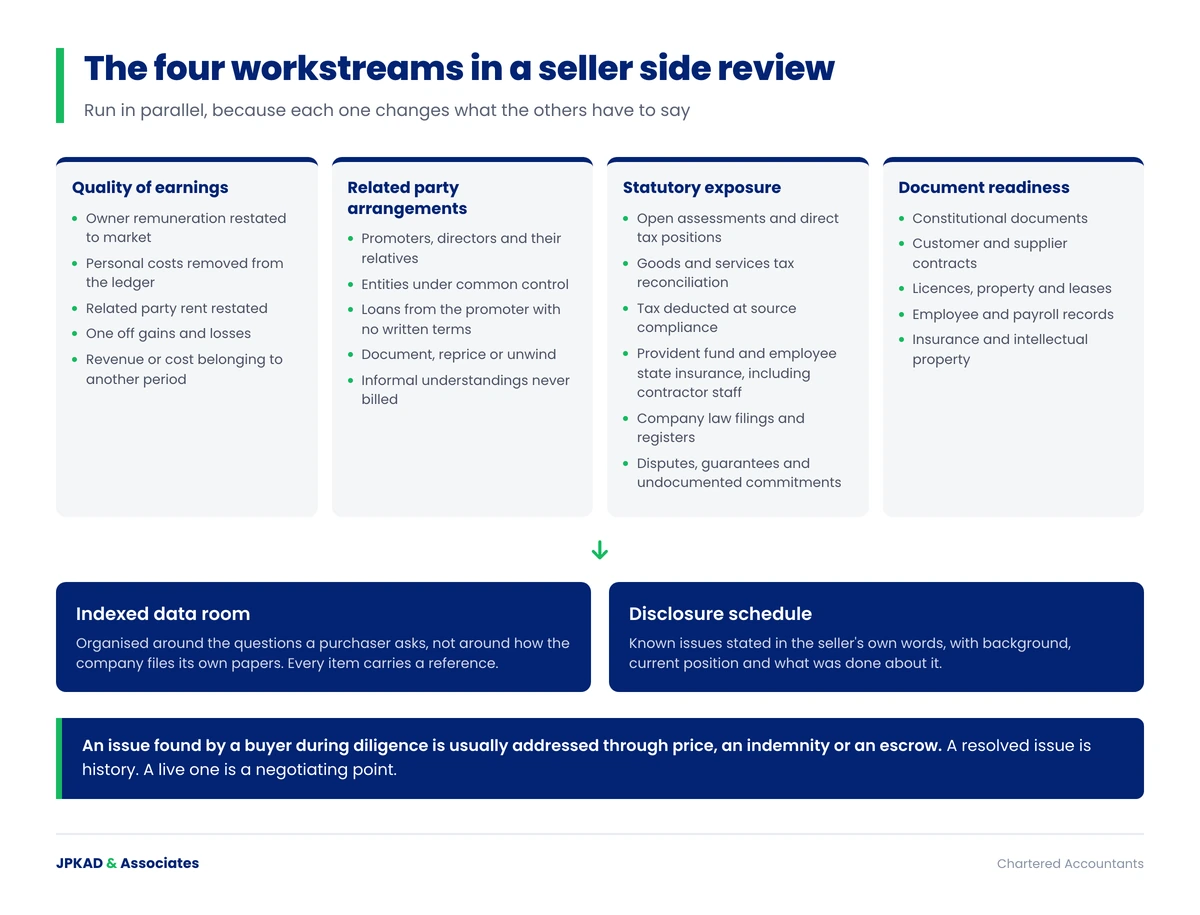
Four workstreams, one file. The buyer sees the output, not the effort.
Business Challenges
Nothing about the business was improper. It had been run as an owner managed company for many years, and that is a different thing from being ready for a purchaser to examine.
Four issues had to be worked through before the company could open a process with any confidence about what would surface.
Why was reported profit not the number a buyer would use?
Because reported profit reflects how the owner chose to run the business, and a purchaser is buying what the business will earn without that owner in place.
The founder drew remuneration well below what a hired replacement would cost, which flattered the profit figure in a way no buyer would accept.
Several personal costs ran through the company, including vehicle and travel expenses, and these had to be identified and taken out.
Premises were rented from a family trust on terms set years earlier, so the rent in the accounts bore little relation to a market rate.
What was the problem with the related party arrangements?
They existed, they were commercially understood inside the family, and almost none of them were written down in a form a purchaser could read.
The lease had no current written agreement. A loan from the founder sat in the accounts with no terms, no interest rate and no repayment schedule.
One supplier was owned by a relative, and the trading terms had never been compared against what an unrelated supplier would charge.
Undocumented arrangements are not merely untidy in a sale. They create uncertainty about what the purchaser is actually acquiring and what continues afterwards.
Which statutory exposures were likely to surface?
Goods and services tax was the first. Input credit had been claimed on the basis of books without a periodic reconciliation against the returns.
Payroll was the second. Several long standing contractor staff worked under the company’s own supervision, which raises a question about coverage.
Tax deducted at source on a handful of professional payments had been deposited late in earlier years, which leaves interest exposure on the record.
None of these were large in the ordinary running of the business. In a diligence exercise every one of them becomes a question, and unanswered questions become price.
Why did document readiness matter so much?
Because a purchaser measures a business partly by how quickly it can answer questions. Delay reads as disorganisation or as concealment.
Customer contracts were held in three places, and several significant ones had been operating past their stated expiry on rolling terms.
Statutory registers had been maintained but not consistently updated, and two older filings needed to be traced before they could be evidenced.
A data room that is assembled while diligence is running puts the seller permanently behind the buyer’s questions, which is the worst position to negotiate from.
Would your records answer a buyer’s questions this week? Read more about our audit and assurance services.
Business Objectives
The founder set three objectives. Know what a buyer will find, fix what can be fixed before the process opens, and be able to disclose the rest in the company’s own words rather than have it discovered.
What did the company need to establish first?
A normalised earnings figure the founder could stand behind, with every adjustment supported by a document rather than by an assertion about intent.
A complete list of related party arrangements, including the informal ones that had never been treated as transactions by anybody inside the business.
An honest assessment of statutory exposure, sized and described, so that nothing would arrive as a surprise once a purchaser began asking.
And an indexed set of documents, so that a request during diligence could be answered the same day rather than after a search.
Why fix issues rather than simply disclose them?
Because a resolved issue and a disclosed issue are treated very differently. A resolved issue is history, and a live one is a negotiating point.
An undocumented lease can be papered before a process opens. The same lease raised during diligence becomes a condition, an indemnity or a price adjustment.
Some items cannot be fixed within the time available, and those were listed deliberately for disclosure rather than left to emerge.
The founder understood the distinction quickly, because it is the same logic he applied to his own customers when a problem surfaced. How the deal is structured also shapes this, as our note on share purchase against asset purchase in India sets out.
What defined success for the vendor due diligence?
A normalised earnings analysis that survived examination by the purchaser’s advisers without material change to its underlying basis.
Related party arrangements either documented on commercial terms or unwound entirely before the company was shown to anyone.
Statutory matters corrected where correction was possible, and clearly disclosed where it was not, in the company’s own words.
And a data room that answered the standard requests on day one, so the process kept moving rather than stalling on document retrieval.
Want to find the surprises before a buyer does? Explore our approach.
Solution Strategy
The four workstreams ran in parallel rather than in sequence, because they inform one another. A related party finding changes the earnings analysis, and a statutory exposure changes what the disclosure schedule has to say.
Everything was built as though an unfriendly reader would examine it, because eventually one did.
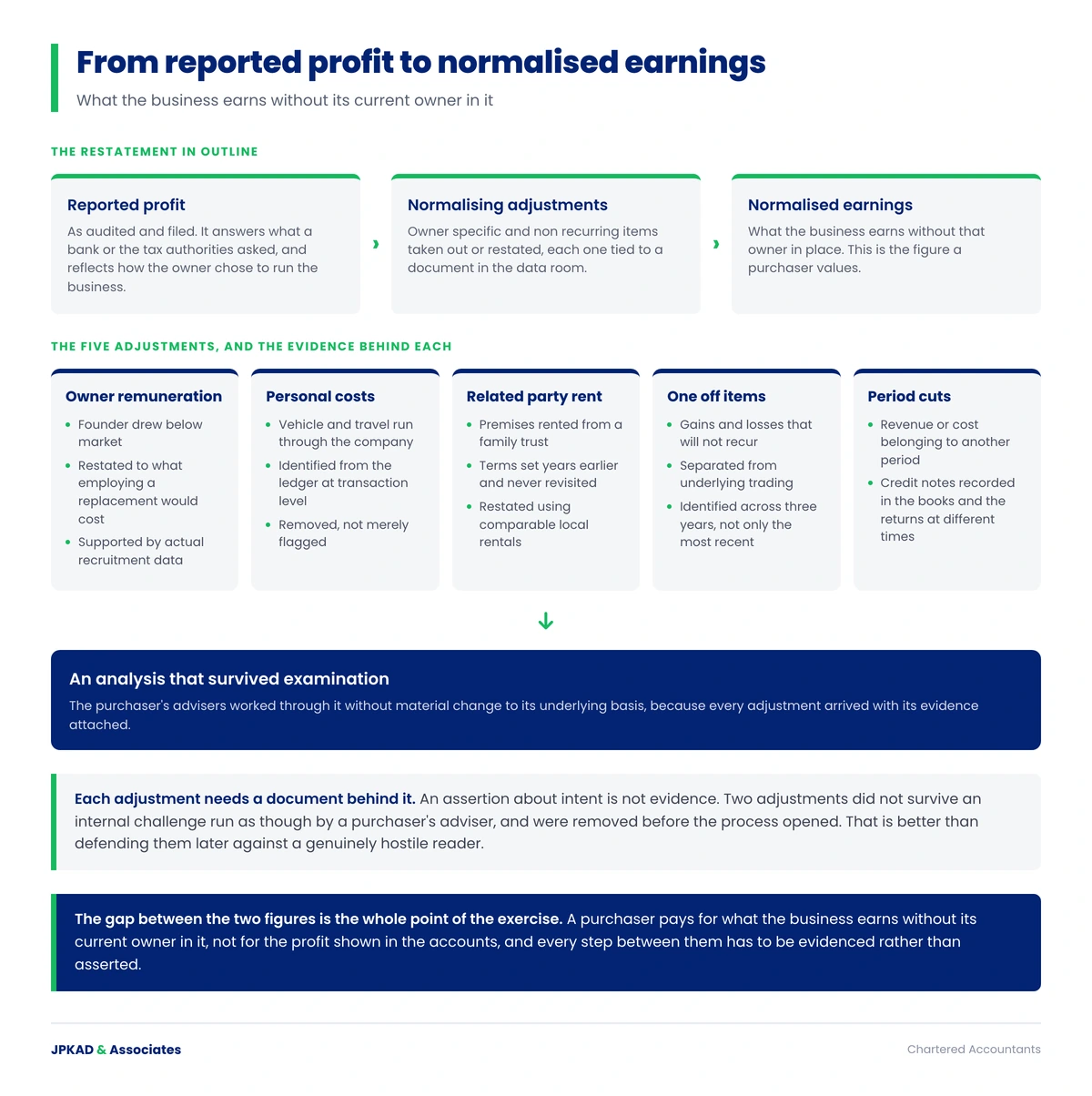
Each step needs a document behind it. An assertion about intent is not evidence.
How was normalised earnings built?
By working through the profit and loss account line by line across three years, rather than adjusting only the most recent year a buyer would focus on.
Owner remuneration was restated to what employing a replacement at market would cost, using actual recruitment data rather than an assumption.
Personal costs were identified from the ledger and from the founder’s own account of what had been routed through the business, then removed.
Related party rent was restated to a market rate supported by comparable local rentals, and each adjustment was documented with its evidence attached.
How were related party arrangements dealt with?
Through a mapping exercise covering the founder, the directors, their relatives and every entity under common control, rather than a review of the ledger alone.
Interviews surfaced arrangements the accounts did not show, including an informal understanding about premises maintenance that nobody had ever billed.
Each arrangement was then documented on commercial terms, repriced where the terms were not commercial, or unwound where it had no place in the business going forward.
The founder’s loan was formalised with written terms, and the decision on whether it would be repaid at completion was settled early rather than left open.
How were statutory exposures sized and addressed?
By reconciling goods and services tax returns against the books for each period, which is the exercise the purchaser’s advisers would run first.
Payroll coverage for long standing contractor staff was reviewed against how those people actually worked, rather than against how they were engaged on paper.
Tax deducted at source records were traced for the periods where deposits had been late, and the resulting interest position was computed and provided for.
Where an exposure could be regularised before the process opened, it was. Where it could not, it was quantified and written into the disclosure schedule.
How was the data room structured?
Around the questions a purchaser asks rather than around how the company happens to file its own papers, which are rarely the same thing.
The index runs from constitutional documents through financial information, tax, contracts, people, property, insurance and disputes.
Every item carries a reference, so a request can be answered with a location rather than with a promise to look for it.
Gaps were listed openly on the index as items being retrieved, because an obvious gap is better than an item quietly missing from a list.
How was the disclosure schedule prepared?
By stating each known issue plainly, with its background, its current position and what the company had done about it.
Wording was drafted so that a reader would understand the matter without needing to ask three follow up questions to establish the basic facts.
The company’s legal advisers took the schedule into the transaction documents, since how a disclosure operates against a warranty is a legal question.
Preparing it early meant the founder knew, before any negotiation, exactly what he was disclosing and why.
Are your related party terms written down anywhere? Read more about our corporate finance advisory.
Records and Tools Used
Most of what the exercise needed already existed. It sat across the accounts, the founder’s own memory and several filing cabinets, and had never been assembled as one body of evidence.
Which records supported the earnings analysis?
Audited financial statements and the underlying trial balances for three years, which set the starting point every adjustment is measured against.
General ledger detail at transaction level, since owner specific costs are identified from individual entries rather than from account totals.
Payroll records and recruitment market data, used to restate founder remuneration to what a replacement would actually cost the business.
Comparable local rental evidence for the premises, which supported the rent adjustment rather than leaving it as a judgement call.
What supported the statutory review?
Goods and services tax returns for each period alongside the books, reconciled so that differences were explained rather than merely noted as differences.
Tax deducted at source returns and challans, traced for the periods where late deposits had occurred, with interest computed on the actual dates.
Payroll registers and contractor agreements, read against how the work was actually supervised and organised day to day.
Assessment records, notices and correspondence for open matters, together with the company’s filings and statutory registers.
How was the data room maintained?
On a secure hosted platform with controlled access, which also records who viewed what and when, information that is useful during a live process.
The index was owned by one person inside the company, so that version control did not drift once several people began uploading documents.
Every document was named to a convention tied to the index, since a well organised room with unreadable file names is not actually organised.
Access was staged, with commercially sensitive material released at a later phase rather than at first contact. Assurance over the underlying records is part of our audit and assurance services work.
Implementation Process
The preparation ran across roughly ten weeks before the company was shown to anyone. That timing was deliberate, since several of the corrections needed a clear run at them without a buyer waiting.
The first two weeks were spent almost entirely on the earnings analysis, because it shapes every other conversation in a sale.
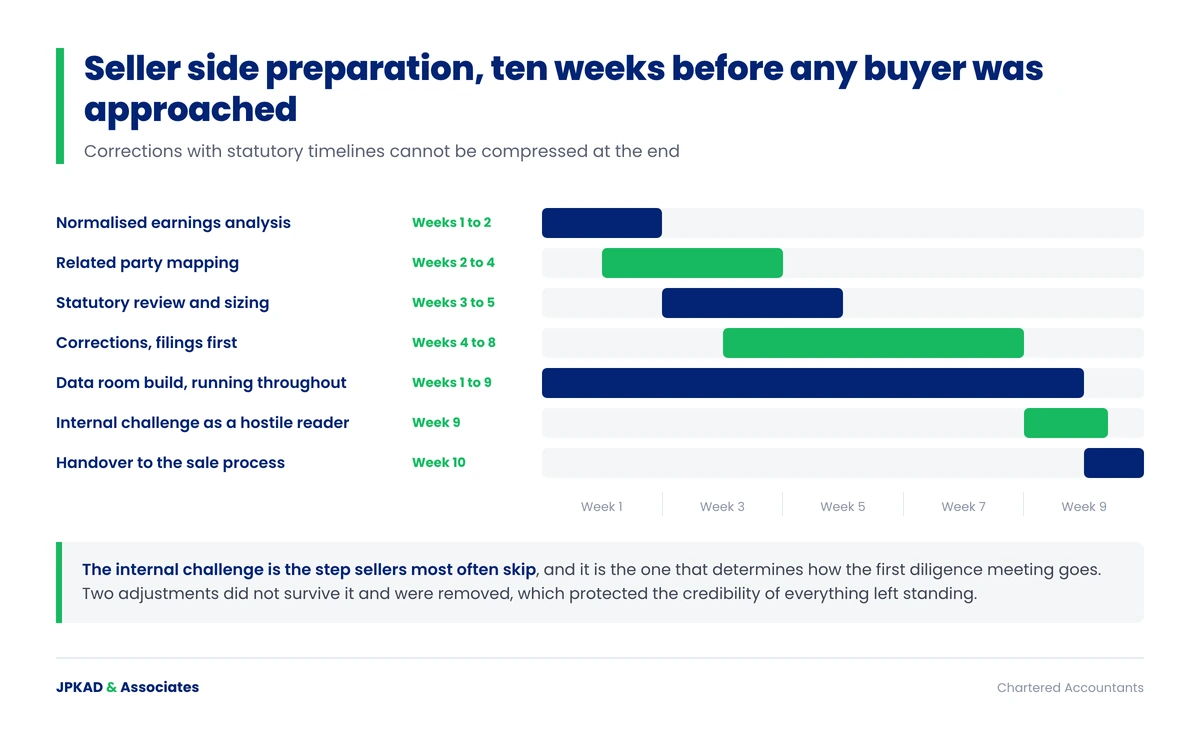
Ten weeks before a buyer appeared. Corrections need a clear run at them.
How was the founder brought into the process?
Through a structured interview covering costs, arrangements and commitments, using a checklist rather than an open question about anything unusual.
Open questions produce the obvious items. Asking specifically about vehicles, travel, premises, relatives and informal understandings produces the rest.
The founder was told at the outset that anything not surfaced now would surface later, in front of a purchaser, in worse circumstances.
That framing mattered. Two of the more significant findings came from him directly once he understood what the exercise was for.
How were the corrections sequenced?
Matters requiring a filing or a payment went first, because those have their own timelines and cannot be compressed at the end.
Documentation of related party arrangements followed, since drafting takes time and the legal advisers needed a clear brief on commercial terms.
The unwinding of arrangements that would not continue was left until the commercial position was settled, to avoid doing it twice.
Everything that could not be completed in the window was moved to the disclosure schedule rather than being rushed into a partial fix.
How was the analysis tested before the process opened?
By having the normalised earnings analysis reviewed internally as though by a purchaser’s adviser, with each adjustment challenged on its evidence.
Two adjustments did not survive that review and were removed, which is better than defending them later against a genuinely hostile reader.
The remaining adjustments were each tied to a document in the data room, so a challenge could be answered with a reference.
That rehearsal is the part sellers most often skip, and it is the part that determines how the first diligence meeting goes.
How was the exercise handed over to the process?
With a report setting out the normalised earnings basis, the related party position, statutory matters and the state of the data room.
The company’s legal and transaction advisers received the same pack, so everyone worked from one version of the facts.
Responsibility for maintaining the data room stayed inside the company, with a named owner, because it keeps moving during a live process.
The founder went into his first meeting knowing what would be asked, which was the entire point of starting ten weeks early.
Want ten weeks of preparation instead of ten days? Explore how we can help.
Business Results
Results are described as direction of change rather than in figures. Deal outcomes depend on the counterparty, on market conditions and on matters no adviser controls, and figures would imply a causation that cannot be demonstrated.
This is what the company reported once the diligence phase had run.
What changed about how diligence ran?
Standard document requests were answered from the index on the day they arrived, rather than triggering an internal search each time.
The purchaser’s advisers worked through the financial information faster, because the normalised earnings analysis came with its evidence attached.
Fewer questions were repeated, since the first answers were complete enough to close the point rather than invite a follow up.
The founder spent his time on commercial discussion instead of on document retrieval, which is where a seller’s attention is worth most.
What changed about the issues themselves?
Related party arrangements were documented or unwound before anyone looked at them, so they were disclosed rather than discovered.
The statutory matters that could be regularised had been, and the correspondence evidencing that sat in the data room.
Remaining exposures appeared in the disclosure schedule in the company’s own words, with the background and current position stated.
An issue the seller raises first is a different conversation from the same issue a buyer finds, and the founder saw that play out.
What changed inside the business?
The finance manager now runs a monthly reconciliation between the goods and services tax returns and the books, which had not existed before.
Related party transactions are recorded against written terms, so the position does not drift back to informality after the transaction.
Customer contracts sit in one place with renewal dates tracked, which turned out to be useful for the business quite apart from the sale.
Document discipline improved generally, largely because staff could see why it mattered rather than being told that it did. Our case study on reading a term sheet before signing a round covers the terms a founder meets once a process is running.
What changed for the founder?
He understood what his business looks like to somebody buying it, which is not how he had ever been asked to think about it.
The distinction between reported profit and what a purchaser will pay for became concrete rather than theoretical.
He went into negotiation knowing what was disclosed and why, rather than learning about his own company during the process.
Preparation also gave him the option to stop. A seller who is not ready rarely has that choice once a process is running.
Want the diligence conversation on your own terms? Speak to us about transaction readiness.
Lessons Learned
Nothing in this exercise was technically difficult. It required somebody to look at a well run owner managed business the way a stranger with money would look at it.
What surprised the company most?
How much of the reported profit depended on decisions the owner had made about himself, particularly remuneration and premises.
How many arrangements existed that nobody thought of as transactions, including the maintenance understanding that had never been billed to anyone.
That audited accounts filed on time said very little about whether the business was ready to be examined by a purchaser.
How long document retrieval actually took once somebody asked for items in a specific order rather than by general subject.
What worked better than expected?
The checklist interview with the founder. Specific questions about vehicles, relatives and premises produced findings that an open question did not.
Reviewing the earnings analysis internally as a hostile reader would. Removing two weak adjustments early protected the credibility of the rest.
Listing gaps openly on the data room index. Buyers read an acknowledged gap very differently from an item that is simply absent.
Starting ten weeks before the process. Several corrections had statutory timelines that could not have been compressed.
What would be done differently next time?
Related party arrangements would be documented as they arise, since papering years of informal dealing at once is the slowest part of the work.
The reconciliation between returns and books would run monthly throughout, rather than being reconstructed across several years under time pressure.
Customer contract renewals would be tracked from the start, because contracts running past expiry raise a question about what a buyer is acquiring.
The founder would have been brought into the earnings discussion even earlier, as his own account produced the most useful findings.
What should other Kerala promoters consider?
Ask what the business earns without you in it, including what a replacement for your own role would actually cost to employ.
List every arrangement with a relative or a connected entity, then ask whether each one is written down and priced commercially.
Reconcile the tax returns against the books for the last three years, because that is the first exercise any purchaser’s adviser will run.
Start well before a buyer is in sight, since almost nothing useful can be corrected once a process is live and a counterparty is watching.
Frequently Asked Questions
1. What is vendor due diligence?
It is a review a seller commissions on its own business before a sale, examining what a purchaser would examine. The purpose is to find issues while there is still time to correct them, and to prepare the supporting analysis and documents so that diligence runs from a prepared position rather than a reactive one.
2. How is it different from the diligence a buyer runs?
A buyer runs diligence to decide whether to proceed and on what terms, working from documents the seller provides. Vendor due diligence looks at the same ground first, from the seller’s side, so that issues can be fixed or disclosed deliberately. The subject matter overlaps heavily and the purpose is entirely different.
3. What is quality of earnings and why does it matter?
It restates reported profit on a normalised basis, removing items specific to the current owner or that will not recur. Owner remuneration, personal costs run through the business, related party rent on non commercial terms and one off gains all get adjusted. Purchasers value the normalised figure, not the profit shown in the accounts.
4. Why do related party arrangements cause problems in a sale?
Because they are usually understood inside the family and rarely written down. A purchaser cannot assess what it is acquiring or what continues after completion when terms do not exist on paper. Undocumented arrangements tend to become conditions, indemnities or price adjustments, whereas documented ones can simply be disclosed.
5. What should a data room contain?
Constitutional documents, financial information, tax records, customer and supplier contracts, employee and payroll records, property and lease papers, licences, insurance, intellectual property and any disputes. Organise it around the questions a purchaser asks rather than around how the company files its own papers, and give every item a reference on the index.
6. When should a seller start preparing?
Several months before approaching anyone, because the corrections that matter most have their own timelines. Statutory regularisation, documenting related party arrangements and legal drafting cannot be compressed. A seller who begins once a buyer is already interested spends the process reacting to questions rather than answering them from a prepared file.
7. What is a disclosure schedule?
It is the document in which a seller states known issues against the warranties being given, in its own words. Preparing it early means the seller knows before negotiation exactly what is being disclosed. How a disclosure operates against a particular warranty is a legal question, so transaction lawyers take it into the documents.
8. Do statutory gaps really affect the price?
They frequently do, because a purchaser prices uncertainty. Tax reconciliation differences, payroll coverage questions and late deposits are often modest in the ordinary running of a business. In diligence each one becomes a question, and a question without a complete answer tends to be addressed through price, an indemnity or an escrow.
9. Can a company do this work internally?
Parts of it, though the difficulty is perspective rather than capability. The people who built the arrangements are rarely the people who can see how they read to a stranger. An internal team also finds it harder to challenge the owner’s own adjustments, which is exactly the challenge a purchaser’s advisers will bring.
10. How long does a vendor due diligence exercise take?
This one ran about ten weeks before the company was shown to anyone. Earnings analysis and related party mapping take a few weeks. Corrections with statutory timelines determine the rest, and document assembly runs throughout. A business with tidier records and fewer informal arrangements can move considerably faster.
Conclusion
Vendor due diligence turned this Kochi company from a business that was profitable into a business that was ready to be examined, and those are not the same thing. Its accounts were audited and filed on time, which told a bank what it needed and told a purchaser very little. What a buyer wanted to know was what the business earns without its founder in it, and that answer sat behind owner remuneration set below market, personal costs running through the ledger, and premises rented from a family trust on terms nobody had revisited in years. Most of the value in the exercise came from sequence rather than from technique. Arrangements were documented before anyone asked about them, statutory matters were regularised while there was still time to file, and the remaining items were disclosed in the company’s own words instead of being discovered. Two adjustments were removed during an internal challenge, which protected the credibility of everything left standing. If you expect to sell in the next two years, the question worth answering now is what your profit looks like once your own decisions about yourself are stripped out of it. JPKAD & Associates advises promoters on transaction readiness and corporate finance, and you can read more through the contact page.
This case study is published for general information only. Client identity and commercially sensitive details have been withheld. Outcomes are described qualitatively, without figures, because deal outcomes depend on the facts, on the counterparty and on matters outside any adviser’s control. Legal drafting and the negotiation of transaction documents were handled by the company’s legal advisers. Nothing here is professional advice on any specific matter.