
Executive Summary
A departmental GST audit under Section 65 arrived at this Thrissur trading company with fifteen working days of notice and a list of records running back three financial years. Nobody in the business had been through one before, and the first reaction was to assume the worst.
The notice came in Form ADT 01 from the state authority, naming the periods under audit and the records to be produced.
The company had filed every return on time. What it had never done was reconcile those returns against its own books in any structured way.
JPKAD & Associates was engaged the week the notice arrived, and the first task was to find out what the records would show before the officer did.
Work covered three reconciliations, a registration defect nobody had noticed, and a paragraph by paragraph reply to the observations that followed.
- A departmental audit under Section 65 is not the reconciliation filed with the annual return.
- Form ADT 01 gives at least fifteen working days notice, and the audit is normally completed within three months.
- Credit differences between the auto populated statement and the return filed are usually the first line of enquiry.
- An additional place of business that was never added to the registration causes disproportionate trouble.
- A paragraph by paragraph reply, supported by working papers, closes more points than a general explanation.
Received a notice in Form ADT 01? Explore our goods and services tax work.
Client Overview
The client is a trading company based in Thrissur, distributing building materials to retailers and contractors across central Kerala. It is closely held, run by two working directors, and it has grown steadily for a decade.
The business operates from a main office with an attached warehouse, and it had opened a second storage yard a few kilometres away two years earlier.
Purchases come from manufacturers across several states, so inward supplies carry a mix of integrated and state tax that has to be tracked carefully.
Finance is a manager and three accounts staff, with returns prepared in house and the annual return handled with support from a consultant each year.
Compliance had always been treated as a filing exercise. Returns went in on time, payments were made, and nobody had asked whether the returns agreed with the books. The groundwork for that is covered in our note on understanding GST compliance for businesses in Kerala.
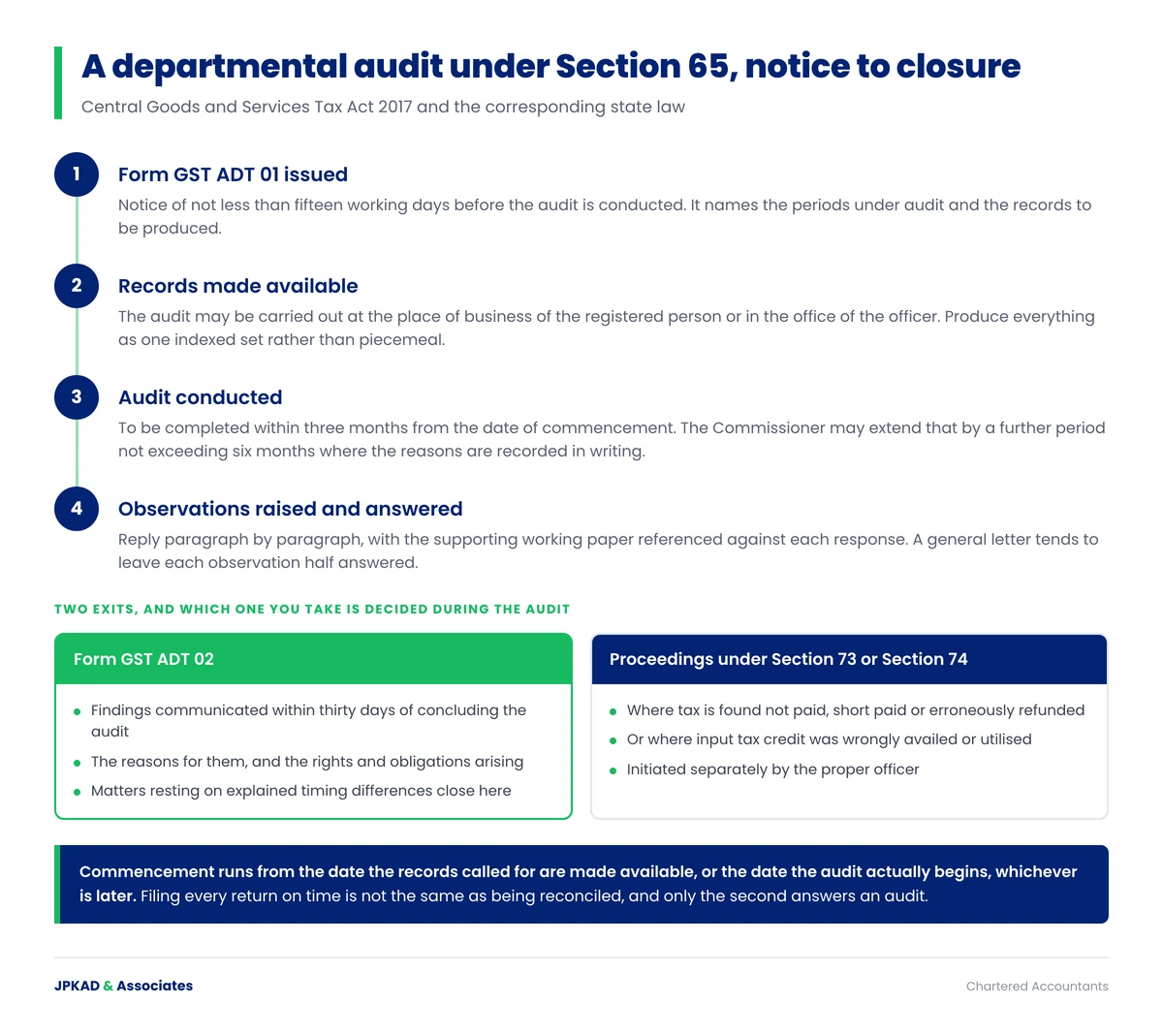
Two exits from an audit. Which one you take is decided during it.
Business Challenges
The company was not being accused of anything. A period had been selected for audit, and the difficulty was that nobody inside the business could say with confidence what the records would show.
Four problems surfaced in the first week, and one of them had nothing to do with the numbers at all.
Why was a departmental audit different from the annual reconciliation?
Because the reconciliation statement filed with the annual return is prepared by the registered person, from its own records, on its own timetable.
A departmental audit under Section 65 is conducted by the officer, over periods the department selects, with the records produced on demand.
The directors had assumed that filing the annual return and its reconciliation each year meant the ground had already been covered.
Those are different exercises with different purposes, and the second one tests whether the first was done properly in the first place.
What did the credit reconciliation reveal?
Credit had been claimed from purchase invoices recorded in the books, without a periodic comparison against the statement auto populated from suppliers’ returns.
Over three years that produced differences in both directions, some because suppliers had filed late and some because invoices were recorded in a later period.
A few differences were genuine and permanent, where a supplier had never reported a supply at all, which leaves the recipient exposed.
Untangling those required matching at invoice level rather than at summary level, which is the work the company had avoided for three years.
Why did the turnover reconciliation take so long?
Because the books and the returns had been maintained on slightly different bases, and nobody had documented the reasons for the differences.
Credit notes were recorded in the books when issued and reflected in the returns in a different period, which moved turnover between months.
Some scrap sales and a small amount of rental income had been recorded in the accounts without being examined for their treatment under the tax.
Each difference was explainable once traced. None of them had ever been written down, so every one had to be reconstructed from source documents.
What was the problem with the second yard?
The storage yard opened two years earlier had never been added to the registration certificate as an additional place of business.
Goods were received there, stored there and dispatched from there, so it was plainly a place of business in the ordinary sense.
A registration defect of this kind is separate from any tax effect, and it invites questions about everything that moved through that location.
It also had to be corrected while the audit was running, which is a considerably less comfortable position than correcting it beforehand.
Do your returns agree with your books? Read more about our taxation services.
Business Objectives
The directors wanted the audit answered properly rather than survived. That meant knowing the position before the officer did, correcting what could be corrected, and explaining the rest with documents rather than assertions.
What did the company need to establish first?
A complete reconciliation of credit claimed against the auto populated statement for every period under audit, at invoice level rather than in summary.
A turnover reconciliation between the returns and the audited financial statements, with each difference traced to its cause and documented.
An honest assessment of where the company was exposed, so the directors could decide what to correct voluntarily before it was raised.
And a clear position on the unregistered yard, including what had to be done and in what order, given that the audit was already underway.
Why correct matters during the audit rather than wait?
Because a difference the company identifies and explains is a different conversation from one the officer finds unexplained in the records.
Voluntary correction, where it is genuinely available, also limits how far a matter travels once the findings are issued.
Waiting achieves nothing useful. The records are in the officer’s hands and the differences are visible in them whether or not anyone mentions them.
The directors accepted that reasoning quickly, largely because it matched how they handled disputes with their own customers. Our case study on resolving a multi state GST mismatch follows a similar reconciliation across several registrations.
What defined success in this GST audit?
Every record called for produced within the time allowed, complete and indexed, so that nothing was outstanding when the officer began.
Reconciliations available on request rather than promised, since a reconciliation offered later is worth much less than one handed over on the day.
A reply addressing each observation separately, supported by working papers, rather than a general letter covering the observations as a group.
And a registration record that matched the reality of where the business actually operates, corrected before the audit concluded.
Want the position known before the officer arrives? Explore our approach.
Solution Strategy
Work ran in two streams from the first day. One produced the records the notice called for, and the other reconstructed the reconciliations the company had never prepared. Neither could wait for the other.
The governing assumption was that the officer would find anything the company could find, so it was better to find it first.
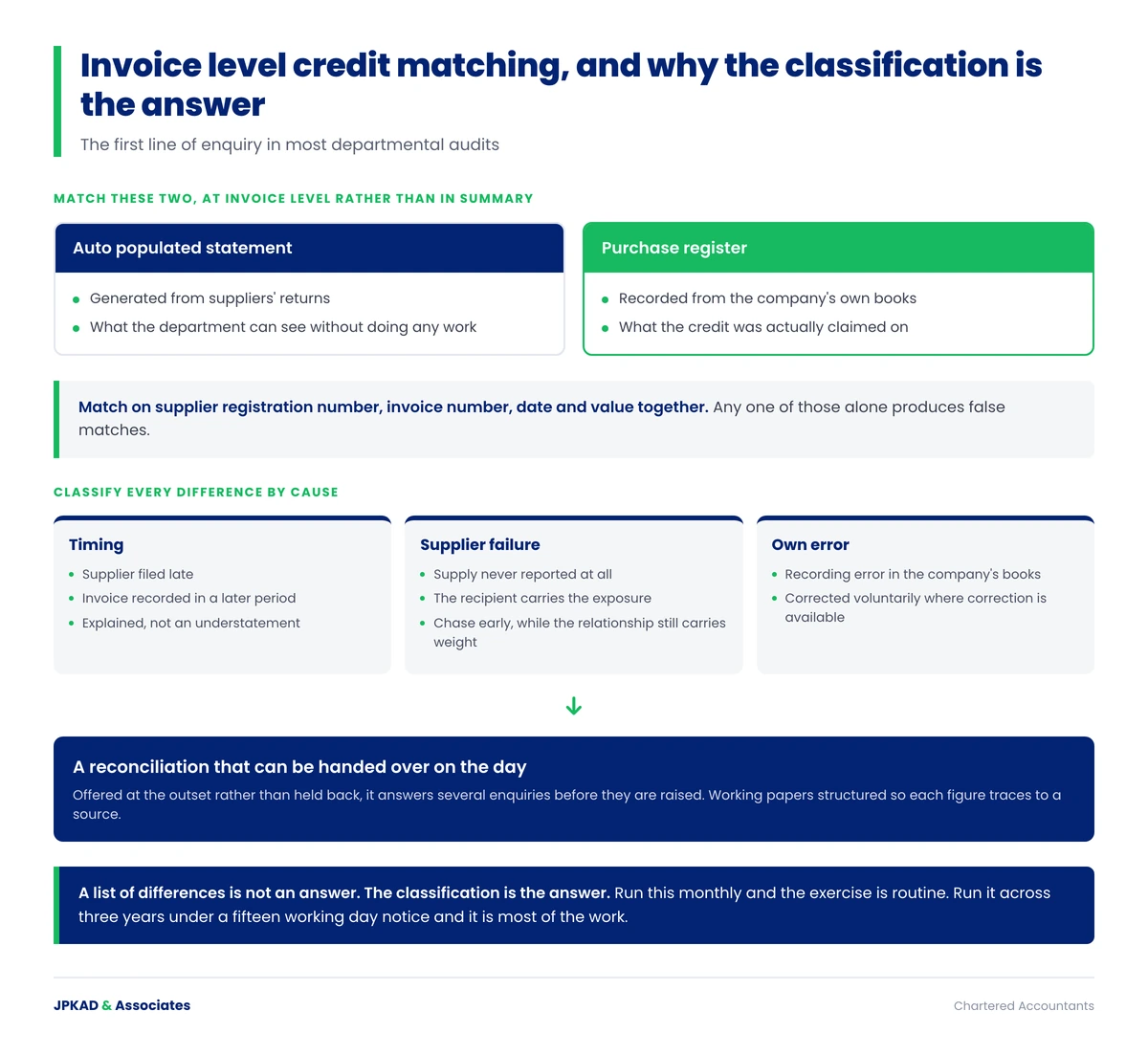
A list of differences is not an answer. The classification is the answer.
How was the credit reconciliation rebuilt?
By downloading the auto populated statement for every period under audit and matching it against the purchase register at invoice level.
Matches were made on supplier registration number, invoice number, date and value together, since any one of those alone produces false matches.
Differences were then classified by cause, separating timing differences from supplier filing failures and from genuine errors in the company’s own records.
That classification is what turns a list of differences into an explanation, and it is the part an officer is actually interested in.
How was the turnover reconciliation prepared?
By starting from the audited financial statements for each year and working towards the turnover declared in the returns, rather than the other way round.
Credit notes, scrap sales and the rental income were each traced and treated explicitly, with the reasoning recorded alongside the figures.
Period differences were identified and presented as period differences, since a timing difference that is explained is not an understatement.
The working was built so that any single line could be traced back to an invoice or a ledger entry without further reconstruction.
How was the registration defect handled?
By amending the registration to add the storage yard as an additional place of business, as soon as the position was established.
The amendment was disclosed to the officer rather than made quietly, because a correction discovered later reads very differently from one that is volunteered.
Records showing what had moved through the yard were assembled separately, so questions about that location could be answered directly.
The directors were advised that correcting the registration does not by itself resolve any question about the earlier period, and it does not.
How were the records produced to the officer?
In a single indexed set, covering each item listed in the notice, with a covering schedule showing where each record sits.
Producing records piecemeal invites repeat visits and extends the audit, which is in nobody’s interest including the department’s.
Electronic records were provided in the formats requested where those were available, and in readable extracts where the system could not produce them directly.
One item called for did not exist in the form described, and that was stated plainly at the outset rather than left to emerge as a gap.
How was the reply to the observations drafted?
Paragraph by paragraph, addressing each observation on its own terms, with the supporting working paper referenced against each response.
Where the company accepted a point, it said so plainly and set out what it had done about it, without argument.
Where it did not accept a point, the response explained why with reference to the records rather than to general principle.
A general letter covering several observations together tends to leave each of them half answered, which invites the next round of correspondence.
Are your credit differences classified or just listed? Read more about our accounting and financial reporting.
Records and Tools Used
Most of what the audit called for existed. It sat in the accounting system, in the returns portal and in physical files, and it had never been brought together as one body of evidence for a single period.
Which records did the notice call for?
Books of account for each of the periods under audit, including the purchase register, the sales register, the cash book and the general ledger.
Returns filed for each period together with the annual returns, and the payment records supporting the tax discharged.
Invoices for inward and outward supplies, delivery documentation, and the stock records for both the warehouse and the second yard.
Bank statements, the audited financial statements for each year, and the registration certificate together with its full history of amendments.
How were the reconciliations built and kept?
In working papers structured so that each figure traces to a source, because a reconciliation that cannot be traced is an assertion rather than evidence.
Invoice level matching was done in a spreadsheet built for the purpose, with the auto populated statement and the purchase register held side by side.
Each classified difference carries a short note recording why it arose and what evidence supports that conclusion.
The working papers were retained after the audit, since the same reconciliations now run periodically rather than being built once under pressure.
How was the audit file organised?
By period first, because the officer works period by period and a file organised by record type forces constant cross referencing.
The notice itself, the index of records produced and the acknowledgement of that production all sit at the front of the file.
Reconciliations follow, then the observations received, then the reply with its working paper references.
Correspondence is kept in date order alongside all of it, so the sequence of what was asked and what was answered can be followed without any reconstruction. The same discipline applies to direct tax proceedings, as our note on managing income tax notices explains.
Implementation Process
The audit ran across about four months from the notice to the findings, and the company’s own preparation occupied the first three weeks of that almost entirely.
Fifteen working days of notice sounds generous until the reconciliations that should already exist turn out not to.
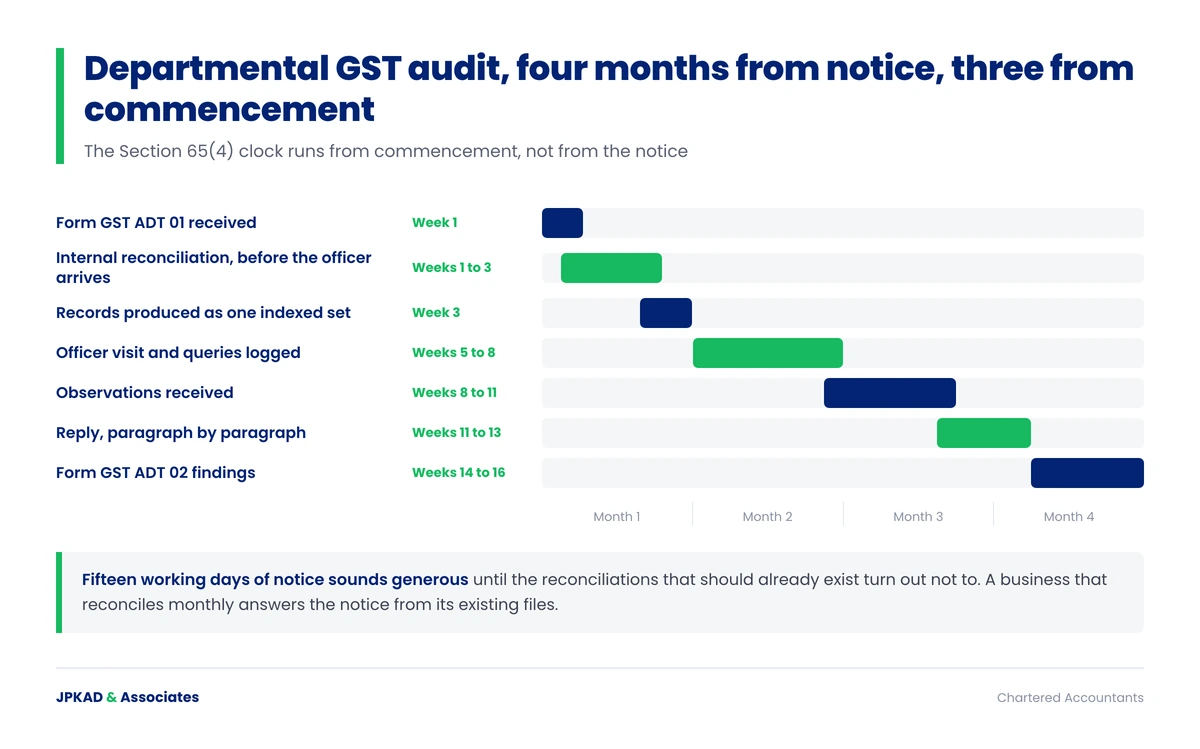
Four months end to end. The first three weeks decided most of it.
How was the first fortnight used?
Entirely on establishing the position, starting with the credit reconciliation because that is where enquiries usually open.
The purchase register was reconciled against the auto populated statement for the earliest period first, since older periods carry weaker documentation.
The registration defect surfaced during this phase, when stock records for the yard were pulled and the address did not appear on the certificate.
By the end of the second week the directors had a written summary of what the officer was likely to raise, which changed the tone of their preparation.
How was the officer’s visit handled?
With the records produced as one indexed set on the first day, and a single point of contact inside the company for every request.
Staff were briefed to route questions rather than answer them directly, which prevents inconsistent answers to the same question.
The reconciliations were offered at the outset rather than held back, since they answer the first several questions before they are asked.
Queries raised during the visit were logged with the date, the question and the response, which later formed the spine of the reply.
How were the observations answered?
Each observation was taken separately, with the relevant working paper attached and referenced in the response rather than merely mentioned.
Two observations arose from timing differences already identified and explained in the reconciliation, so those responses were short.
The supplier filing failures required a different answer, setting out what the company had done to pursue those suppliers and what evidence it held.
The reply was submitted within the time allowed, complete, rather than seeking an extension to add material later.
How did the audit conclude?
The findings were communicated in Form ADT 02, setting out the conclusions and the reasons for them.
The matters the company had identified and corrected during the audit were recorded as such, rather than being raised afresh.
Points that rested on timing differences closed on the strength of the reconciliations, which is what those working papers were built for.
Where an amount remained payable, it was discharged with interest rather than contested, because the records supported the department’s position.
Need reconciliations built before the visit, not after? Explore how we can help.
Business Results
Results are described as direction of change rather than in figures. The outcome of any audit depends on the records, on the facts and on the view taken by the proper officer, and figures would imply a pattern that does not transfer between cases.
This is what the company reported once the findings had been issued.
What changed about the audit position?
The matters resting on timing differences closed on the reconciliations, because an explained difference is not an understatement.
The registration was corrected during the audit and disclosed, so the defect was addressed rather than left to be found.
Where tax remained payable the amount was discharged with interest, and the company chose not to contest positions its own records did not support.
The audit concluded through the findings rather than escalating, which was the outcome the directors had hoped for without expecting.
What changed about monthly compliance?
Credit is now reconciled against the auto populated statement every month, at invoice level, before the return is filed.
Differences are classified as they arise, which means a supplier filing failure is chased within weeks instead of surfacing three years later.
Turnover is reconciled to the books quarterly, with the reasons for differences written down at the time rather than reconstructed afterwards.
Credit notes and scrap sales are treated consistently between the books and the returns, which removed a recurring source of difference.
What changed inside the finance function?
The accounts manager owns the monthly reconciliation and reviews it with the controller, so the work has a named owner rather than being everybody’s task.
Working papers are retained in a standard structure, which means a future request can be answered from the file rather than rebuilt.
Suppliers who repeatedly file late are now identified early and handled commercially, since the recipient carries the consequence of their delay.
Compliance is treated as a reconciliation exercise rather than a filing exercise, which is the change that mattered most. Reconciliations of this kind are part of our accounting and financial reporting work.
What changed for the directors?
They understand that filing on time and being reconciled are different things, and that only the second one answers an audit.
Any new location is now added to the registration before it starts operating, which had simply never occurred to anyone previously.
The board sees the reconciliation summary quarterly, so exposure is visible rather than discovered when a notice arrives.
Having been through one audit, the directors treat the next notice as a process to run rather than an event to fear.
Want compliance that survives an audit? Speak to us about an audit notice.
Lessons Learned
Nothing about this audit required an unusual reading of the law. It required records that agreed with each other, and those had never been checked in the years when checking would have been easy.
What surprised the company most?
That filing every return on time provided almost no protection, because the audit tested whether those returns agreed with the books.
How much work invoice level matching involves after three years, compared with doing the same comparison monthly as the periods close.
That the storage yard, which felt like a warehouse rather than a place of business, was a registration matter and a significant one.
That a supplier’s failure to report a supply becomes the recipient’s problem, which the directors had not appreciated at all.
What worked better than expected?
Producing every record as one indexed set on the first day. It shortened the visit and reduced the number of follow up requests considerably.
Offering the reconciliations at the outset rather than holding them back, since they answered several enquiries before they were raised.
Routing all questions through one person. Inconsistent answers from different staff create work that is hard to undo afterwards.
Replying paragraph by paragraph. A general letter would have left several observations half answered and invited another round.
What would be done differently next time?
The reconciliations would already exist, which removes almost the whole of the first three weeks of pressure.
The registration would have been amended when the yard opened, rather than two years later while an officer was reviewing the records.
Supplier filing behaviour would be monitored continuously, since the recipient carries the exposure and early chasing is the only practical remedy.
The directors would be briefed on the likely lines of enquiry at the start, as that briefing changed how they approached the whole process.
What should other Kerala businesses review?
Compare credit claimed against the auto populated statement for the last three years, at invoice level, and see what the difference actually is.
Reconcile turnover in the returns to the audited financial statements for each year, and write down the reason for every difference.
Verify that every location where goods are stored or dispatched appears on the registration certificate as a place of business.
Ask whether anyone could produce the records listed in a notice within fifteen working days, complete and indexed, starting today.
Frequently Asked Questions
1. What is an audit under Section 65?
It is an audit of a registered person conducted by the tax department, covering periods the department selects. The Commissioner or an authorised officer undertakes it, and the registered person receives notice in Form GST ADT 01. It is separate from the reconciliation statement a business files with its own annual return.
2. How much notice does the department give?
Form GST ADT 01 is issued not less than fifteen working days before the audit is conducted. That period sounds workable until a business discovers it has to build reconciliations covering several years within it. Businesses that reconcile monthly find the notice period comfortable, and those that do not find it very short.
3. How long can a departmental audit take?
It is to be completed within three months from the date of commencement. The Commissioner may extend that by a further period not exceeding six months where the reasons are recorded in writing. Commencement runs from when the records called for are made available or when the audit actually begins, whichever of those is later.
4. What is Form ADT 02?
It is the document in which the proper officer communicates the findings of the audit, the reasons for those findings, and the rights and obligations that follow. It is issued within thirty days of concluding the audit. Where tax is found short paid or credit wrongly availed, separate proceedings may be initiated.
5. What do officers usually examine first?
The difference between input tax credit auto populated from suppliers’ returns and the credit actually claimed is a common starting point, because it is visible without any work. Turnover reconciliation against audited financial statements, reversal of credit relating to exempt supplies and liability under reverse charge typically follow closely behind.
6. What happens if a supplier never reported a supply?
The credit claimed by the recipient is exposed, because the supply does not appear in the statement generated from the supplier’s returns. That is uncomfortable, since the recipient has paid the supplier and carries the consequence of the supplier’s failure. Practical protection comes from reconciling monthly and chasing early, while the commercial relationship still carries some weight.
7. Does an unregistered additional place of business matter?
It does. Every location where goods are stored, received or dispatched is ordinarily a place of business and should appear on the registration certificate. A defect of this kind is separate from any tax effect and it draws attention to everything that passed through that location, which makes it disproportionately troublesome during an audit.
8. Should differences be corrected during an audit?
Where correction is genuinely available it is usually better than waiting. The records are already with the officer, so a difference will be visible whether or not the business mentions it. A matter the business identifies and explains is treated differently from one found unexplained in the records.
9. Is this the same as the annual reconciliation statement?
No. The reconciliation statement filed with the annual return is prepared by the registered person from its own records. A departmental audit is conducted by the officer, over periods the department chooses, using records produced on demand. The second exercise partly tests whether the first was done properly.
10. How should a business prepare before a notice arrives?
Reconcile credit against the auto populated statement monthly at invoice level, reconcile turnover to the books each quarter, and record the reason for every difference at the time it arises. Keep the working papers. A business doing that can answer a notice from its existing files instead of rebuilding three years of analysis under time pressure.
Conclusion
This GST audit was answered in the first three weeks, before the officer had raised a single observation. The notice in Form ADT 01 gave fifteen working days and called for three years of records, and the company had filed every return on time without ever checking whether those returns agreed with its own books. Those are different things, and only the second one answers an audit. Credit matching at invoice level did most of the work. Once differences were classified into timing, supplier failure and genuine error, the majority of them stopped being exposures and became explanations. The registration defect was the item nobody expected, because a storage yard feels like a warehouse rather than a place of business, and correcting it during an audit is far less comfortable than correcting it when it opens. What changed afterwards was the rhythm rather than the rules. Credit is reconciled monthly now, turnover quarterly, and the reasons are written down while anyone still remembers them. If you have not compared your claimed credit against the auto populated statement at invoice level for the last three years, that is the exercise worth starting this month. JPKAD & Associates advises Kerala businesses on goods and services tax compliance and departmental proceedings, and you can read more through the contact page.
This case study is published for general information only. Client identity and commercially sensitive details have been withheld. Outcomes are described qualitatively, without figures, because the result of any audit depends on the records, on the facts and on the view taken by the proper officer. Nothing here is tax or legal advice on any specific matter.