
Saudi based businesses looking at India face a specific set of questions that generic entry guides do not answer. How should the investment be held. What does the treaty position look like. How much compliance will a small Indian entity actually carry. This guide addresses India entry from a Saudi perspective, focusing on the finance decisions that matter in the first year. Sound startup advisory for foreign investors starts with structure, not incorporation.
Key Takeaways
- Decide whether to invest directly from Saudi Arabia or through an existing group entity before incorporating, as the treaty position depends on it.
- A small Indian subsidiary still carries statutory audit, annual filings, tax returns and foreign exchange reporting.
- Budget for a full first year of compliance support rather than a one time incorporation fee.
Deciding Where the Investment Is Held
The first question is not what to set up in India but where the Indian entity will be owned from. A Saudi company can invest directly. Alternatively, many groups already hold an entity elsewhere in the GCC and consider investing through it. The choice affects the applicable treaty, the withholding rates on payments leaving India and the documentation you must maintain.
Neither route is automatically better. Investing directly is simpler to explain and to evidence. Investing through an existing group entity may offer advantages where that entity has genuine activity and substance, but it invites questions where it does not. The substance test has tightened considerably, and structures that worked a decade ago are not all sustainable now.
Decide this before incorporation. Changing the shareholder afterwards means a share transfer, which triggers pricing guidelines, valuation requirements and reporting obligations. Getting it right at the outset costs nothing. Correcting it later costs both money and time.
Attestation requirements are a practical dimension of this decision that is easy to overlook. Corporate documents issued in Saudi Arabia need appropriate notarisation and attestation before they can be used to incorporate an Indian company, and the process runs through authorities in Saudi Arabia rather than in India. Where an intermediate holding entity sits in another jurisdiction, its documents need the same treatment under that country’s rules, which can add or remove weeks depending on where it is.
Ownership of the Indian entity by individuals rather than a company is a further option worth considering. Some Saudi based founders, particularly expatriates, hold Indian ventures personally rather than through a corporate vehicle. This can simplify incorporation but changes the tax profile on exit and the treaty analysis on dividends, so it should be a considered choice rather than a default.
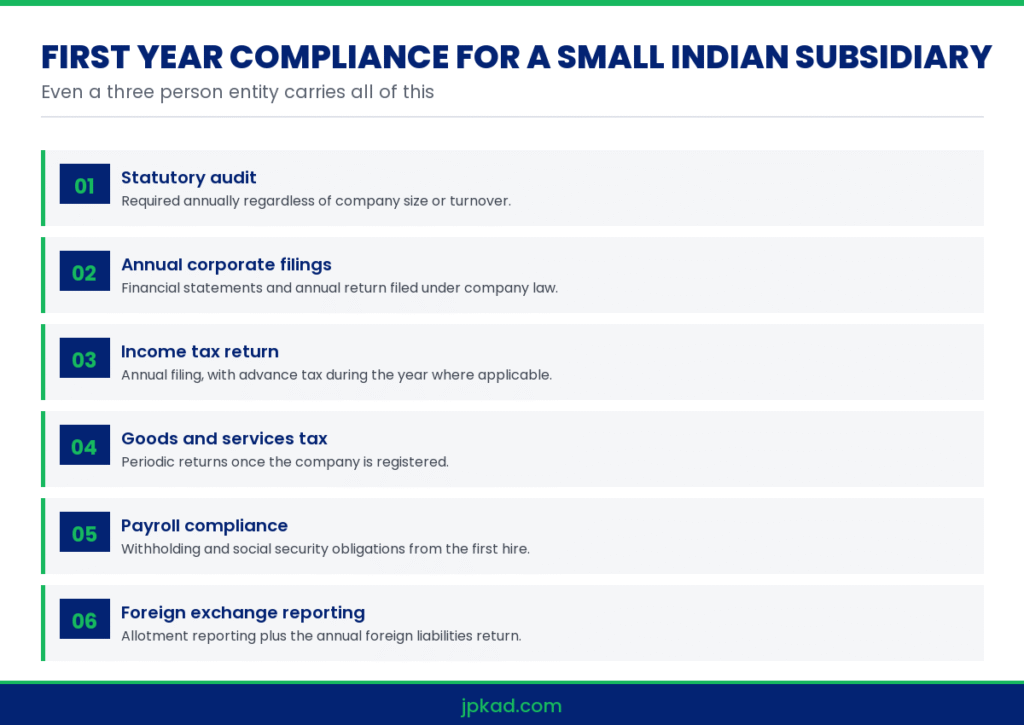
first year compliance obligations for a small Indian subsidiary of a GCC parent
Structure, Funding and the First Year Compliance Load
For most Saudi investors intending to trade in India, the wholly owned subsidiary is the appropriate vehicle. It is taxed at Indian corporate rates rather than the higher rate applied to branches, it can contract and hire without restriction, and it can be sold cleanly if the group later restructures.
Funding usually combines share capital with, where appropriate, intercompany debt. Equity is simplest and carries the reporting obligations that follow any foreign investment. Debt can reduce the overall cost through deductible interest but sits within a separate regulatory regime that needs deliberate structuring rather than an informal transfer.
The compliance load surprises people. Even a subsidiary with three employees faces statutory audit, annual corporate filings, income tax returns, goods and services tax returns where registered, payroll compliance, the annual foreign liabilities return and transfer pricing documentation if it transacts with the parent. Budget for a full year of support, not an incorporation fee.
Sector eligibility should be confirmed before any of this is finalised. Most activities are open to full foreign ownership under the automatic route, but caps and conditions apply in specific sectors and are revised periodically. The current position by sector is published by Invest India, and it should be verified for your precise activity rather than for the industry in general.
Plan the resident director requirement early, as it frequently shapes the whole board. An Indian company needs at least one director meeting the residence test for the financial year. Groups without a suitable person already in India need to identify one before incorporation, and relying on an arrangement where a nominee has no real involvement in the company is unwise given the personal exposure directors carry.
Your Treaty Position and What It Requires
India maintains a double taxation agreement with Saudi Arabia, and it can reduce withholding on dividends, interest, royalties and service fees flowing from India. The benefit is real but conditional. It requires a valid tax residency certificate from the Saudi authorities covering the period in which the payment falls, together with the supporting declarations the Indian payer needs.
Characterisation matters as much as documentation. Different payment types attract different treaty rates, so how a payment is defined in the underlying contract affects what you pay. Settling this at the contract stage is straightforward. Arguing it after an assessment is not.
Where the investment is held through another GCC jurisdiction, a different treaty applies with different rates and conditions. This is precisely why the holding decision belongs at the start of the process rather than being treated as an administrative detail after the commercial plan is settled.
Where the Saudi group has people travelling to India regularly, test the permanent establishment position alongside the treaty rates. Frequent visits, a local agent authorised to conclude contracts or a fixed place of business can create a taxable presence in India independently of the subsidiary. This is a fact specific question and is far easier to manage prospectively than to argue retrospectively. The general framework is outlined in the PwC India corporate residence summary.
Currency is a further planning point. Revenue earned in rupees against costs or reporting in riyals introduces exposure that compounds as the operation grows. Decide early whether that exposure will be hedged, absorbed or managed through pricing, because retrofitting a treasury policy onto an established operation is considerably harder than setting one at the outset.
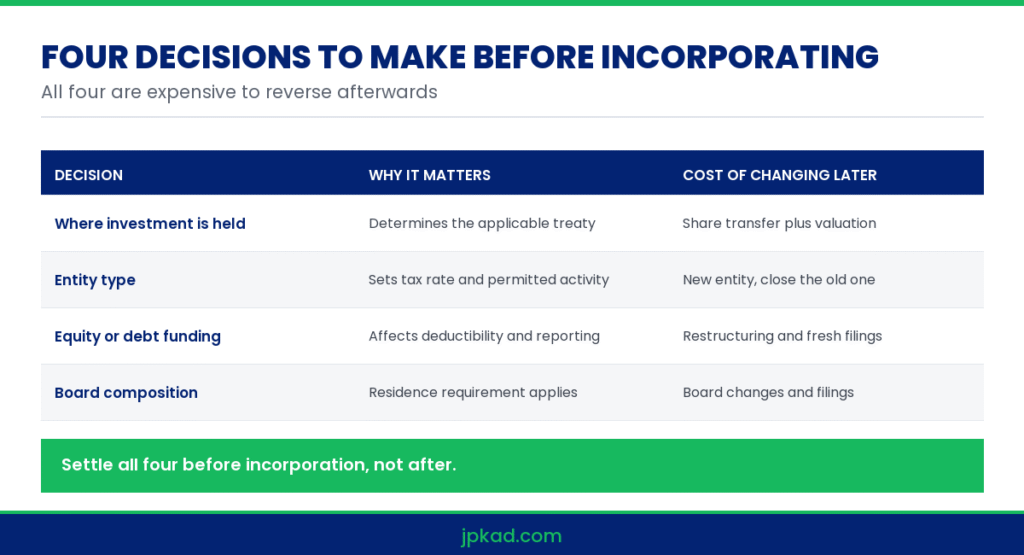
key structural decisions Saudi investors should make before incorporating in India
Timelines, Costs and Choosing Local Support
Allow four to eight weeks from first document to an operating bank account, assuming Saudi corporate documents are properly notarised and attested for use in India. Document authentication is the usual constraint and it happens in Saudi Arabia, outside your Indian advisor’s control, so begin it before anything else.
On cost, separate one time from recurring. Incorporation is a modest one time expense. The recurring cost of audit, filings, tax and reporting support is the number that matters, and it should be quoted clearly before you engage anyone. A proposal that covers only setup is incomplete.
Local presence matters for banking, registered office and dealings with authorities. Firms such as JPKAD and Associates support GCC investors entering through Kerala and the wider South India corridor, and our case study on a UAE business expansion into Kochi illustrates the sequence for a comparable GCC entry.
Hiring introduces obligations from the first employee rather than at some later threshold. Payroll withholding, social security contributions and employment documentation all apply immediately, and getting them wrong is both costly and damaging to the employment relationship. Where the initial team is small, outsourced payroll is usually more economical and more reliable than building the capability internally.
Ask any prospective advisor for a specific comparable engagement rather than a general claim of GCC experience. A firm that has taken a Saudi or wider Gulf client through incorporation, banking, first audit and first repatriation can describe the sequence and the points where it typically stalls. One that cannot is learning on your engagement, which is a reasonable thing to know before you commit.
Conclusion
India entry from Saudi Arabia is well trodden and entirely manageable, provided the structural decisions are made before incorporation rather than after. Settle where the investment will be held, choose the vehicle to match your commercial plan, secure your treaty documentation early and budget honestly for the recurring compliance load. Talk to our GCC desk to review your India plan before you commit.
Frequently Asked Questions
Should a Saudi company invest in India directly or through another GCC entity?
It depends on the substance of the intermediate entity. Direct investment is simpler to evidence. Holding through another entity may suit groups with genuine activity there, but structures without real presence face challenge. Learn more about our investment readiness advisory for fundraising.
Which entity type suits a Saudi investor best?
For any operation intended to trade, the wholly owned subsidiary. It carries the Indian corporate tax rate rather than the higher branch rate, unrestricted activity and a considerably cleaner exit.
Is there a tax treaty between India and Saudi Arabia?
Yes. It can reduce withholding on dividends, interest, royalties and service fees paid from India, subject to holding a valid residency certificate and meeting the treaty conditions for that income type.
How long does India entry take from Saudi Arabia?
Typically four to eight weeks to an operating bank account. Notarisation and attestation of Saudi corporate documents is usually the binding constraint, so start that step before anything else.
What compliance will a small Indian subsidiary face?
Statutory audit, annual corporate filings, income tax returns, goods and services tax returns where registered, payroll compliance, the annual foreign liabilities return and transfer pricing documentation where relevant.
Can we fund the Indian company with a loan from Saudi Arabia?
Partly. Overseas borrowing sits within a separate regime with eligibility conditions and reporting requirements. It needs deliberate structuring rather than an informal intercompany transfer.
Do we need an Indian resident director?
Yes. An Indian company must have at least one director meeting the residence requirement for the financial year. This often shapes the initial board composition, so plan it early.
What should a fee proposal include?
Both the one time incorporation cost and the recurring annual cost of audit, filings, tax and reporting support. A proposal covering only setup is incomplete and will understate your real commitment.
Why choose an advisor in Kerala rather than a metro city?
Local presence matters for banking, registered office and dealings with authorities. What matters more is demonstrated experience with GCC entries, so ask for specific comparable examples before engaging. See our bookkeeping and data entry support for related support.