
A data room is not a folder of documents. It is an argument for your price, made in the order a buyer reads it. Most sellers assemble one reactively, sending files as they are requested, and lose weeks and leverage doing so. This guide sets out how to build a virtual data room before a process starts, what belongs in each section, and how what happens when nobody checks the numbers actually consumes it.
Key Takeaways
- A data room built before the process starts shortens the timetable and protects price. One assembled reactively does the opposite.
- Structure matters more than volume. Buyers score a seller on how quickly they can find an answer, not on how many files were uploaded.
- Every gap you leave becomes either a warranty, an indemnity or a price adjustment, so find them yourself first.
What a Data Room Is Actually For
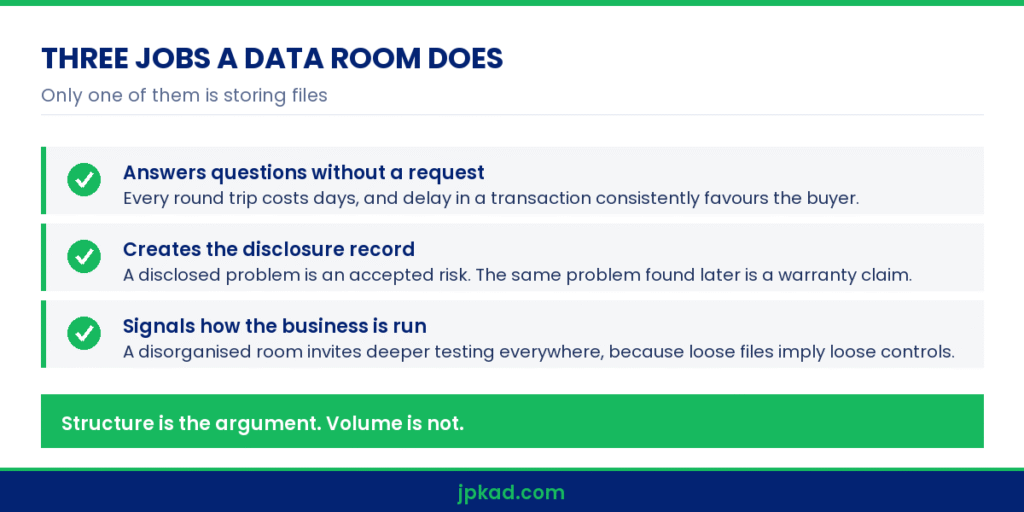
The commercial purpose is to let a buyer verify what the seller has claimed, quickly and without repeated requests. Every unanswered question costs time, and time in a transaction favours the buyer, whose enthusiasm is finite and whose lawyers bill by the hour.
The second purpose is evidential. What sits in the data room at signing usually forms the disclosure against the warranties. A properly disclosed problem is a known risk that the buyer has accepted. The same problem discovered later is a claim. That single distinction is worth more than most sellers realise.
The third purpose is signalling. A well organised room tells a buyer that the business is well run. A chaotic one invites deeper testing everywhere, because the buyer reasonably assumes that if the documentation is loose, the underlying controls are loose too.
This is distinct from the diligence a buyer runs on its own side of a venture round. Our note on preparing for a fundraising diligence process covers that reader, whose document set and questions are quite different from a trade buyer’s. Sellers preparing for a trade sale should not simply reuse a fundraising folder.
Existing posts on why pre-deal checks matter and on making a merger safer explain why buyers run the exercise. This one covers the seller’s side of the table.
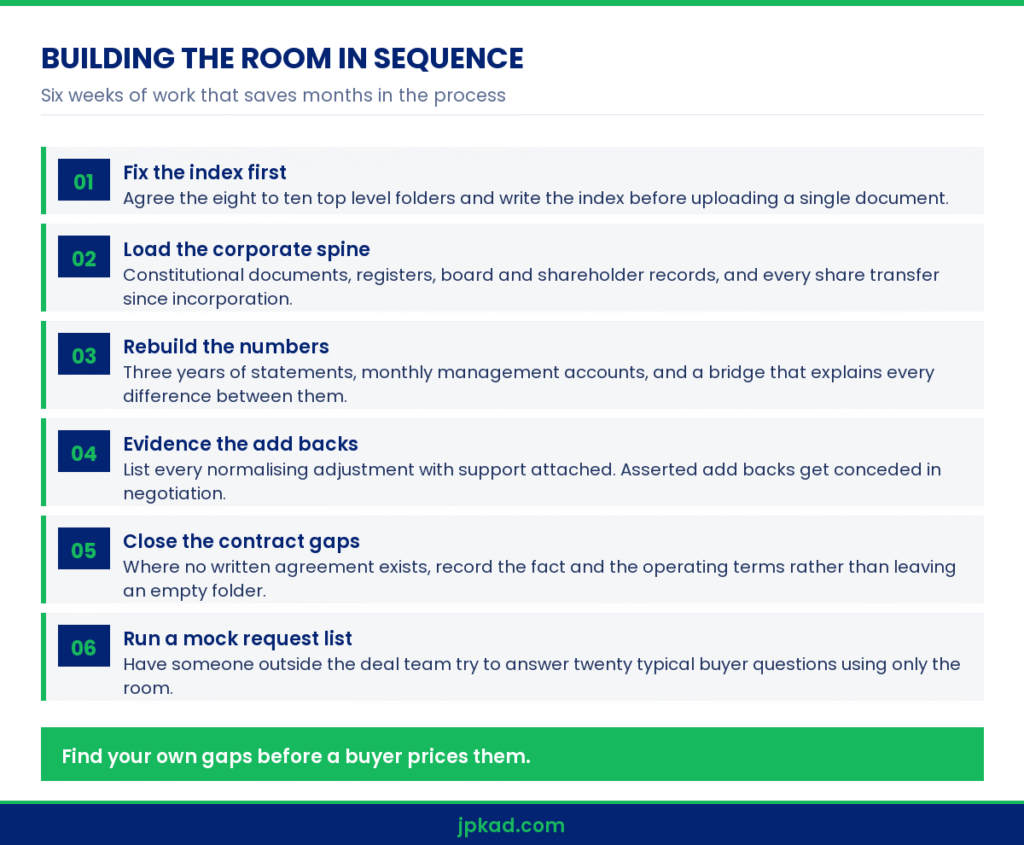
One further point about timing. The room should be built while the business is calm, not while a buyer is waiting. Assembling documents under time pressure produces gaps, inconsistent versions and answers given from memory, and each of those becomes something a lawyer has to paper over later. The seller who spends six unhurried weeks in advance is buying negotiating room, not just tidiness.
The Folder Structure That Buyers Expect
Use a numbered top level of eight to ten folders and resist the urge to invent categories. Corporate and constitutional. Financial. Tax. Commercial contracts. Employment. Property and assets. Intellectual property and technology. Litigation and regulatory. Insurance. Anything that does not fit one of those usually belongs in a schedule inside one of them.
Within each folder, order documents chronologically and name them so the name alone answers the obvious question. A file called supplier agreement is useless. One called supplier agreement, name of supplier, date, term and renewal date can be assessed without opening it.
Build an index as a separate document and keep it current. The index is the first thing a diligence team reads and the thing they will keep returning to. A room with two thousand files and no index is slower to work through than a room with four hundred files and a good one.
Where a document does not exist, say so in the index rather than leaving a silent gap. Buyers assume the worst about silence. A line reading that no written agreement exists with a named distributor, and that the arrangement has run on stated terms for a stated period, is far better than an empty folder.
Version control matters more than people expect. Superseded drafts left alongside executed documents create genuine confusion about what actually binds the company, and a buyer who finds three unsigned versions of a key contract will ask about all three.
Keep the corporate folder complete rather than representative. Every share transfer since incorporation, every board resolution authorising an issue, and every register in its current form. Buyers reconstruct the ownership history from this folder, and a single unexplained gap in the chain of title will hold up completion long after every commercial point has been settled.
What Belongs in the Financial and Tax Sections
Financial diligence rebuilds your earnings from the ground up, so give it the material to do that quickly. Audited statements for three years, monthly management accounts for the same period, the trial balance behind them, and a bridge explaining every difference between management and statutory numbers.
Add the analyses a buyer will otherwise build themselves. Revenue by customer and by product, gross margin by line, the ageing of receivables and payables, stock ageing, and a monthly working capital series long enough to show the seasonal pattern. Our note on preparing records before a buyer looks covers how to prepare these.
Include your own quality of earnings analysis, with normalising adjustments listed and evidenced. Owner remuneration above or below market, personal costs run through the business, one off legal fees and non recurring gains all belong here with support attached. An add back you can evidence is usually accepted. One you merely assert is conceded.
The tax section needs returns and acknowledgements for income tax, indirect tax and withholding across the relevant period, assessment orders and any appeals, reconciliations between returns and the books, and a schedule of open positions with your assessment of exposure. The public Indian tax administration summary is a useful orientation for an overseas buyer reading the section for the first time.
Do not hide a known exposure. Diligence teams find them, and the discovery converts a manageable indemnity discussion into a question about whether anything else was concealed. That question is far more expensive than the exposure itself.
Reconciliation schedules earn their keep here. A statement tying the revenue in the statutory accounts to the revenue declared in indirect tax returns, and payroll costs to the withholding returns, answers a question the diligence team would otherwise spend a fortnight raising in stages. Prepare it once and it closes an entire workstream.
Access, Control and the Question Log
Set permissions by group rather than by individual, and decide in advance what the first tier of access shows. Most sellers stage disclosure, opening commercially sensitive material such as customer names and pricing only once a buyer has committed to exclusivity.
Watermark documents with the viewer identity and keep download rights off for the most sensitive folders. This is not paranoia. Competitors do sometimes enter processes for the information, and a seller who has not thought about it will hand over a customer list to a rival for nothing.
Run every question through a single log with an owner and a date. Answers given verbally in a call have a habit of being remembered differently later, and a written log becomes part of the disclosure record. It also stops the same question being answered three different ways by three different people.
Watch the analytics the platform gives you. Which folders a buyer spends time in tells you where the negotiation is heading. Heavy attention on customer contracts usually precedes a concentration argument. Heavy attention on tax usually precedes an indemnity request.
Finally, freeze and archive the room at signing. A complete, dated copy of exactly what the buyer saw is the single most useful document to have if a warranty claim arrives eighteen months later, and it is impossible to reconstruct after the platform subscription lapses.
Budget for the room to stay open past completion. Warranty periods run for months or years, and post completion adjustments to working capital are settled from the same documents. Closing the subscription the week after signing is a small saving that occasionally costs a great deal.
Conclusion
A good data room is a project, not a folder. Structure it the way a buyer reads, evidence your own adjustments, disclose the gaps rather than hiding them, and control access deliberately. Sellers who invest six weeks here routinely complete faster and concede less in warranties. JPKAD prepares vendor side documentation and supports clients through transaction due diligence on both sides of the table. Speak to our transaction team before your process begins.
Frequently Asked Questions
When should I start building the data room?
Three to six months before you approach buyers. The value is in finding your own gaps early, and most of them take weeks rather than days to close once identified.
How many documents should a data room contain?
Enough to answer the obvious questions and no more. A curated room with a strong index works better than an exhaustive dump, which slows the buyer and hides the important material.
Should I include documents that show problems?
Yes. A disclosed problem is a risk the buyer has accepted. The same problem discovered later becomes a warranty claim and raises questions about what else was left out.
Can I use a shared drive instead of a data room platform?
For a very small transaction, sometimes. You lose permissioning, watermarking and the analytics that tell you where the buyer is concentrating, all of which are genuinely useful.
What if a contract was never put in writing?
Record that in the index, with the operating terms and how long they have run. Silence reads worse than the gap itself, and buyers price uncertainty more harshly than a known informality.
Who should manage the question log?
One named person on the seller side, with a written answer for every question and a date. Verbal answers given in calls are remembered differently by each side when a dispute arises.
How do I protect commercially sensitive information?
Stage the disclosure. Open customer names, pricing and supplier terms only after exclusivity, and watermark everything with the viewer identity in the meantime.
Is a data room different for a fundraising?
Yes. A venture investor asks different questions from a trade buyer and needs a different document set. Reusing a fundraising folder for a trade sale leaves obvious gaps.
What happens to the room after completion?
Freeze and archive a dated copy of exactly what the buyer saw. It is the primary evidence if a claim arrives later. See our note on accurate records driving business success.