
An employee share scheme creates two valuation moments and two tax events, and Indian companies routinely get the second one wrong. The grant needs a defensible price. The exercise needs a fair market value on a prescribed basis, because that is what the employee is taxed on. This guide explains where numbers an investor tests first meets Rule 11UA, who must sign what, and what the company has to keep on file.
Key Takeaways
- An ESOP creates two valuation points: the exercise price set at grant, and the fair market value at exercise that determines the employee’s tax.
- The valuation basis for the perquisite calculation is prescribed rather than negotiable, and the company carries the withholding obligation.
- A second valuation is needed on sale, because capital gains are computed from the value already taxed as a perquisite.
Two Valuation Moments, Two Different Questions
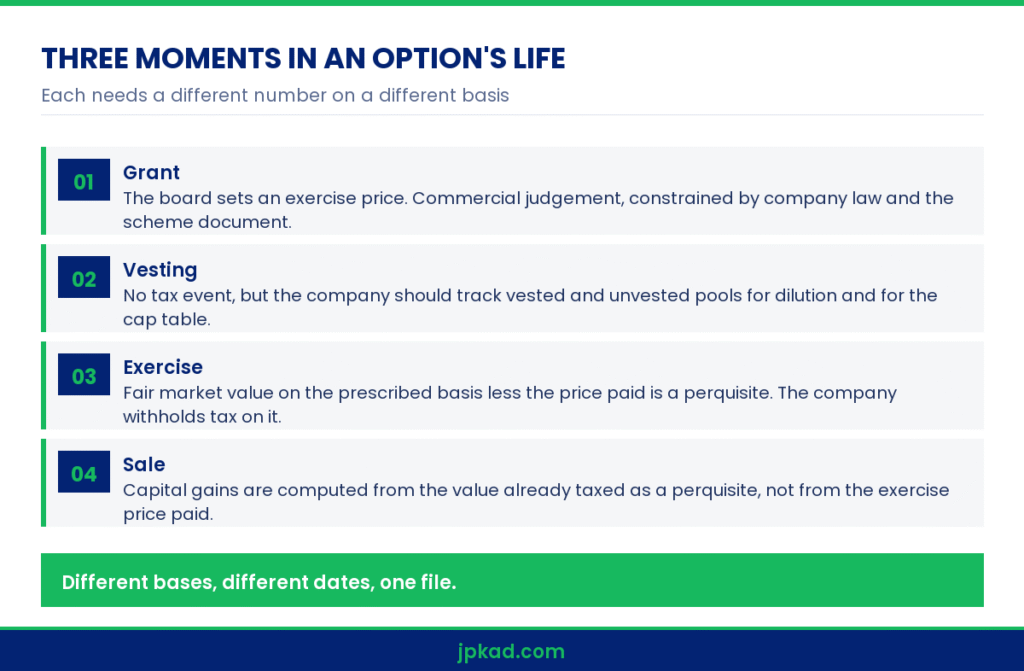
At grant the company sets an exercise price. That is a commercial decision constrained by company law and by the scheme document, and it determines what the employee will eventually pay for the shares. Setting it low is generous to the employee and dilutive to shareholders. Setting it high makes the option less motivating.
At exercise a different question arises. The difference between the fair market value of the share on the exercise date and the price the employee actually pays is treated as a perquisite in the employee’s hands. That is employment income, and the company is required to withhold tax on it.
Those two numbers are produced for different purposes and often by different processes. The grant price reflects what the board decided. The exercise value must follow the prescribed basis, and it cannot be chosen for convenience.
A third moment follows on sale. Capital gains are computed by reference to the value already taxed as a perquisite rather than to what the employee paid, which prevents the same gain being taxed twice. Employees frequently miscompute this and either overpay or file inconsistently.
The practical consequence is that a company running an option scheme needs a valuation discipline, not a one off report. Grants happen periodically, exercises happen unpredictably, and each event needs a value supported on the correct basis as at the correct date.
It is worth separating the two roles inside the company. Human resources owns the scheme, the communication and the grant approvals. Finance owns the valuation cycle, the perquisite computation and the withholding. Where a single person carries both, the valuation discipline is usually the part that quietly lapses.
The Rule 11UA Basis and Who May Sign
Indian income tax rules prescribe how the fair market value of unquoted shares is determined for various purposes, and the ESOP perquisite calculation is one of them. The rule specifies both the method and the category of professional who may certify the result, and using the wrong basis or the wrong signatory makes the certificate unusable.
This is where companies most often go wrong. A management estimate, or a valuation prepared for a fundraising round, is not automatically a valid basis for the perquisite computation. The fundraising number reflects what an investor would pay for preference shares with rights attached, which is not the same thing as the value of an ordinary share on a prescribed basis.
The valuation must also be as at the relevant date rather than a convenient recent date. Where exercises occur across a year, the company needs values that correspond to those dates, which in practice means commissioning valuations on a planned cycle rather than reactively.
Company law adds its own layer. Certain valuations require a person registered for that purpose, and the scheme document itself may impose requirements on how the exercise price is fixed. Read the scheme before assuming the tax rule is the only constraint. Our note on investor checks on a business covers the commercial side of the same exercise.
The broader tax treatment of employment income and perquisites is summarised in the Indian tax summary published by PwC, which is a useful orientation for a foreign parent company encountering the Indian rules for the first time.
Keep the certificate itself, not merely the number. Diligence teams and assessing officers both ask to see the signed report with its basis, date and signatory qualification on the face of it. A value carried forward in a spreadsheet with no supporting certificate is treated as unsupported, whatever its origin.
Withholding, Cash Flow and the Employee Problem
The perquisite is taxed at exercise, whether or not the employee has sold anything. In a private company there is usually no market, so the employee owes tax on a gain they cannot realise. This is the single biggest practical problem with Indian option schemes and it is a design issue rather than a compliance one.
The company must withhold, which means it needs cash from the employee or a mechanism to fund the withholding. Common approaches include a cashless exercise where a portion of the shares is sold or bought back to fund the tax, a company loan, or timing exercises around a liquidity event.
Whichever route is chosen, it must be in the scheme document and consistent with company law on financial assistance. Improvising at exercise time is how companies end up with an unfunded withholding obligation and an unhappy employee simultaneously.
Communicate the arithmetic before people exercise. Employees who understand that exercising creates an immediate tax liability on an illiquid asset make better decisions and are considerably less aggrieved afterwards. A one page worked example does more for scheme credibility than any amount of policy text.
For companies expecting a funding round or a sale, coordinating the exercise window with the liquidity event solves most of this. It requires planning several months ahead, which is a reason to involve finance in scheme design rather than treating it as a human resources exercise.
Leavers need their own rule. What happens to vested options when someone resigns, is dismissed, or leaves on medical grounds should be settled in the scheme rather than negotiated case by case. Companies that improvise here create precedent they cannot control and, occasionally, a dispute that surfaces during a funding round.
Where ESOPs Break in Diligence
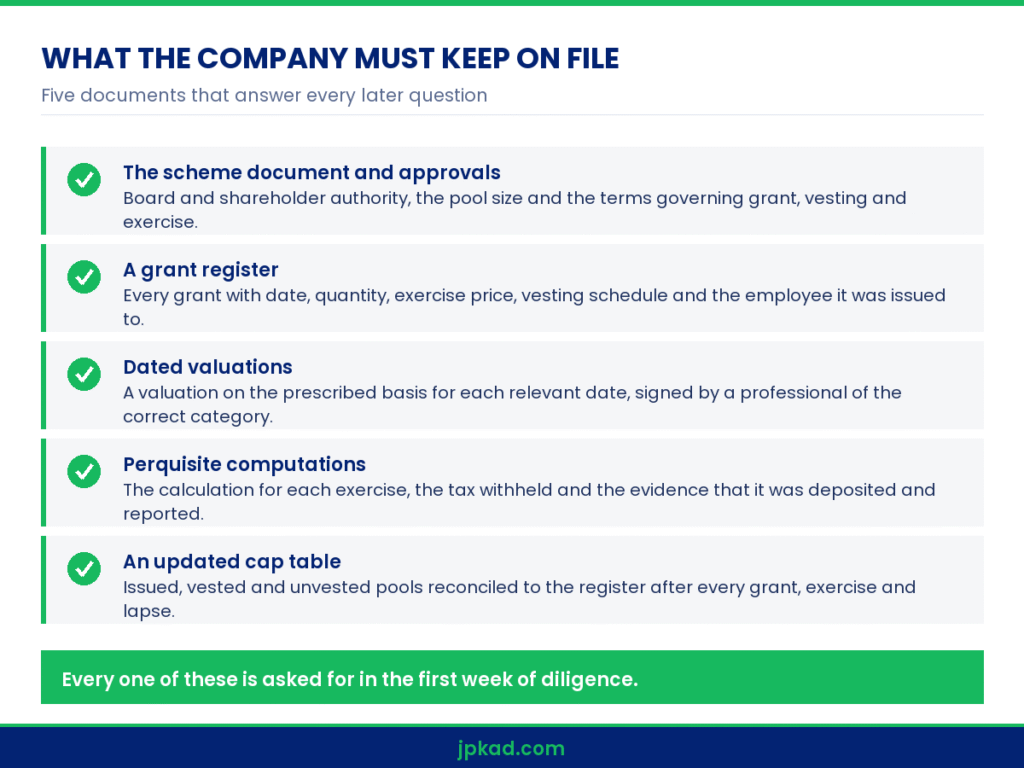
The most common finding is a pool that does not reconcile. Grants recorded in a spreadsheet, lapses never written back, and a cap table maintained separately from the register produce three different numbers for fully diluted share capital. Investors treat this as a governance signal well beyond the numbers themselves.
The second is missing or wrongly based valuations. Where exercises occurred without a contemporaneous valuation on the correct basis, the perquisite computation cannot be supported and the withholding may have been wrong. That becomes an indemnity, and quantifying it is expensive.
The third is grants made without proper authority. Options promised in an offer letter but never formally granted, or granted beyond the approved pool, create genuine legal uncertainty about what the company owes. Employees remember promises even when the register does not record them.
The fourth is interaction with the cap table on exit. Option holders’ entitlements sit behind preference rights in a waterfall, and employees who were told a headline valuation figure are frequently surprised by what they actually receive. Our note on cap table management and dilution across funding rounds covers how that waterfall works.
None of this is difficult to avoid. A register maintained in real time, valuations commissioned on a cycle, and every grant approved before it is communicated will survive almost any diligence process.
Run a reconciliation once a quarter rather than once a transaction. Compare the grant register, the cap table and the statutory records, and investigate any difference immediately. Differences found within weeks are clerical. The same differences found two years later are legal questions about who owns what.
Conclusion
ESOP valuation in India is really a documentation discipline with a valuation inside it. Get the basis right, get the date right, use a professional of the correct category, and keep a register that reconciles to the cap table. Then design the exercise mechanics so employees are not taxed on gains they cannot realise. JPKAD advises on scheme design, valuation and the compliance that follows. Contact our team to review an existing scheme.
Frequently Asked Questions
When is an employee taxed on ESOPs in India?
At exercise, on the difference between the fair market value of the share and the price paid. That amount is a perquisite, the company withholds tax on it, and a second event arises on eventual sale.
Can I use my last funding round valuation for ESOPs?
Usually not. A round prices preference shares with rights attached, which is a different question from the prescribed fair market value of an ordinary share on the exercise date.
Who can sign an ESOP valuation?
A professional of the category prescribed for that purpose. Using the wrong signatory makes the certificate unusable regardless of how sound the underlying analysis is.
How often do we need a valuation?
Often enough that every grant and every exercise has a value as at the relevant date. Companies with regular activity commission them on a planned cycle rather than reactively.
What if the employee cannot fund the tax at exercise?
That is a design problem. Cashless exercise, a company facility, or timing the exercise window around a liquidity event are the usual answers, and each must be written into the scheme.
Do lapsed options go back into the pool?
Only if the scheme says so, and only if someone actually records it. Unrecorded lapses are a leading cause of a pool that will not reconcile during diligence.
Is a valuation needed when options are only granted, not exercised?
The exercise price still needs a defensible basis, and company law or the scheme may impose requirements. The prescribed perquisite valuation, however, bites at exercise.
What do investors check first on ESOPs?
Whether the register reconciles to the cap table and whether every grant was properly authorised. Both are quick to test and both reveal how the company is run.
Can a foreign parent grant options to Indian employees?
Yes, but exchange control and reporting requirements apply alongside the tax treatment. See our checklist on FEMA compliance for foreign owned Indian companies.