
Foreign exchange compliance is where well run Indian subsidiaries quietly go wrong. The investment is permitted, the tax is paid, the audit is clean, and yet the company has three years of unfiled returns nobody noticed. This checklist sets out what a foreign owned Indian company must actually do under FEMA, when each obligation falls due, and what to do if you are already behind. Experienced fdi consultants in india treat this as month one work, not year end work.
Key Takeaways
- FEMA obligations sit with the Indian company, not the foreign parent, and they are not triggered by any reminder from the authorities.
- The two recurring obligations most often missed are the report on share allotment and the annual return on foreign liabilities and assets.
- Past defaults can be regularised through compounding, but the cost and delay rise sharply the longer they remain unaddressed.
What FEMA Actually Requires of a Foreign Owned Company
The Foreign Exchange Management Act governs how money crosses India’s borders. For a foreign owned company, it regulates three things: how investment comes in, how it is reported, and how value goes back out. The statute itself is short. The operative detail sits in regulations and master directions issued by the Reserve Bank of India and updated regularly.
The critical point for foreign parents is that FEMA compliance is self executing. No authority writes to tell you a return is due. The Indian company carries the obligation, the Indian directors carry the exposure, and the clock runs whether or not anyone is watching. Groups accustomed to jurisdictions where filings generate reminders routinely underestimate this.
Compliance also outlives the transaction. An investment made once creates a reporting obligation that year and an annual obligation for as long as the foreign holding exists. Companies that filed correctly at incorporation, then assumed the matter closed, make up a large share of the defaults we see.
It is worth separating the two things FEMA governs. The first is whether a transaction is permitted at all, which depends on the sector, the investor and the instrument. The second is whether a permitted transaction has been properly reported. Most foreign owned companies never have a problem with the first and accumulate problems with the second, because permission is checked once while reporting recurs indefinitely.
Directors carry personal exposure here, which changes how seriously the obligation should be treated. A parent appointing a nominee director to an Indian subsidiary should ensure that person understands what is being filed in their name and has visibility of the compliance calendar. Nominee directors who discover a three year backlog at the point of a transaction are in a genuinely difficult position.
The Reporting Calendar You Need in Place
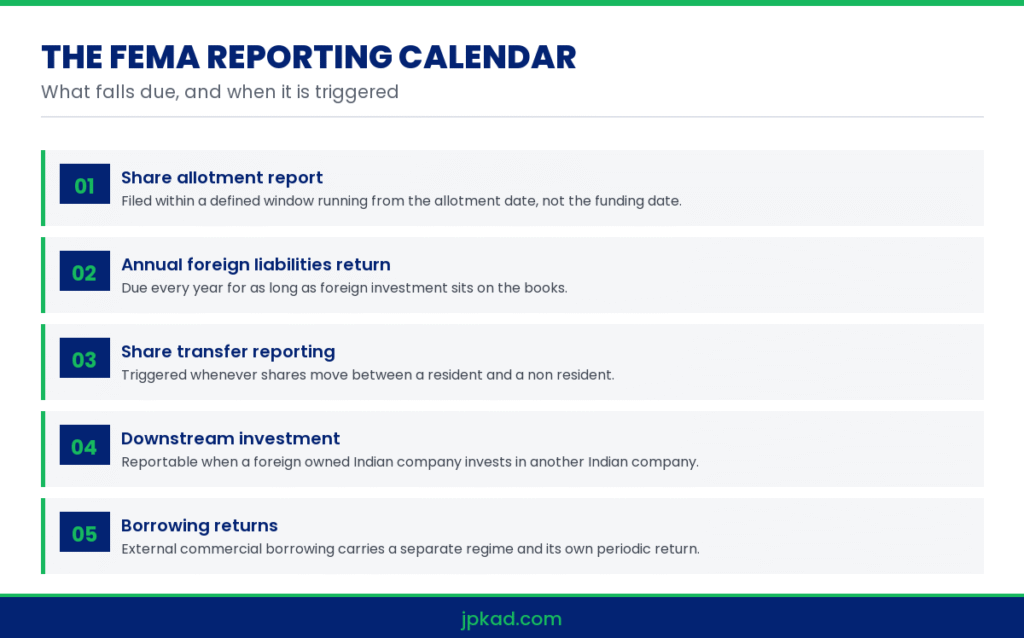
Two filings form the backbone. When the Indian company allots shares to a foreign investor, it must report that allotment to the Reserve Bank within a defined window running from the allotment date. Separately, every company with foreign investment on its books must file an annual return covering its foreign liabilities and assets, based on its audited or provisional figures for the financial year.
Around these sit event driven filings. A transfer of shares between a resident and a non resident is reportable. Downstream investment by a foreign owned Indian company into another Indian company is reportable. External commercial borrowing carries its own regime entirely. Each has its own form, its own window and its own supporting documents.
Build the calendar in month one and give it a named owner on both sides, in India and at the parent. Most failures are not technical. They are ownership failures, where the parent assumed the Indian team was handling it and the Indian team assumed the parent’s advisors were. A quarterly review closes that gap cheaply.
Certain transactions look domestic but are not. A rights issue to existing shareholders, a bonus issue, a conversion of preference shares, or an allotment under an employee stock plan to someone resident abroad all involve a non resident and therefore attract reporting. Companies filter their year end checklist for foreign transactions and routinely miss these, because internally they were treated as ordinary corporate housekeeping.
The register that solves this is simple. Record every event affecting the share capital or the shareholder base, note whether any party to it was non resident, and if so record which filing was made and when. Reviewed quarterly, this catches almost everything. Built only when a problem emerges, it takes weeks to reconstruct.
The Breaches That Occur Most Often
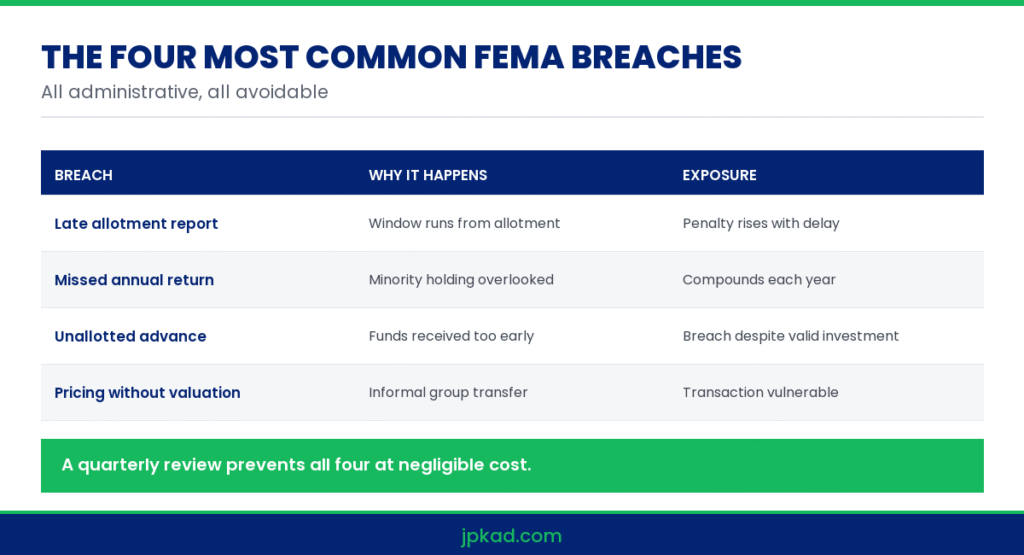
Late reporting of share allotment leads the list. The window is short, and it runs from allotment rather than from receipt of funds, which catches companies that allot promptly but file slowly. Second is the annual return, which is missed most often by companies whose foreign shareholder is a minority investor, because nobody thinks of the company as foreign owned.
Third is receiving money before the company is in a position to allot shares against it. Funds sitting as an unallotted advance beyond the permitted period become a breach even though the investment itself was always permitted. Fourth is pricing. Shares issued to or transferred from a non resident must respect valuation guidelines, and a transaction priced without a supporting valuation is vulnerable.
None of these are exotic. They are ordinary administrative failures with disproportionate consequences, which is exactly why they belong on a checklist rather than in someone’s memory. Related governance discipline is covered in our note on contractual documentation in corporate governance.
A fifth pattern is worth adding because it is growing. Companies increasingly receive funds from a group entity other than the registered shareholder, typically a treasury company managing group cash. The investment is genuine and permitted, but the remittance evidence does not tie to the shareholder on the register, and the filing stalls until the bank issues a confirmation linking them. Flag this before the remittance, not after.
What connects all of these is that none involves any intention to breach anything. They are sequencing and record keeping failures in companies that believed they were compliant. That is precisely why a checklist works here. The failure mode is not misjudgement, it is inattention, and a checklist addresses inattention directly.
Ordinary administrative failures with disproportionate consequences.
How to Regularise a Past Default
If you are already behind, the position is fixable. FEMA provides a compounding mechanism through which past contraventions are admitted, quantified and settled. The company applies, discloses the breach, and pays a compounding amount determined by reference to the sum involved and the period of delay.
Two things are worth understanding before you start. Compounding is voluntary disclosure, so it works best when initiated by the company rather than discovered by someone else. And the amount rises with delay, which means the cheapest moment to act is always now. A default discovered during buyer due diligence, weeks before a signing, is the most expensive version of this problem.
Practically, the sequence is to reconstruct the full history of foreign investment transactions, identify every missed filing, complete the outstanding filings where still possible, then apply for compounding on what remains. This is detailed work, and it benefits from the same discipline applied to financial reporting for due diligence.
Expect the exercise to take longer than the filing itself suggests. Reconstructing several years of transactions means retrieving bank advices, board minutes, valuation certificates and share registers that may sit with different people in different countries. Begin gathering documents before deciding on an approach, because the documents often reveal that the position is better or worse than assumed.
There is a strategic timing point too. If a transaction, fundraise or group restructuring is anticipated within the next year, regularise before it starts rather than during it. Buyers and investors will find these gaps in diligence, and a company that has already disclosed and settled them is in a far stronger negotiating position than one discovering them under time pressure. The current instructions sit within the RBI master directions, which are updated regularly.
Conclusion
FEMA compliance is not difficult. It is simply unforgiving of inattention. A foreign owned Indian company that maintains a reporting calendar, assigns clear ownership and reviews the position quarterly will rarely have a problem. One that treats it as an annual afterthought usually will. If you are unsure of your current standing, a short review is far cheaper than a compounding application. Speak to our cross border compliance team for a position check.
Frequently Asked Questions
Who is responsible for FEMA compliance, the parent or the Indian company?
The Indian company carries the statutory obligation and its directors carry the exposure. The foreign parent has no filing duty. Both sides should still hold the compliance calendar. Learn more about our virtual CFO services for foreign subsidiaries.
What is the deadline for reporting share allotment to a foreign investor?
The report must be filed within a defined window running from the date of allotment, not from the date funds were received. Because the window is short, prepare the supporting documents before allotting rather than after.
Does a company with only a small foreign shareholder need to file?
Yes. The annual return on foreign liabilities and assets applies wherever foreign investment sits on the books, regardless of the size of the holding. Minority foreign shareholding is a very common reason for missed filings.
What happens if we received funds but have not yet allotted shares?
Funds may be held as an advance only for a limited period. Beyond that, the position becomes a contravention even though the underlying investment was permitted. Plan the allotment timetable before requesting the remittance.
Can past FEMA defaults be fixed?
Yes, through compounding. The company discloses the contravention and pays an amount based on the sum involved and the delay. Voluntary disclosure is treated more favourably than a default discovered by someone else.
Do we need a valuation to issue shares to our foreign parent?
Pricing guidelines apply to issues and transfers involving non residents. A supporting valuation protects the transaction. Pricing without one leaves the company exposed if the position is later examined.
Is FEMA compliance connected to our tax filings?
They are separate regimes with separate deadlines and separate authorities. A clean tax record offers no protection against FEMA exposure, which is why companies with good tax compliance still accumulate FEMA defaults.
How often should we review our FEMA position?
Quarterly is sufficient for most companies. Review outstanding filings, upcoming deadlines and any transactions during the quarter that may have triggered an event based reporting obligation.
Does external commercial borrowing fall under the same rules?
Borrowing from overseas sits under a separate regime with its own eligibility conditions, reporting forms and monthly return. It should not be assumed to follow the same process as equity investment reporting. See our company law and compliance support for related support.