
Most India entry mistakes are made in a single meeting, early, when someone picks a structure because it sounds cheaper. The liaison office looks light. The branch looks simple. Both carry restrictions that only become obvious once you try to invoice a customer. This guide compares the three main vehicles on the factors that actually decide the question, and sets out when each is the wrong answer. Good Foreign Company Setup Consultants In India will ask about your business plan before recommending anything.
Key Takeaways
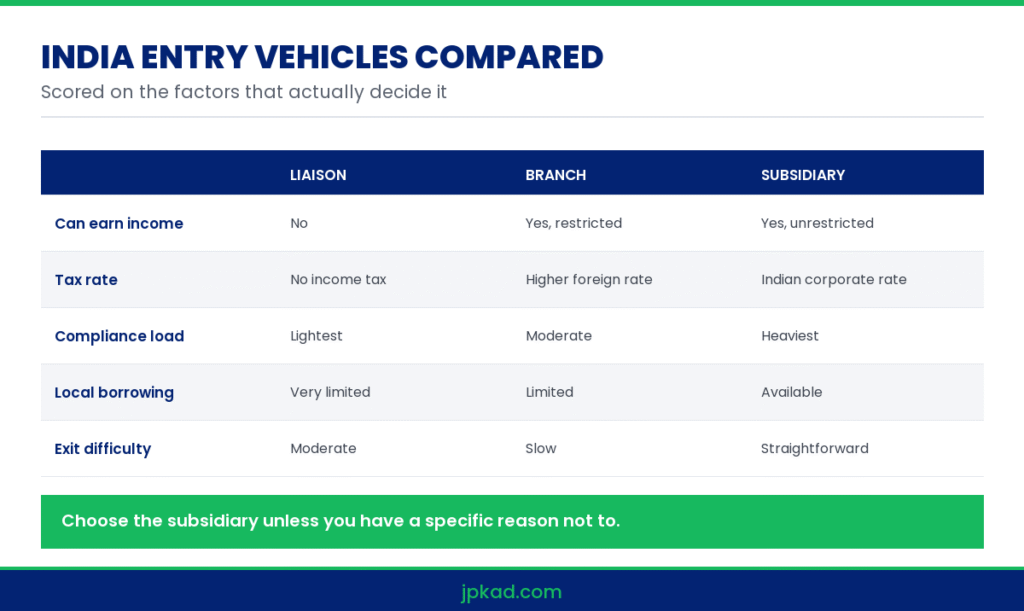
- A liaison office cannot earn income at all, which makes it unsuitable for any commercial market test.
- A branch office may trade but is taxed at a materially higher rate than an Indian subsidiary and is slower to close.
- The wholly owned subsidiary carries the heaviest compliance load and remains the right default for most trading operations.
The Liaison Office and Its One Hard Limit
A liaison office exists to represent the foreign parent in India. It may promote the parent’s business, gather market information, build relationships and act as a communication channel. It is funded entirely by inward remittance from the parent, because it has no other permitted source of money.
The hard limit is absolute. A liaison office may not earn income in India. It cannot invoice, cannot contract commercially in its own right and cannot generate revenue of any kind. Since it earns nothing, it pays no tax on income, which is often mistaken for a tax advantage rather than what it is, a consequence of being commercially inert.
This is where companies go wrong. A group wanting to test whether Indian customers will buy sets up a liaison office because it is cheap and light, then discovers it cannot complete a single sale. If your market test involves taking money from a customer, the liaison office is the wrong vehicle regardless of cost.
Approval and renewal add a further consideration. A liaison office operates under a permission granted for a defined period and renewed thereafter, rather than existing indefinitely by right. It must also file an annual activity certificate confirming it has stayed within its permitted scope. An office that has quietly drifted into commercial activity has a problem at renewal, not merely a theoretical one.
Staff and premises are permitted, so the vehicle is not merely a postal address. A liaison office can employ people in India, occupy premises and represent the parent properly. What it cannot do is convert any of that activity into revenue, which makes it well suited to relationship building and poorly suited to anything that ends in an invoice.
The Branch Office and the Rate That Decides It
A branch office is an extension of the foreign parent rather than a separate company. It may carry out a defined range of activities including exporting and importing goods, providing professional services, and conducting research for the parent. Unlike a liaison office, it may earn income and remit profits abroad after tax.
The decisive factor is tax. A branch is taxed as a foreign company at a materially higher rate than an Indian subsidiary pays on the same profit. For a business expected to be genuinely profitable, that differential compounds every year and usually overwhelms any saving on setup or compliance. The comparative rate position is summarised in the PwC India corporate tax summary.
Closure is the second consideration. Winding up a branch involves tax clearance and takes longer than selling or dissolving a subsidiary. Groups that expect to restructure within a few years should weigh that before choosing the branch on grounds of simplicity.
Permitted activity is narrower than many assume. A branch may undertake a defined list of activities on behalf of the parent, and general trading or retail activity is not among them for most foreign companies. Groups planning to buy and sell goods domestically in India frequently find the branch route unavailable for what they actually intend to do.
Branches also file their own audited accounts and carry an annual activity certificate requirement, so the compliance saving relative to a subsidiary is smaller than the structure’s reputation suggests. Once the higher tax rate, the narrower permitted scope and the slower closure are weighed together, the branch usually only wins in specific cases such as project work or regulated activities where it is the required form.
The Wholly Owned Subsidiary as the Working Default
A subsidiary is a separate Indian company owned by the foreign parent. It is an Indian tax resident, taxed at Indian corporate rates, and may conduct any activity permitted under the foreign investment policy for its sector. It can hire freely, contract in its own name, raise local finance and be sold as a discrete asset.
Its disadvantage is compliance weight. A subsidiary carries statutory audit, annual corporate filings, tax returns, foreign exchange reporting and transfer pricing documentation where it transacts with the parent. That is genuinely more work than a liaison office requires, and the ongoing cost should be budgeted from the start rather than discovered in month nine.
Even so, it remains the right default for most entrants. The lower tax rate, unrestricted activity and clean exit outweigh the administrative load for any operation intended to trade. Our case study on a US technology market entry in Bengaluru shows how the structure works in practice.
The subsidiary also behaves better commercially. Indian customers, particularly larger ones and public sector buyers, are often more comfortable contracting with an Indian company than with a branch of a foreign entity. Vendors extend credit more readily and employees generally find the employment relationship clearer. These are soft factors, but they affect how quickly an operation reaches scale.
Local finance is the other practical advantage. A subsidiary can borrow from Indian banks against Indian assets and cash flows, subject to ordinary lending criteria. Branch and liaison offices are considerably more constrained, which matters for any business whose working capital cycle requires local funding rather than repeated remittances from the parent.
Matching the Vehicle to Your Actual Plan
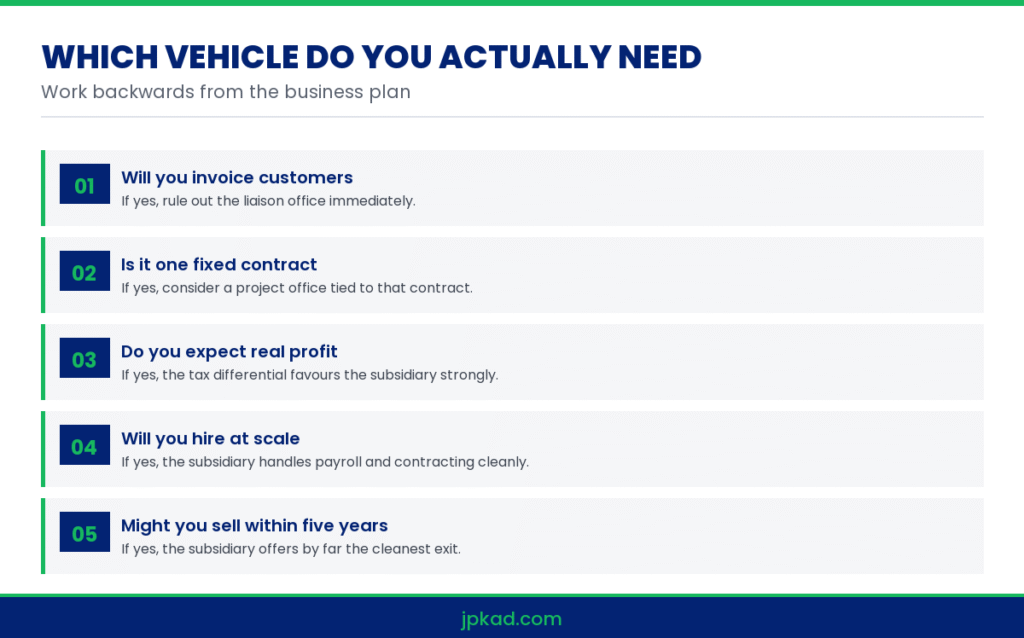
Work backwards from what you intend to do. If you will invoice Indian customers, you need a subsidiary or a branch, and the tax differential will usually decide between them. If you will only represent the parent, gather intelligence and build relationships, a liaison office is sufficient and appropriately light.
If the work is a single defined contract with a fixed end, a project office may fit better than either. It is tied to that contract and concludes with it, which avoids the overhead of maintaining a permanent presence for work that is inherently temporary.
Then test the decision against your exit. A structure that suits year one but obstructs a sale in year four is a poor choice, and converting between vehicles later is neither quick nor cheap. Deciding once, with the exit in view, is what separates a considered entry from an expensive one.
Test the decision against a downside as well as a plan. If the India venture does not succeed, how quickly and cheaply can it be closed. A subsidiary can be sold, struck off or wound up through recognised routes. A branch closure requires tax clearance and takes materially longer, which means an unsuccessful branch continues generating compliance cost well after the commercial decision to exit has been taken.
Consider the time horizon honestly too. Groups frequently choose a lighter vehicle intending to convert within a year or two, and then do not, because conversion means establishing a new entity and closing the old one. If the realistic plan is a trading operation within eighteen months, incorporate the subsidiary now rather than paying twice.
Conclusion
The right India entry vehicle follows the business plan, never the reverse. Decide what you will actually do, how profitable it is likely to be, and how you expect to leave. Those three answers usually make the choice obvious. If they point to a subsidiary, accept the compliance load and budget for it properly. Talk to our India entry team before you incorporate, because restructuring afterwards costs far more than getting it right first.
Frequently Asked Questions
Can a liaison office sell anything in India?
No. A liaison office may not earn income of any kind. It cannot invoice or contract commercially. Groups wanting to test whether customers will buy need a subsidiary or branch instead. Learn more about our corporate finance advisory.
Why is a branch office taxed more than a subsidiary?
A branch is treated as a foreign company for tax purposes, and foreign companies face a higher rate than Indian resident companies. For a profitable operation that differential usually outweighs any setup saving.
Which vehicle is cheapest to run?
A liaison office carries the lightest compliance, followed by the branch, with the subsidiary heaviest. Cost alone is a poor basis for the decision, because the cheapest vehicle is also the most restricted.
Can we convert a liaison office into a subsidiary later?
There is no simple conversion. In practice it means establishing the new entity and closing the old one, which takes time and cost. This is why the initial decision deserves proper attention.
What is a project office used for?
A project office supports a specific contract in India and concludes when that contract ends. It suits defined, time limited work better than maintaining a permanent presence.
Do all three vehicles require RBI reporting?
Each carries foreign exchange obligations, though the specific filings differ. None is exempt, and assuming the lighter vehicles are unregulated is a frequent and costly error.
How long does each take to establish?
A subsidiary typically takes four to eight weeks. Branch and liaison offices involve an approval process that can take longer. Document authentication abroad is usually the binding constraint in all three cases.
Can a subsidiary raise money from Indian banks?
Yes. As an Indian company it can access local finance, subject to the lender’s requirements. Branch and liaison offices are considerably more limited in this respect.
Which structure do most foreign investors choose?
The wholly owned subsidiary, for any operation intended to trade. Its lower tax rate, unrestricted activity and clean exit outweigh the heavier compliance for the large majority of entrants. See our risk advisory for growing operations for related support.