
Two forms carry most of the reporting burden for a foreign owned Indian company. One reports the shares you issued. The other reports what the foreign investor holds, every year, for as long as they hold it. Both are straightforward when prepared properly and painful when rushed. This guide covers what each requires, when it is due, and the rejection reasons that most often send a filing back. Anyone offering foreign company registration services in India should walk you through this before incorporation.
Key Takeaways
- The share allotment return is event driven and its window runs from the allotment date, while the annual foreign liabilities return is calendar driven.
- Most rejections are documentary, not substantive, and the valuation certificate and remittance advice cause the majority of them.
- A rejected filing does not stop the clock, so preparation quality directly affects your penalty exposure.
What Each Return Actually Does
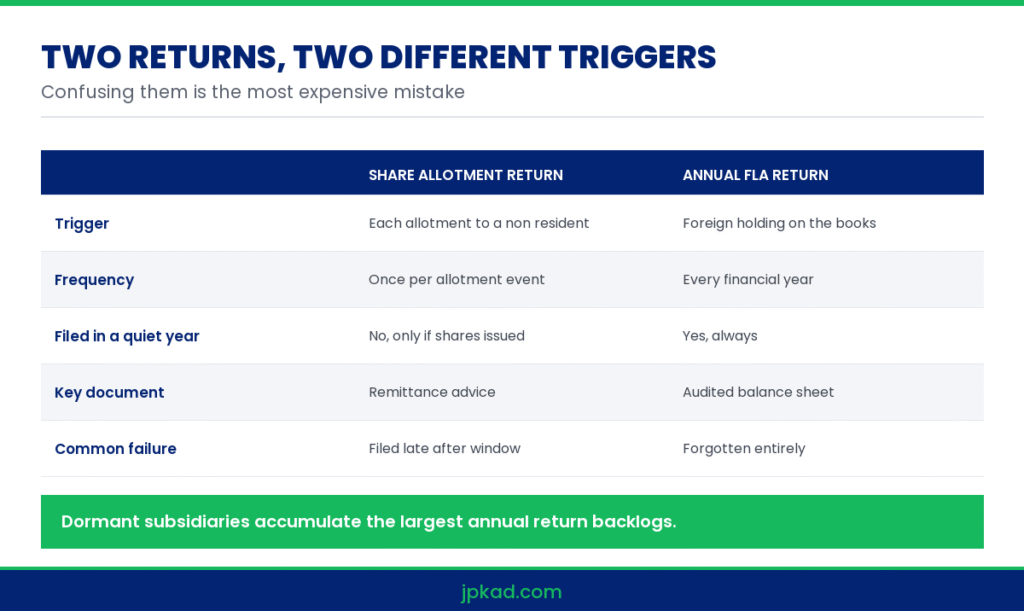
The share allotment return reports a specific event. When an Indian company issues shares to a person resident outside India, it tells the Reserve Bank who invested, how much, at what price and against which remittance. It is filed once per allotment. Ten allotments in a year mean ten filings.
The annual foreign liabilities and assets return does something different. It reports a position rather than an event. Every company carrying foreign investment on its balance sheet files it each year, showing the foreign holding, the value, and any overseas assets the Indian company itself holds. It is filed even in a year with no new investment activity at all.
Confusing the two is common and costly. Companies that filed the allotment return at incorporation frequently assume the annual return is only required when something changes. It is not. It is required every year the foreign holding exists, which is why long dormant subsidiaries accumulate the largest backlogs.
A third distinction matters for companies with several foreign shareholders. The allotment return is filed per allotment event, covering all investors in that event, rather than per investor. The annual return, by contrast, aggregates the whole foreign position at year end. Companies with rolling investment from multiple parties sometimes file one where the other was needed, which produces a technically incomplete record.
Both returns are filed through the Reserve Bank’s online reporting system rather than on paper, and access to that system requires the company to be registered as an entity user with authorised signatories in place. Obtaining that access takes time and is frequently left until a deadline is imminent. Set it up at incorporation, when there is no time pressure, and confirm the authorised user is someone who will still be with the company next year.
FC GPR share allotment reporting with the annual FLA return in India
Documents to Assemble Before You Start
The allotment return needs the inward remittance advice from the receiving bank, confirming the money arrived from abroad and identifying the remitter. It needs a certificate confirming the shares were issued at a price consistent with applicable pricing guidelines, supported by a valuation where required. It needs the board and shareholder authority for the allotment, and the return of allotment filed under company law.
The annual return needs the audited balance sheet and profit figures for the year, or provisional figures where the audit is incomplete, together with the shareholding pattern and details of any overseas investments. If provisional figures are used, the return is revised once the audit concludes.
Assemble these before you begin the filing rather than during it. The single most common cause of delay is discovering mid filing that the remittance advice names a different remitter than the shareholder on the register, which then requires a bank confirmation that takes days to obtain.
For the allotment return specifically, reconcile three numbers before you begin: the amount remitted per the bank advice, the amount credited to the company’s account after charges, and the amount recorded as share capital and premium. These frequently differ by small sums because of bank charges or exchange conversion, and the filing needs a coherent explanation of the difference rather than a discrepancy left unaddressed.
For the annual return, the most common practical problem is that the audit is incomplete when the return falls due. Filing on provisional figures and revising later is expressly contemplated and is far better than filing late. Companies that wait for audited numbers past the deadline convert a routine filing into a contravention for no benefit whatsoever.
Why Filings Get Rejected
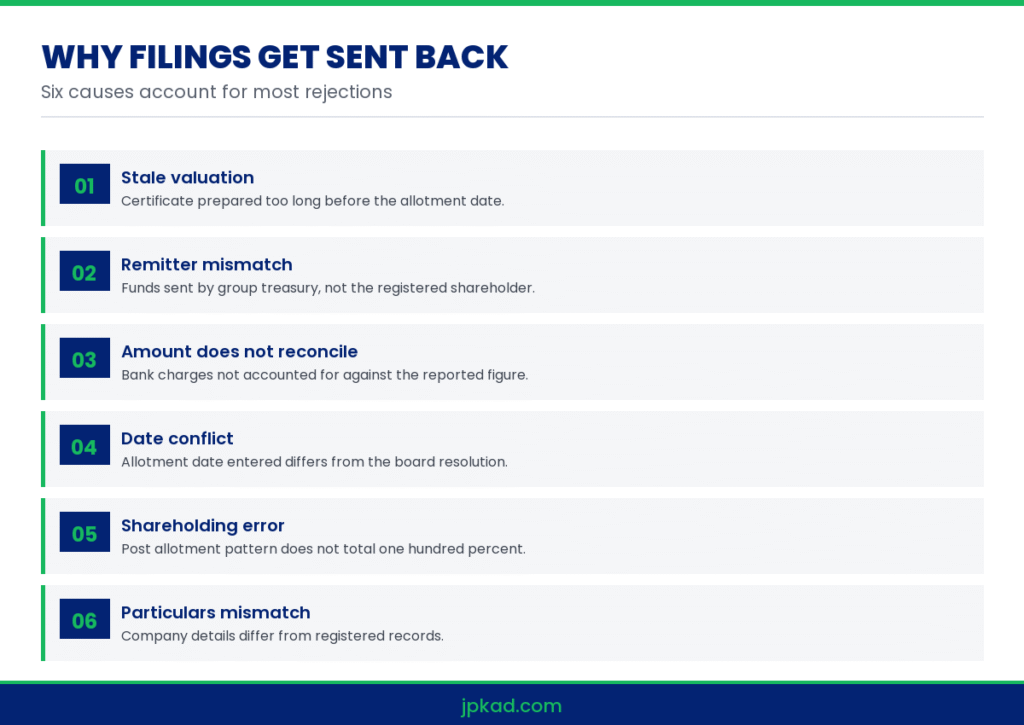
Rejections cluster around a handful of causes. The valuation certificate is stale, having been prepared too long before the allotment. The remittance advice does not tie to the shareholder, typically because the parent remitted through a group treasury entity. The amount reported does not reconcile to the amount received once bank charges are accounted for.
Others are simpler still. The allotment date entered does not match the board resolution. The shareholding pattern after allotment does not add to one hundred percent. The company’s own details do not match its registered particulars. Each of these is trivial to prevent and tedious to fix after the fact.
A rejected filing does not pause the deadline. If the return is rejected and resubmitted after the window closes, the filing is late, and lateness is what drives penalty exposure. Preparation quality therefore has a direct financial consequence, which is not obvious until the first rejection arrives.
Certification is a further point of failure. These filings carry professional certification, and the certifying professional needs to have seen the underlying documents rather than working from a summary. Where certification is sought at short notice, the professional may reasonably decline or ask for time, which is another reason to assemble documents early rather than at the deadline.
Keep a record of every submission, including acknowledgements and any queries raised. When a later filing or a due diligence exercise requires the history, a maintained file answers in minutes what an unmaintained one takes days to reconstruct. The relevant forms and instructions are published among the RBI FEMA notifications and change periodically, so confirm you are using the current version before preparing anything.
The most common rejection reasons for foreign investment filings in India
Fixing a Late or Missed Filing
Where the window has already closed, the filing should still be completed. An unfiled return is a continuing contravention, while a late filed return at least fixes the position going forward and demonstrates good faith. The residual exposure is then addressed through compounding.
For multi year backlogs, reconstruct the history before filing anything. Identify every allotment, transfer and year end position across the period, then file in chronological order. Filing recent years first, while earlier years remain outstanding, produces inconsistent data that invites queries.
This work sits naturally alongside a broader compliance review. Companies discovering one gap usually have others, and a single coordinated exercise is cheaper than several sequential ones. Our note on optimising compliance systems in a chartered accountant firm covers how to structure that review.
Where a backlog spans several years, quantify the exposure before filing so the company understands what it is walking into. Compounding amounts are driven by the sums involved and the length of delay, so a small investment reported five years late may cost far less than a large one reported one year late. Knowing the likely order of magnitude helps the board decide how quickly to act and what to disclose.
It also helps to fix the process at the same time as the history. Companies that regularise a backlog without assigning ongoing ownership tend to rebuild the same backlog within two or three years. Pair the remediation with a named owner, a calendar and a quarterly review, otherwise the exercise buys time rather than solving the problem.
Conclusion
Neither of these returns is intellectually difficult. Both punish poor preparation. Assemble the documents first, reconcile the numbers before you file, and treat the annual return as a permanent fixture rather than an occasional task. If you are carrying a backlog, address it in chronological order and take advice before you file. Our team provides foreign company registration services in india including full reporting support. Get in touch for a filing review.
Frequently Asked Questions
When is the share allotment return due?
Within a defined window that runs from the date of allotment rather than the date funds were received. Because the period is short, assemble the valuation certificate and remittance advice before allotting the shares. Learn more about our bookkeeping and annual filing compliance.
Do we file the annual return in a year with no new investment?
Yes. The annual foreign liabilities and assets return reports a position, not an event. It is due every year that foreign investment appears on the balance sheet, including years with no activity whatsoever.
Can we file the annual return using provisional figures?
Yes, where the audit is not complete by the due date. The return is then revised once audited figures are available. Filing provisionally is preferable to filing late while waiting for the audit.
What is the most common reason a filing is rejected?
Documentary mismatches. A stale valuation certificate, or a remittance advice naming a group treasury entity rather than the shareholder, account for a large share of rejections and both are avoidable.
Does a rejection extend the deadline?
No. The deadline continues to run. A return rejected and resubmitted after the window has closed is treated as late, which is why preparation quality directly affects penalty exposure.
Our parent remitted through a group treasury company. Is that a problem?
It requires additional evidence linking the remitter to the shareholder, usually a bank confirmation. It is workable but adds time, so flag it to your advisor before the remittance rather than after.
We have several years of missed annual returns. Where do we start?
Reconstruct the full history first, then file in chronological order. Filing recent years while earlier years remain open creates inconsistent data and invites queries that slow the whole exercise.
Is a valuation always required?
Pricing guidelines apply to issues involving non residents, and a valuation supports the price. Requirements vary with the nature of the issue, so confirm the position for your specific transaction before pricing it.
Who signs these filings?
They are filed by the Indian company with certification from the appropriate professional. Ensure whoever certifies has seen the underlying documents, since certification carries responsibility. See our accounting and financial reporting services for related support.