
Getting money out of India is legal, routine and frequently more expensive than it needs to be. Most groups do not choose a bad route. They fail to choose at all, default to dividends, and pay for that default every year. This guide compares the five routes by which value leaves an Indian subsidiary, what each costs once tax is accounted for, and what each requires by way of substance. Sound cfo services for foreign companies in india model this before a pattern sets in.
Key Takeaways
- Five routes exist: dividends, royalties, service fees, interest and capital on exit, and each carries a different post tax cost.
- The binding constraint on dividends is usually the audit timetable rather than the tax rate.
- Expense based routes reduce the Indian tax base but require genuine substance and contemporaneous documentation to survive challenge.
Dividends and the Constraint Nobody Plans For
Dividends are the most familiar route and the most commonly defaulted to. They are paid out of profits that have already borne Indian corporate tax, and they attract withholding tax on payment abroad, which a tax treaty will often reduce. The mechanics are well understood and rarely contentious.
The practical constraint is not tax. It is timing. A dividend must be paid from distributable profits, and those profits are established by completed accounts. A parent expecting cash early in the financial year discovers that the audit timetable governs when the money can move, not the board’s willingness to declare.
This catches groups whose own reporting calendar assumes cash arrives on a schedule the Indian audit cannot support. Planning the audit timetable backwards from the parent’s cash requirement is a simple fix that few groups make until they have been caught once. It sits squarely within ordinary treasury and working capital management.
Dividends also require the underlying corporate steps to be in order. A declaration needs board and, depending on the type of dividend, shareholder approval, and it must be paid within the statutory period once declared. Companies that declare a dividend and then delay payment while arranging the remittance create an avoidable compliance issue on top of the cash flow one.
There is a further practical point about accumulated losses. A subsidiary that has traded at a loss in early years cannot distribute until those losses are absorbed, regardless of how profitable the current year is. Parents planning repatriation from a young subsidiary should check the distributable position rather than the current year profit, because the two are frequently very different.
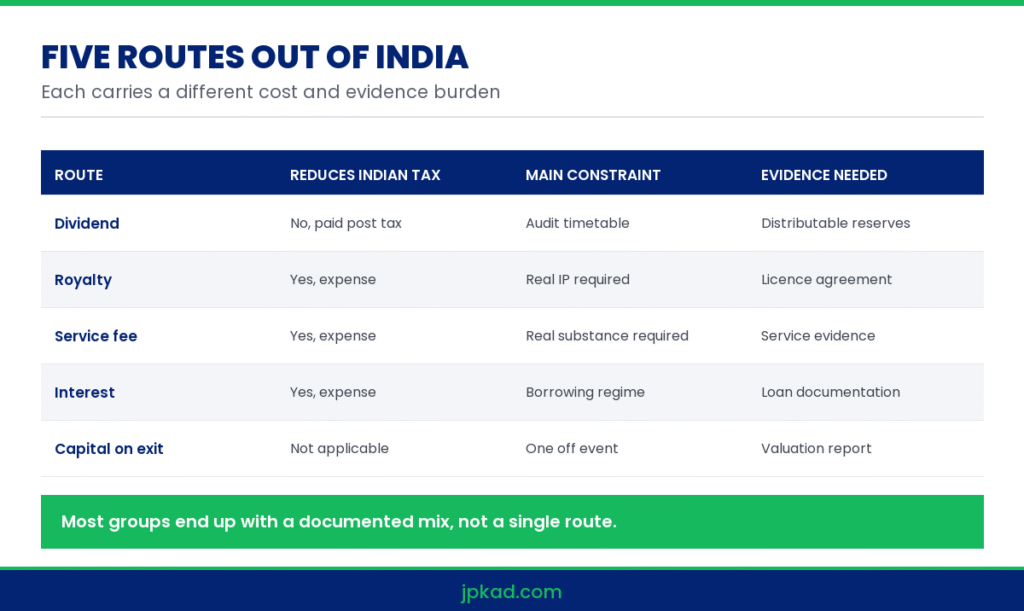
five profit repatriation routes from an Indian subsidiary to a foreign parent
Royalties and Service Fees as Operating Expenses
Royalties and technical service fees work differently. They are operating expenses of the Indian company, which means they reduce Indian taxable profit before corporate tax applies. They attract withholding tax on payment, again often reduced by treaty. For groups where the parent genuinely owns intellectual property or genuinely performs services, these routes can be materially cheaper than dividends after tax.
The word carrying the weight is genuinely. A royalty must reflect real use of real intellectual property under a written licence. A service fee must reflect services actually performed, by identifiable people, with evidence. Charges lacking substance are the first thing an examiner looks for, and they are removed with interest and penalty when found.
Both must also be priced at arm’s length and documented contemporaneously. Groups that set the charge at year end, to arrive at a target profit, create exactly the pattern that invites challenge. Set the arrangement at the start of the year, document the basis, and apply it consistently.
These routes also carry indirect tax consequences that are easily overlooked. Services received from an overseas parent may attract goods and services tax on a reverse charge basis in the hands of the Indian company, which affects cash flow even where credit is ultimately available. Modelling only income tax and withholding gives an incomplete picture of the real cost.
Cap the expectations too. Expense based routes reduce Indian taxable profit, but they increase taxable income at the parent, and the net group position depends on rates at both ends. A route that looks efficient viewed from India alone can be neutral or worse once the parent’s own tax position is included. Model the group outcome, not just the Indian one.
Interest and Capital Returns
Interest on properly constituted borrowing is deductible in India and attracts its own withholding rate. Funding an Indian subsidiary partly with debt rather than entirely with equity can therefore reduce the overall cost. Overseas borrowing sits within a distinct regulatory regime with eligibility conditions and its own reporting, so it needs to be structured deliberately rather than assumed.
Capital returns arise on exit, through a share sale, a buyback or a capital reduction. These are usually one off events rather than a recurring repatriation mechanism, but they matter enormously at the point they occur. Pricing guidelines apply to any transfer involving a non resident, and a supporting valuation protects the transaction.
Because exit events are large and infrequent, they reward planning well in advance. The considerations overlap closely with those in our note on share purchase versus asset purchase in India.
Thin capitalisation limits deserve attention wherever intercompany debt is used at scale. Deductions for interest paid to a related overseas lender can be restricted once borrowing is large relative to earnings, with disallowed amounts carried forward rather than lost. A funding structure built purely for deductibility can therefore deliver considerably less than modelled.
Buybacks and capital reductions each carry distinct treatment and procedural requirements, and the relative attractiveness between them has shifted over time as rules changed. Because these are infrequent, high value events, take current advice at the point of planning rather than relying on how a comparable transaction was structured several years ago.
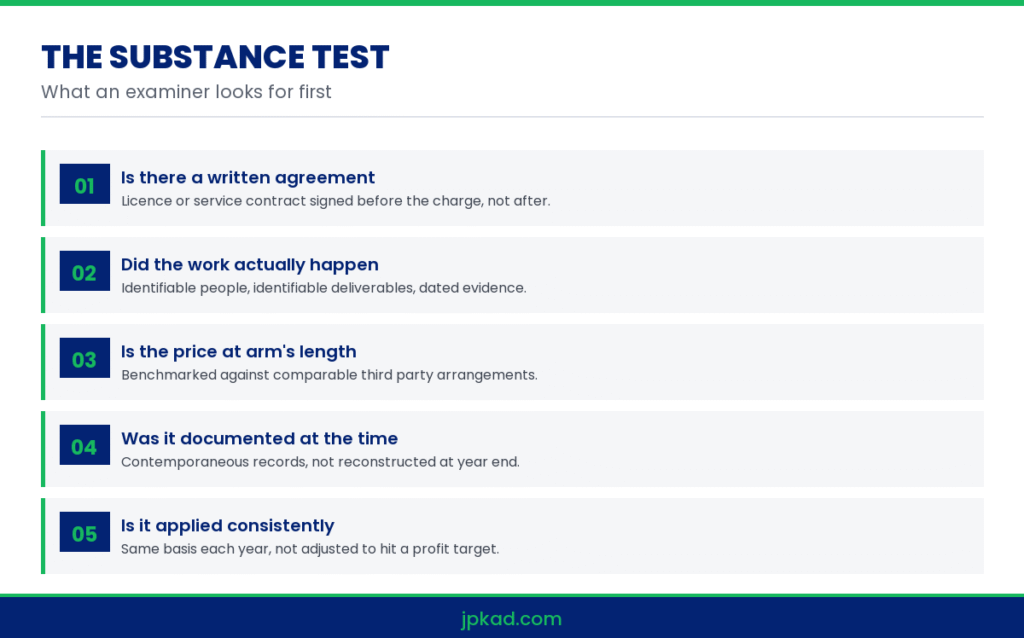
The substance requirements for expense based repatriation routes from India
Choosing a Mix Rather Than a Default
In practice most groups use a combination. A modest, well documented service fee for functions the parent genuinely performs, a royalty where real intellectual property is licensed, and dividends for the balance. The mix reflects the commercial reality of the relationship rather than a tax preference imposed on top of it.
Model the post tax cost of each route before settling in. The right answer depends on your treaty position, your Indian profitability and how much genuine substance sits at the parent. A group with real shared services will reach a different conclusion from one whose parent is essentially a holding company, and both answers can be correct.
Review it periodically. Treaty positions change, Indian rates change and the business itself changes. A mix chosen sensibly at incorporation may be poorly suited five years later, and reviewing it is far cheaper than continuing to overpay. The general position is summarised in the PwC India withholding tax summary.
Document the rationale for the mix, not just the mix itself. A short internal note recording why the group charges what it charges, prepared when the arrangement is set, is disproportionately useful years later when the people involved have moved on and someone asks why the structure looks as it does. This costs an hour and repeatedly proves its value.
Finally, keep the commercial and the tax reasoning aligned. Arrangements that make no commercial sense without their tax effect are the most vulnerable, and they are also the hardest to explain to a buyer during diligence. A repatriation pattern that reflects how the group genuinely operates will survive scrutiny from both tax authorities and acquirers.
Conclusion
Repatriation deserves the same attention as any other recurring cost. Choose the mix deliberately, support expense based routes with genuine substance and contemporaneous documentation, and plan the audit timetable around when the parent actually needs cash. Groups that do this pay materially less than those that default to dividends and hope. Speak to our cross border advisory team to model your position before the pattern hardens.
Frequently Asked Questions
What is the cheapest way to take profits out of India?
It depends on your treaty position, Indian profitability and the substance at the parent. Expense based routes often cost less after tax than dividends, but only where genuine services or intellectual property exist. Learn more about our valuation in business and what investors look for.
Why can we not pay a dividend immediately?
Dividends must come from distributable profits established by completed accounts. The audit timetable therefore governs timing. Plan the audit backwards from when the parent actually needs the cash.
Are service fees to the parent allowed?
Yes, where the services are genuinely performed and evidenced. They must be priced at arm’s length and documented contemporaneously. Charges set at year end to reach a target profit invite challenge.
Does a tax treaty reduce withholding on dividends?
Often, yes. Treaty rates can be lower than domestic rates, subject to conditions including residence documentation. Confirm the position for your specific jurisdiction before relying on a reduced rate.
Can we fund the Indian subsidiary with debt instead of equity?
Partly. Interest is deductible in India, which can reduce overall cost, but overseas borrowing sits under a separate regime with eligibility conditions and its own reporting requirements.
What documentation supports a royalty payment?
A written licence agreement covering genuine intellectual property, evidence of actual use, arm’s length pricing and contemporaneous transfer pricing documentation. A royalty without a licence is difficult to defend.
How are capital returns on exit treated?
Share sales, buybacks and capital reductions each have their own treatment. Pricing guidelines apply to transfers involving non residents, and a supporting valuation protects the transaction.
Should the repatriation mix be reviewed?
Yes, periodically. Treaty positions, tax rates and the business itself all change. A mix chosen at incorporation may be poorly suited several years later, and reviewing costs far less than overpaying.
Can we change our repatriation pattern later?
You can, but established patterns attract scrutiny when they change abruptly. Choosing deliberately at the outset is easier than justifying a shift after several consistent years. See our taxation services for related support.