
A deal is priced on what the combined business will do. Whether it does it is settled in the months after completion, and finance carries much of that load. The first hundred days decide whether the acquirer has visibility, whether the earn out can be measured, and whether the cash behaves as modelled. This guide sets out what support through an M&A deal should deliver in that window.
Key Takeaways
- Control comes before improvement. Bank access, payment authority and cash visibility on day one matter more than any system decision.
- One set of numbers, on one calendar, with one owner, is the single most valuable output of the first hundred days.
- Where an earn out exists, the measurement basis must be protected while everything around it is being reorganised.
Day One: Control Before Improvement
The first task is not integration. It is control. On completion day the acquirer needs to know who can move money, what is committed, and what is about to fall due. Everything else can wait a fortnight.
That means bank mandates updated or at minimum countersigned, payment authority limits reset to the acquirer’s policy, and a list of every recurring payment with its amount and date. Businesses discover surprising standing commitments in the first weeks, and the earlier they surface the cheaper they are.
Cash visibility is the second day one requirement. A daily or weekly cash position covering every account in the acquired group, however crude, is worth more than an elegant monthly report that arrives three weeks late. Our note on keeping working capital under control covers the discipline.
Third, secure the records. Accounting system access, historic files, statutory registers and the tax portal credentials should transfer in an orderly way rather than remaining with a departing owner. This sounds administrative and it is the source of genuine difficulty when it is skipped.
Fourth, identify the people who actually know how things work. In owner managed businesses the knowledge usually sits with two or three long serving staff rather than in documentation. Retaining them through the transition is worth more than any process the acquirer imports.
Only once those four are in place does it make sense to talk about systems, policies or synergies. Acquirers who reverse the order spend the first quarter arguing about a chart of accounts while nobody is watching the bank balance.

Aligning Policy Before Aligning Systems
Acquirers reach for the system question first because it feels concrete. It is the wrong order. Two businesses running the same software on different accounting policies still produce incomparable numbers, while two businesses on different software with the same policies can be consolidated by hand.
Start with revenue recognition. When does the acquired business recognise a sale, and does that match the acquirer’s policy. Differences here change reported growth immediately and are the most common cause of a post completion surprise in the first consolidated accounts.
Then work through provisioning. Bad debt policy, stock obsolescence, warranty provisions and the capitalisation threshold for fixed assets. Owner managed businesses commonly provide less than a group policy requires, and the catch up adjustment is better identified in week four than in the year end audit.
Map the chart of accounts rather than replacing it. A mapping table that translates the acquired ledger into the group structure lets consolidated reporting start immediately, while a full migration takes months. Do the mapping now and the migration when there is capacity.
Agree a reporting calendar and hold to it. A fixed close date, a fixed pack and a fixed review meeting create the rhythm that everything else hangs from. Our note on reporting that makes a business legible covers what that pack should contain.
Where the acquired entity is crossing a reporting threshold as a result of the transaction, the accounting framework itself may change. That is a project rather than an adjustment, and it should be identified in the first month rather than discovered at the year end.
Where a foreign parent is involved, the group reporting package adds a further layer of policy difference on top of the local statutory position. The accounting standards material published by the ICAI is the reference point for the Indian side of that reconciliation, and the differences should be scheduled rather than resolved informally each quarter.
Protecting the Earn Out While Integrating
Where part of the consideration depends on the acquired business’s performance, integration and measurement pull in opposite directions. Integration wants shared costs, combined teams and merged systems. Measurement needs the acquired business to remain separately identifiable.
Resolve this by agreeing, in writing and early, exactly how the earn out result will be computed while integration proceeds. Which costs may be allocated, at what rate, and which may not. Which revenue counts as the acquired business’s when a combined team wins it.
Keep a separate reporting line for the earn out calculation even where the operational reporting is consolidated. A parallel schedule maintained monthly is far easier to defend than a reconstruction attempted at the end of the period.
Involve the seller in the monthly result rather than presenting a total at the end. Where the seller has remained in the business, this is straightforward. Where they have not, a monthly statement with the underlying calculation attached prevents the accumulation of misunderstanding that drives disputes.
Watch for decisions that are commercially right and earn out negative. Discontinuing a low margin product line, repricing a customer or moving production may all be correct and may all reduce the measured result. Where that happens, raise it immediately rather than letting the seller discover it later.
If a dispute does arise, the file is the defence. Monthly calculations, the allocation policy agreed at the outset and a record of decisions that affected the metric will resolve most arguments without reaching the expert determination clause.
Building the Finance Function the Business Now Needs
Most Indian small and mid market acquisitions reveal the same gap. The target had bookkeeping and compliance, not finance. Nobody was producing forward looking analysis, and nobody owned cash. The acquirer inherits that gap along with the business.
Decide quickly whether to fill it internally or externally. A full time finance lead is the right answer at scale. Below that, outsourced finance leadership gives the business the analysis and discipline it needs without the fixed cost, and can be scaled back as internal capability grows.
Define the reporting pack the acquirer actually needs rather than the one the target used to produce. Cash, order book, margin by line, working capital movement and a short commentary. Five pages that get read beat twenty that do not.
Rebuild the forecast within the first quarter. The model that supported the purchase price was built on outside information. Once inside, the acquirer can see the real cost base and the real pipeline, and the forecast should be reset accordingly rather than defended.
Set up the controls the target lacked. Segregation of payment initiation and approval, a purchase authority matrix, and monthly bank and control account reconciliations. These are inexpensive and they prevent the losses that surface in owner managed businesses after the owner leaves.
Then measure the outcome against the deal model at twelve months. Very few acquirers do this honestly, which is why the same estimation errors repeat. An hour spent comparing actual performance to the assumptions that justified the price improves every subsequent transaction.
Do not neglect the compliance calendar in the meantime. Acquired entities frequently arrive with filings in arrears, registrations that were never updated, and returns prepared by an adviser who has now been disengaged. Mapping every recurring obligation with its date and owner in the first month prevents a penalty arriving in the second quarter, when nobody is looking for it.
Conclusion
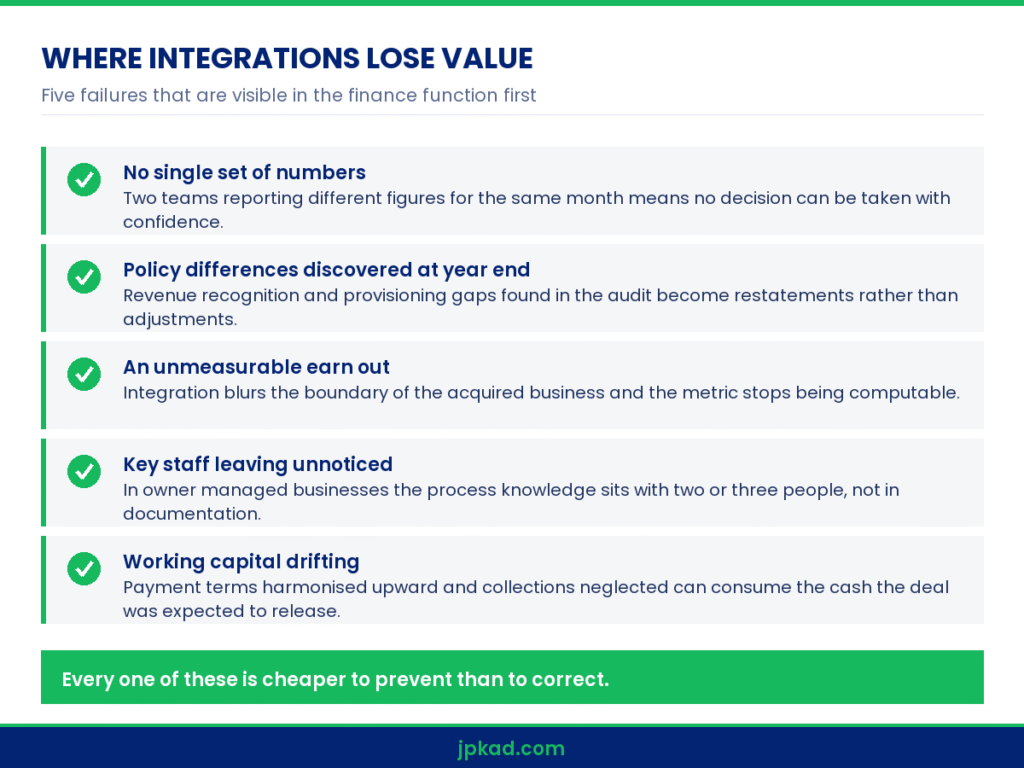
Post merger integration is where the price is either justified or lost, and the finance function is where it becomes visible first. Take control before improving anything, align policy before systems, protect the earn out measurement while everything else changes, and build the finance capability the target never had. JPKAD supports acquirers through integration as well as through the transaction. Talk to our team about the first hundred days.
Frequently Asked Questions
What should finance do on day one after completion?
Take control. Bank mandates, payment authority limits, a list of recurring commitments and access to systems and records. Improvement work can wait a fortnight without harm.
Should we migrate the acquired company onto our system immediately?
Usually not. Map the chart of accounts first so consolidated reporting can start within weeks, and schedule the migration when there is capacity to do it properly.
Which accounting policy differences matter most?
Revenue recognition first, because it changes reported growth immediately. Then provisioning for bad debts, stock and warranties, where owner managed businesses commonly provide less than a group policy requires.
How do we protect an earn out during integration?
Agree the allocation and measurement rules in writing before integrating, keep a parallel monthly calculation, and tell the seller promptly when a commercial decision reduces the measured result.
How long should the first hundred days plan be?
Short enough that people read it. A page of objectives by fortnight with named owners works better than a detailed programme nobody maintains after week three.
What if the target has no finance leadership at all?
That is the common case. Fill it quickly, internally at scale or through outsourced leadership below that, because nothing else in the plan works without someone owning the numbers.
When should we rebuild the forecast?
Within the first quarter. The deal model was built on outside information, and once inside the business the real cost base and pipeline are visible and should replace the assumptions.
How do we keep the people who know how things work?
Identify them in week one and talk to them directly. In owner managed businesses the operating knowledge usually sits with two or three long serving staff rather than in any document.
Should we review the deal against the model afterwards?
Yes, at twelve months. It is the cheapest way to improve the next transaction. See our note on investor grade board reports and our management advisory service.