A founder closes a round at one number and then discovers the tax authorities work from a different one. Both figures
can be correct. They answer different questions under different rules. Understanding why they diverge, and how far
they may diverge safely, is the difference between a clean round and an assessment several years later. Our note on
what investors look for in a valuation
covers the commercial side.
Key Takeaways
-
A fundraising valuation prices a forward plan and a preference instrument. A tax valuation applies a prescribed
method to ordinary shares on a defined date. -
Where shares are issued above the prescribed value, the excess can be taxed in the company’s hands, which is the
mechanism behind angel tax disputes. - The defence is documentation prepared at the time, not an explanation constructed during an assessment.
Two Questions, Two Answers
An investor asks what the business could be worth if the plan works. They are pricing optionality, and they accept
that most of the value lies in outcomes that have not happened yet. That is a rational basis for a venture investment
and a poor basis for a tax computation.
A tax valuation asks a narrower question. What is the fair market value of these shares, on this date, determined by a
prescribed method. It looks at what exists rather than at what is planned, which is why it typically produces a lower
figure for an early stage company.
The instrument being priced is also different. Investors usually subscribe to preference shares carrying liquidation
preference, anti dilution protection and information rights. Those rights have value. An ordinary share without them
is worth less, sometimes considerably less, and comparing the two prices directly is comparing different things.
Timing compounds the divergence. A round price is negotiated over weeks and reflects the market at the moment of
signing. A prescribed valuation speaks as at a specific date and cannot borrow information that emerged afterwards.
None of this means the two numbers are unrelated. A very large gap invites scrutiny, and a company that cannot explain
the gap in writing is in a weak position. The objective is not to make them equal. It is to be able to account for the
difference. A gap of a reasonable size, explained by instrument rights and by a forward plan supported by evidence, is
unremarkable. A gap of several multiples with nothing on file is where assessments begin.
The same logic applies to employee share schemes, where a third number appears. Our note on
what investors look for in a business valuation
and the broader Indian tax summary maintained by PwC both help orient
the surrounding rules.
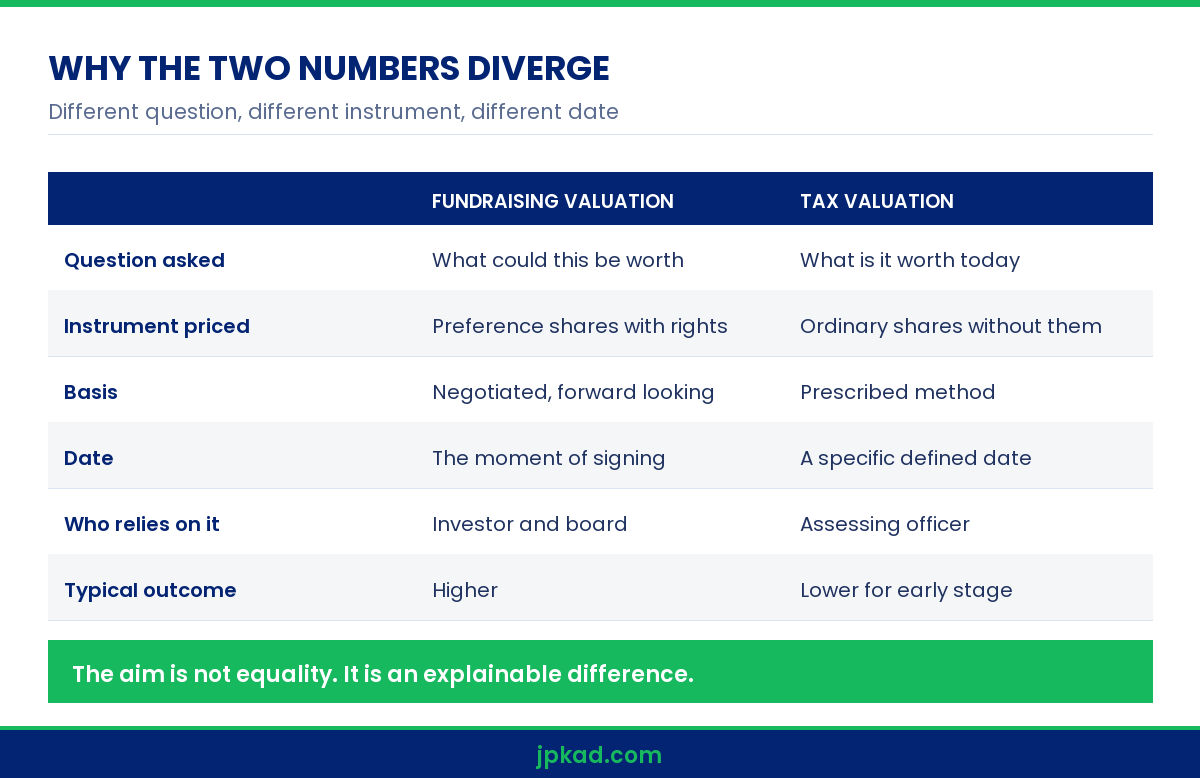
Two valuations of the same company, both correct.
Where the Tax Charge Arises
Indian income tax rules address share issues priced away from fair market value in two directions. Where a closely
held company issues shares above the prescribed value, the excess can be treated as income of the company. Where
shares change hands below prescribed value, a charge can arise in the recipient’s hands.
The first of these is what founders know as angel tax. The company raises money at a negotiated price, the prescribed
valuation supports a lower figure, and the difference is assessed as income. The tax falls on the company rather than
the investor, which is what makes it so damaging to an early stage balance sheet.
Exemptions and reliefs exist for companies meeting defined conditions, and the position has been revised more than
once, so the current requirements should be confirmed for the specific facts rather than assumed from an older
article. The Startup India portal is the reference point for
recognition based reliefs.
The practical exposure is rarely discovered at the time. It surfaces during a later assessment, often years after the
round, when the company has moved on and the people who negotiated the price have left. By then the contemporaneous
evidence either exists or it does not.
This is why the valuation is worth commissioning even when nobody is asking for it. The cost of a prescribed valuation
at the time of the round is trivial compared with the cost of defending a reconstructed position later.
Where the investor is non resident, exchange control pricing rules apply as well, setting a floor below which shares
may not be issued. Our checklist on
FEMA compliance for foreign owned Indian companies
sets out that layer.
Documenting the Gap
The defence to a valuation challenge is a contemporaneous file. Not a persuasive argument constructed later, but
documents created at the time that show what was known and why the price was set where it was.
Start with the prescribed valuation itself, signed by a professional of the correct category, dated appropriately and
setting out its method on the face of the report. A value carried in a spreadsheet with no certificate behind it is
treated as unsupported.
Keep the commercial evidence alongside it. The business plan presented to investors, the term sheet, the board minutes
recording the decision and any competing offers received. Together these show that the price was negotiated at arm’s
length rather than fixed for convenience.
Explain the instrument difference explicitly. A short memorandum recording that the round priced preference shares
carrying stated rights, while the prescribed valuation addressed ordinary shares without them, closes the most obvious
line of challenge before it is raised.
Where the plan underlying the round was ambitious, keep the evidence that it was credible at the time. Signed
contracts, pipeline data, pilot results and market data all support a forward looking number. An assessment made three
years later benefits from hindsight that was not available to the board.
File all of this together and index it. Companies that keep valuation files properly resolve these questions in a
single exchange of correspondence. Companies that do not spend years in appeals. Our note on
how a tax consultant assists with income tax notices
covers what that process looks like.
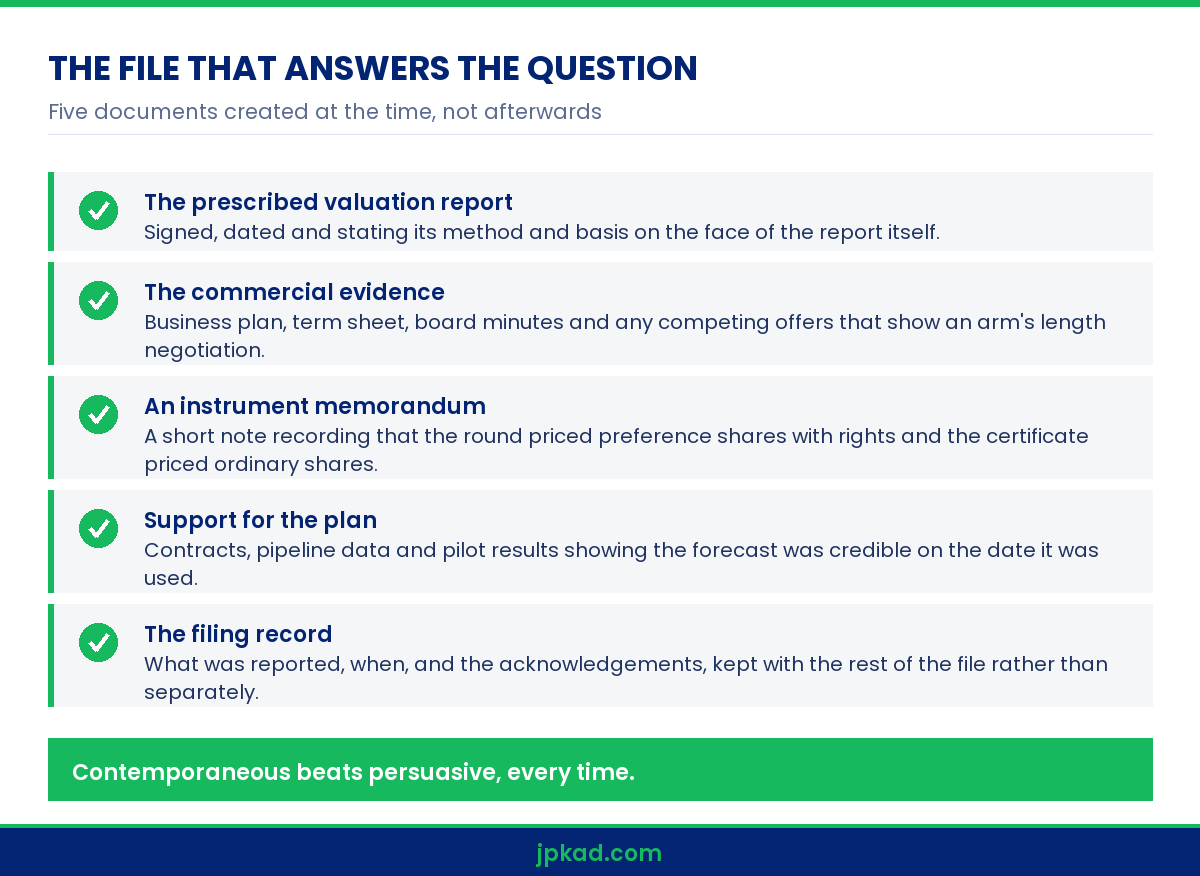
What a defensible valuation file contains.
Practical Choices That Reduce the Risk
Commission the prescribed valuation before the round closes rather than after. A valuation dated after the issue is
weaker evidence, and one commissioned during an assessment is weaker still. The sequence itself is part of the
argument.
Consider the instrument you actually issue. Where the commercial terms allow, using an instrument whose rights
genuinely justify the premium makes the gap easier to explain than issuing ordinary shares at a price that only a
forward plan supports.
Keep the plan realistic in the documents that will survive. Founders naturally present ambitious projections to
investors. Where those projections are the only evidence of value, an assessment years later will test them against
what actually happened, and a large miss invites the conclusion that the price was never supportable.
Where a company qualifies for a recognition based relief, obtain the recognition and keep the documentation.
Eligibility conditions are specific and are checked, so treat it as a compliance exercise rather than a formality.
Review historic rounds when preparing for the next one. Investors run diligence on prior issues, and an unsupported
earlier round becomes an indemnity in the current one. Fixing what can be fixed before the process starts is cheaper
than negotiating it during.
Finally, treat the valuation professional as part of the round team rather than a supplier engaged at the end.
Involving them while terms are still being negotiated occasionally changes the structure in ways that avoid the
problem entirely.
Keep the two workstreams visibly separate in your own records. One folder for the commercial round, holding the plan,
the term sheet and the board approvals. Another for the prescribed valuation and the filings that followed it.
Companies that mix the two end up producing a single confused bundle in response to a query, which invites more
questions rather than closing them.
Conclusion
Two valuations of the same company are normal. A gap you cannot explain is not. Commission the prescribed valuation at
the time, document why the commercial price differs, keep the evidence that the plan was credible, and index the file.
That preparation costs very little and resolves in one exchange what otherwise takes years.
Talk to JPKAD before your next round closes.