
Executive Summary
An overseas direct investment had already been made by the time anyone in this Thrissur group asked what to call it. The promoters had incorporated a company in the UAE to hold stock closer to Gulf customers and to bid for work that required a local presence. Money went out, the trade licence was issued, and trading began.
Part of the subscription came from the Indian company and part came personally from two directors. Neither route had been reported under the exchange control rules.
The group believed a minority stake counted as a portfolio investment. Unlisted equity cannot be portfolio investment, and that single misunderstanding shaped everything that followed.
JPKAD & Associates was engaged after the authorised dealer bank queried a later remittance and asked for a unique identification number the group did not have.
Work covered classification, regularisation with the bank, the outstanding annual reporting, and a restructuring of the personal holdings so the group ran on one route rather than two.
- Equity in an unlisted foreign company is overseas direct investment, whatever size the stake is.
- Overseas portfolio investment cannot apply to unlisted equity, which is where most misclassifications start.
- A unique identification number has to be allotted through the authorised dealer bank before further commitment.
- Form FC reports the commitment, and an annual performance report follows every year after that.
- A company route and a resident individual route are different regimes, and mixing them creates work later.
Funded a company abroad without reporting it? Explore our advisory work.
Client Overview
The client is a Thrissur based group trading in industrial consumables, with a distribution business in Kerala and customers across the Gulf. It is closely held, with a family holding and two directors running the operation day to day.
Gulf sales had been handled directly from India for several years. Orders were placed with the Indian company and shipped from Kerala.
Customers began asking for local stock and local invoicing. Several tenders also required a counterparty established in the country.
So the promoters incorporated a UAE company. Commercially the decision was sound, and it did exactly what they wanted it to do. The Indian tax side of a Gulf structure is covered in our corporate tax services guide for UAE investors.
Finance is a controller and three accounts staff, with income tax and goods and services tax work handled in house. Exchange control had never come up before, because nothing had ever gone out.
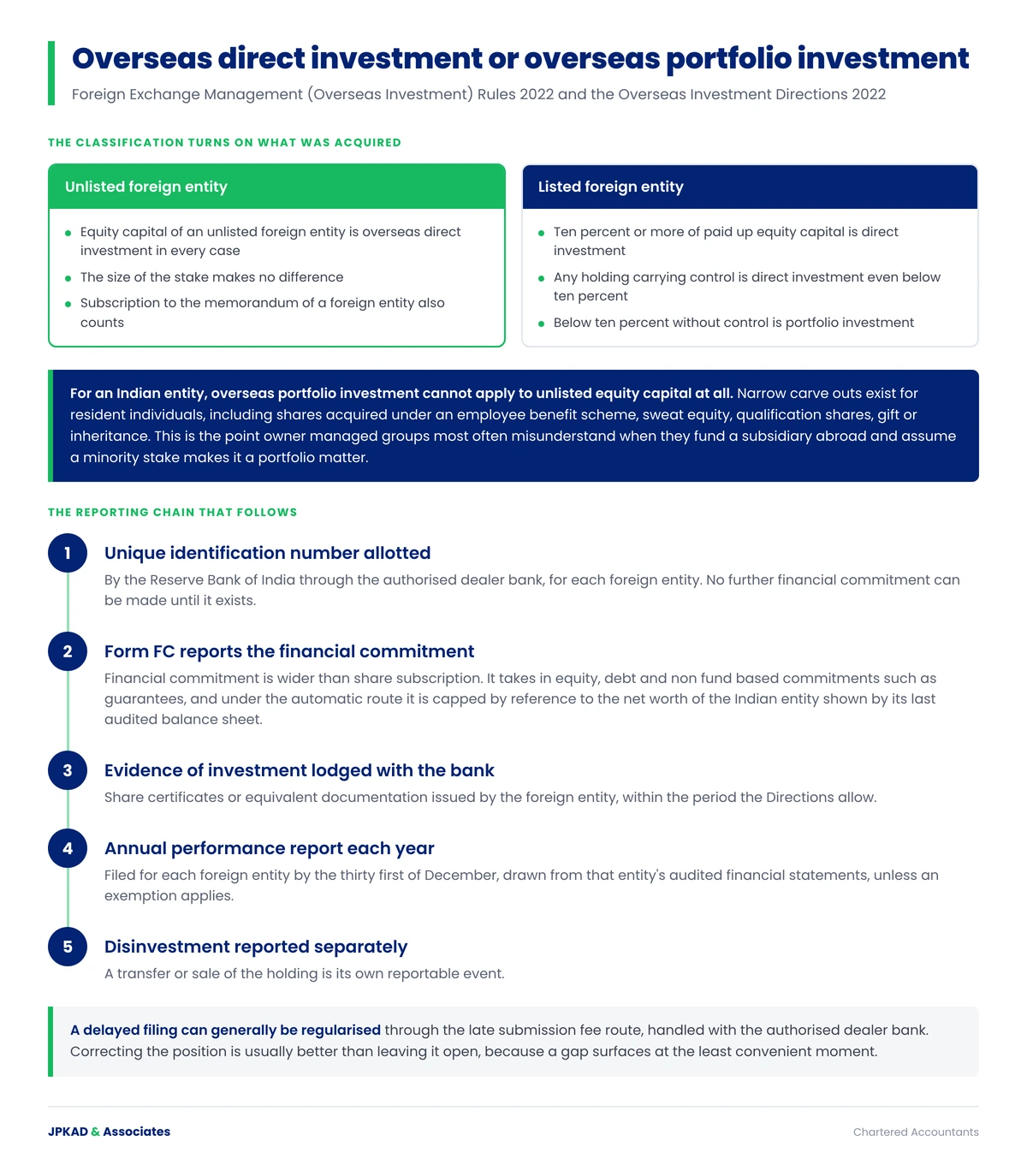
Unlisted equity has only one answer. The size of the stake does not change it.
Business Challenges
The commercial decision was sound and the compliance position was not. Obligations had attached from the date of the first remittance, and nothing had been filed against any of them.
Four problems had to be untangled before the group could make any further investment in its own subsidiary.
Why was a minority stake still overseas direct investment?
Because the classification turns on what was acquired rather than on how much of it was acquired. The UAE company is unlisted.
Under the 2022 rules, equity capital of an unlisted foreign entity is overseas direct investment in every case, whatever the percentage.
Portfolio investment is a different category and it does not reach unlisted equity at all, so the route the group thought it had taken did not exist.
That distinction is the one most owner managed groups get wrong, because the words portfolio and minority sound related and in this context they are not.
What went wrong with the two funding routes?
Part of the subscription came from the Indian company and part came from two directors personally, out of their own resources.
Those are separate regimes. A company invests under the rules applying to an Indian entity, and a resident individual invests under a different set of conditions.
The individual route carries restrictions that the group had not considered, including conditions about the activity of the foreign entity and its own subsidiaries.
Running both routes into one foreign company, without reporting either, produced a shareholding that was awkward to explain and awkward to correct.
Why did the bank stop the later remittance?
Because a unique identification number is allotted for each foreign entity, and no further financial commitment can be made until it exists.
The group asked to send working capital to its own subsidiary and could not produce a number it had never applied for.
The authorised dealer bank is the channel for all of this reporting, so a gap in the file surfaces the moment anything else is attempted.
What looked like a routine transfer became the point at which the whole position had to be reconstructed.
What was outstanding beyond the initial reporting?
An annual performance report falls due for each foreign entity by the thirty first of December, drawn from that entity’s audited financial statements.
Two such reports had already passed unfiled, because nobody had connected an Indian filing obligation to a UAE audit.
The UAE company had been audited locally, so the underlying statements existed. They had simply never travelled back to India for this purpose.
Evidence of the investment itself, in the form of share documentation, had also never been lodged with the bank.
Has your bank asked for a number you do not have? Read more about our taxation services.
Business Objectives
The board wanted the position regularised rather than argued, the subsidiary funded properly going forward, and the group left on a single clean route it could operate without advice on every transaction.
What did the group need to settle first?
A written classification of what had actually been done, tested against the 2022 rules rather than against the group’s own description of it.
A complete reconstruction of every remittance, by date, amount, sender and purpose, since the filings that follow depend entirely on that record.
An assessment of whether the personal holdings could remain where they were or had to move into the company.
And a clear answer on whether further funding could proceed before the historic position was closed, because trading needs did not pause.
Why was the structure addressed alongside the filings?
Because regularising a structure the group intended to change would have meant filing twice and paying for the privilege.
The split between company holding and personal holding had no commercial purpose. It happened because two directors had ready funds at the time.
Consolidating the holding into the Indian company matched how the business actually operates, since customers and stock belong to the trading operation.
It also simplified every future filing, because one route means one set of conditions and one annual report rather than parallel obligations. Holding changes of that kind also run through our company law matters and compliances work.
What defined success for this engagement?
A unique identification number allotted for the foreign entity, with the whole of the historic financial commitment reported through the authorised dealer bank.
Outstanding annual performance reports filed, and the group current rather than merely explained.
The personal holdings transferred so the group runs on one route, with the transfer itself reported as the rules require.
And a calendar inside the finance function, so the December reporting date is met from the UAE audit each year without anybody having to chase it.
Want a structure that matches how the business actually trades? Explore our approach.
Solution Strategy
Work began with classification, because everything downstream depends on it. Reconstruction of the remittance history came next, then regularisation through the bank, then the restructuring, then the annual cycle.
Nothing was filed until the whole position was mapped. Filing one piece of a disordered history tends to create inconsistencies that are harder to explain than the original gap.
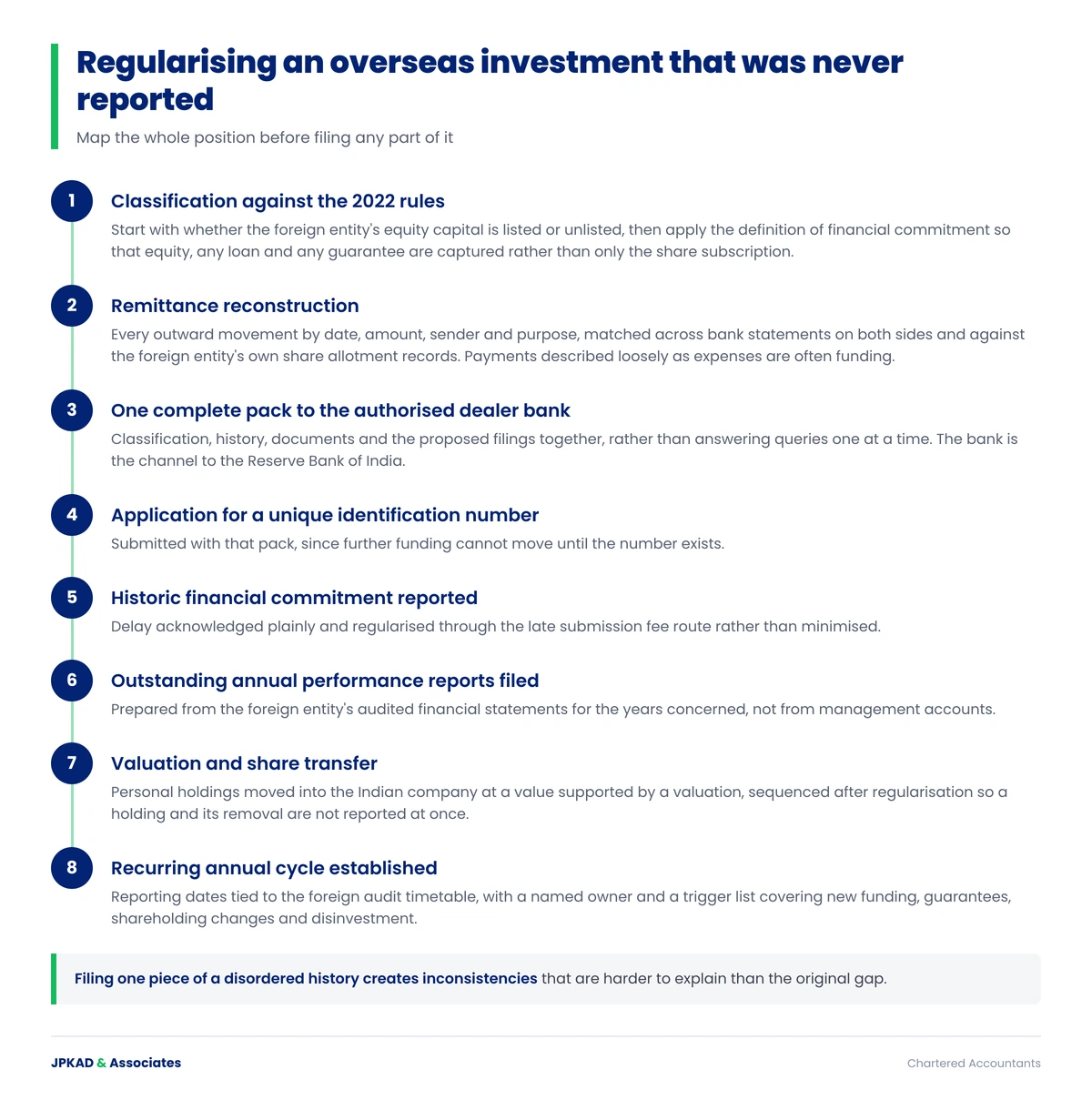
Map the whole position first. Filing one piece of a disordered history creates more work.
How was the classification settled?
By reading the 2022 rules against the facts of the UAE entity, starting with whether its equity capital is listed or unlisted.
It is unlisted, which places the investment in the direct investment category and closes the portfolio argument entirely.
The definition of financial commitment was then applied, so that equity, any loan and any guarantee were captured rather than only the share subscription.
The conclusion was recorded in writing with the supporting documents attached, which became the opening section of the file handed to the bank.
How was the remittance history reconstructed?
Through bank statements on both sides, matched to the UAE company’s own receipts and to its share allotment records.
Each outward movement was classified as subscription, loan or expense reimbursement, because they attract different treatment and had been mixed.
Two payments initially described as expenses turned out to be funding, which changed the commitment figure and had to be corrected before filing.
The reconstructed schedule was agreed with the directors and signed, since the reporting rests on the company’s own statement of what happened.
How was the regularisation approached with the bank?
By preparing a single pack rather than answering queries one at a time, covering the classification, the history, the documents and the proposed filings.
The authorised dealer bank is the channel to the Reserve Bank of India, and a complete pack lets it form a view without repeated correspondence.
Delay was acknowledged plainly rather than minimised, and the late submission fee route was addressed openly as part of the proposal.
The application for a unique identification number went in with that pack, since further funding could not move until the number existed.
How were the personal holdings brought into the company?
By transferring the directors’ shares in the UAE entity to the Indian company, at a value supported by a valuation rather than at cost.
Transfers of this kind are themselves reportable events, so the transfer was sequenced after the original position had been regularised.
Doing it in the other order would have meant reporting a holding on one basis and then immediately reporting its removal, which invites questions.
The UAE side of the transfer was handled by advisers in that jurisdiction, with the Indian reporting built around their timetable.
How was the annual cycle put in place?
By tying the Indian reporting date to the UAE audit timetable, so the audited statements arrive before the December deadline rather than after it.
The controller now holds a single calendar covering the annual performance report, any further commitment and the evidence the bank expects.
Responsibility was named rather than assumed, because a date owned by everyone is a date owned by nobody.
A short note records what triggers a fresh filing, including new funding, a guarantee, a change in shareholding and any disinvestment.
Do your remittances describe funding as something else? Read more about our corporate finance advisory.
Records and Tools Used
Almost everything the file needed already existed, in two countries and in nobody’s particular custody. Bringing it together was most of the work.
Which records supported the reconstruction?
Indian bank statements and outward remittance advices, which carry the purpose code originally declared and therefore show how each payment was described at the time.
UAE bank statements and the subsidiary’s receipts, matched against the Indian side so that no movement was counted twice or missed.
Incorporation documents, the trade licence and the share allotment record for the UAE entity, establishing what was issued and to whom.
Board minutes and the directors’ own records for the personal subscriptions, which were the least documented part of the history. The inbound equivalent of this reporting is set out in our FEMA compliance checklist for foreign owned Indian companies.
What did the authorised dealer bank require?
A coherent account of the investment, supported by documents rather than by explanation, and consistent with the purpose codes already on its records.
Evidence of the investment made, in the form of share documentation issued by the foreign entity.
The audited financial statements of the UAE company for the years in question, since the annual reporting draws directly from them.
A valuation to support the share transfer when the personal holdings moved, prepared by a party competent to give it rather than by the company.
How is the exchange control file organised?
By foreign entity first, because the unique identification number attaches to the entity itself and every filing made afterwards refers back to it.
The classification note and its supporting documents sit at the front, followed by the reconstructed remittance schedule.
Filings and acknowledgements follow in date order, with the bank correspondence kept alongside rather than separately.
Audited statements of the foreign entity are filed by year, so each annual report can be traced directly back to the accounts it was drawn from.
Implementation Process
The engagement ran across roughly fourteen weeks. Most of that was reconstruction and correspondence rather than analysis, and the timetable depended partly on advisers in another jurisdiction.
The opening fortnight went entirely on establishing what had actually happened, which nobody inside the group could state completely.
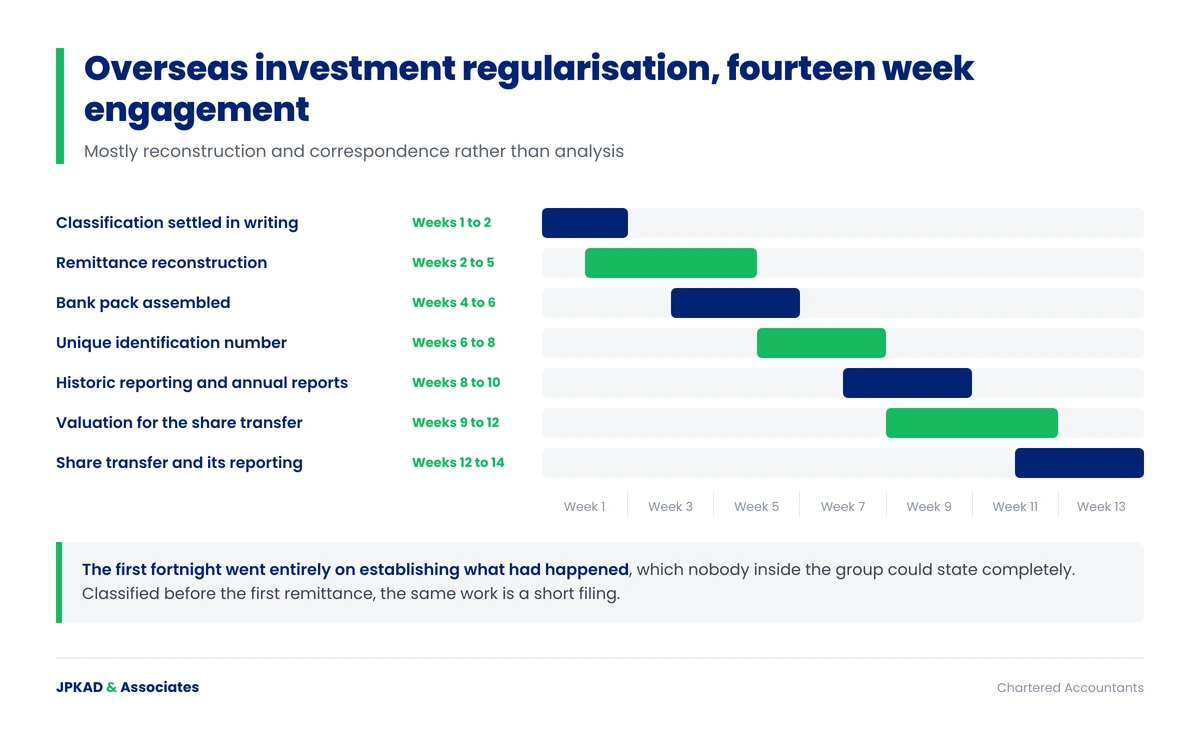
Fourteen weeks, most of it reconstruction. Reported on time it is a short filing.
How was the classification question settled?
By testing the facts against the definitions in the 2022 rules and recording a written conclusion with reasons before anything was filed.
The directors had expected an argument about percentages and received a shorter answer, because unlisted equity does not turn on percentages.
That conclusion was given to the board before the regularisation was commissioned, so the decision to proceed rested with them.
It also settled the question of whether the personal holdings could stay outside the company, which had been the directors’ preference until then.
How was the history agreed with the directors?
Through a schedule circulated in draft, with every movement listed by date and a proposed classification against each one.
Two entries were challenged and one of those challenges was right, which is the reason the schedule goes out in draft rather than final.
Reimbursements and funding had been recorded loosely in the early months, when nobody expected the distinction to matter.
The signed schedule became the factual basis for every filing, and the directors understood that they were attesting to it.
How was the bank engagement handled?
With one complete pack at the outset and a single point of contact on each side, which kept the exchange short.
Queries were answered in writing and logged, so the same point was not addressed twice in different terms by different people.
The bank raised two matters the group had not anticipated, both concerning how early remittances had been described when they went out.
Those were answered with the reconstructed schedule rather than with argument, and the unique identification number followed.
How was the annual reporting brought current?
The outstanding annual performance reports were prepared from the UAE audited statements for the years concerned, rather than from management accounts.
Both were filed through the authorised dealer bank, with the delay regularised through the late submission route rather than left open.
The current year report was then prepared on the normal timetable, which is the point at which the group stopped being in arrears.
Acknowledgements were filed against the years they relate to, so the position can be demonstrated without reassembling correspondence.
Facing a bank query on an investment made years ago? Explore how we can help.
Business Results
Results are given as direction of change rather than in figures. Exchange control outcomes depend on the documents filed and on the view taken by the bank and the regulator, and numbers would imply a certainty that does not exist.
This is what the group reported once the position had been brought current.
What changed about the regulatory position?
A unique identification number now exists for the foreign entity, and every filing refers to it, which is the spine of the whole file.
The historic financial commitment has been reported, with the delay regularised rather than left to surface at a later date.
Outstanding annual performance reports were filed from audited statements, and the group is current rather than in arrears.
Evidence of the investment sits with the authorised dealer bank, so the routine question at the start of any future filing is already answered.
What changed about the group structure?
The UAE company is now held by the Indian company alone, which matches where the customers, the stock and the trading risk actually sit.
The directors no longer hold shares personally, so the group operates under one regime instead of two overlapping ones.
Further funding moves through a route the bank recognises, and working capital reaches the subsidiary without a stoppage.
The structure is also easier to explain to a UAE bank or counterparty, which had been an unexpected friction in the early months. Our case study on clearing a backlog of FC GPR and FLA filings follows the same problem from the inbound direction.
What changed inside the finance function?
The controller holds a calendar tied to the UAE audit, so the December reporting date is met from statements that arrive in time.
Outward remittances are now classified before they leave the country, rather than described loosely at the time and reclassified long afterwards.
A short trigger list covers new funding, guarantees, shareholding changes and disinvestment, each of which starts a filing.
Correspondence with the bank now goes through one named person rather than whoever picked up the query, which shortened the last exchange considerably.
What changed for the board?
The directors understand that forming a company abroad creates Indian reporting obligations from the date of the first remittance, not from some later threshold.
Structural decisions are now discussed before they are executed, rather than being described to advisers afterwards.
The board also sees that a personal subscription and a company subscription are different acts with different consequences.
Confidence about the position replaced a background awareness that something somewhere had been left undone, which had sat with them for two years.
Want your outbound structure evidenced rather than explained? Speak to us about an outbound structure.
Lessons Learned
None of this required a difficult reading of the rules. It required somebody to ask what a payment was, at the moment it was made, rather than two years later.
What surprised the group most?
The size of the stake made no difference at all. Unlisted equity is direct investment whether the holding is five percent or ninety.
Portfolio investment turned out to be unavailable rather than merely unsuitable, which ended a discussion the directors expected to have.
Two payments recorded as expense reimbursements were funding, and that reclassification moved the commitment figure.
Local audit in the UAE had been completed on time each year, so the information needed for the Indian filings had existed all along.
What worked better than expected?
Preparing one complete pack for the bank instead of answering queries as they arrived. It shortened the exchange substantially.
Circulating the remittance schedule in draft. One director’s challenge was correct and it would have gone into a filing otherwise.
Acknowledging the delay plainly. Attempting to characterise it as something other than delay tends to extend the correspondence.
Sequencing the share transfer after regularisation, so that the group was not reporting a holding and then its removal at the same time.
What would be done earlier next time?
Classification would happen before the first remittance, since it determines the route, the limits and every filing that follows.
The funding decision would be taken at board level rather than settled by whoever had money available that week.
Purpose codes on outward remittances would be set deliberately, because they are the first thing the bank compares a later story against.
Reporting dates would be entered in the finance calendar when the foreign entity is incorporated, not when a deadline has passed.
What should other Kerala groups look at?
Establish whether any foreign company in the group is unlisted, because that single fact decides the classification.
Review how past remittances were described when they left, since a loose description is harder to correct than an absent one.
Confirm whether a unique identification number exists for each foreign entity, and whether anything has been committed since it was allotted.
Ask when the foreign entity audit completes each year, because the Indian annual report depends on it and the December date arrives quickly.
Frequently Asked Questions
1. What counts as overseas direct investment from India?
Acquiring equity capital of an unlisted foreign entity, subscribing to its memorandum, or taking ten percent or more of a listed foreign entity, all count. So does any investment carrying control even where the holding is smaller. The 2022 rules govern it, and the classification turns on what was acquired rather than on the amount invested.
2. How is overseas portfolio investment different?
Portfolio investment covers foreign securities that fall outside direct investment, and it cannot apply to unlisted equity capital at all. That is the practical dividing line. A small stake in an unlisted foreign company is still direct investment, which is the point owner managed groups most often misunderstand when they fund a subsidiary abroad.
3. What is a unique identification number and why does it matter?
It is a number allotted by the Reserve Bank of India through the authorised dealer bank, attaching to each foreign entity invested in. Further financial commitment cannot be made until it exists, so a missing number stops routine funding. Every subsequent filing refers back to it, which makes it the spine of the exchange control file.
4. What is Form FC used for?
It reports financial commitment to a foreign entity through the authorised dealer bank. Financial commitment is wider than share subscription and takes in loans and non fund based commitments such as guarantees. Groups that report only the equity subscription often leave a loan or a guarantee unreported, and that gap surfaces when the next transaction is attempted.
5. Who has to file an annual performance report and when?
An Indian entity holding overseas direct investment files one for each foreign entity by the thirty first of December each year, drawn from that entity’s audited financial statements. Certain holdings are exempt, including some small holdings without control. The filing depends on the foreign audit, so the overseas timetable needs to be aligned with the Indian date.
6. Can a delayed filing be corrected?
Delayed reporting can generally be regularised through the late submission fee route, handled with the authorised dealer bank. Correcting the position is usually better than leaving it open, because a gap tends to surface at the least convenient moment, typically when the group wants to send further funds or complete a transaction abroad.
7. Can directors hold shares in the foreign subsidiary personally?
A resident individual can invest abroad, but under a different set of conditions from those applying to an Indian company, including restrictions on the activity of the foreign entity and its own subsidiaries. Running both routes into one foreign company is permitted in principle and awkward in practice, since it creates parallel obligations for the same business.
8. What is financial commitment and how is it limited?
Financial commitment covers equity, debt and non fund based exposure such as guarantees given for the foreign entity. Under the automatic route it is capped by reference to the net worth of the Indian entity shown by its last audited balance sheet. Commitments above prescribed levels need approval, so the headroom should be checked before anything is promised.
9. Does a guarantee to a foreign subsidiary need reporting?
A guarantee is part of financial commitment, so it is reportable even though no money has left India. This catches groups out regularly, because a comfort letter or a guarantee given to a bank abroad feels like a supporting document rather than an investment. It counts against the limit as well as requiring a filing.
10. How long does it take to regularise an unreported investment?
This engagement ran about fourteen weeks, and most of that went on reconstructing the remittance history and corresponding with the bank rather than on analysis. Timelines depend on how well documented the original payments were, and on whether advisers in the foreign jurisdiction are needed for share documentation or a valuation.
Conclusion
This overseas direct investment was made before anyone asked what it was, which is how most outbound reporting problems begin. The group formed a UAE company for sound commercial reasons, funded it from two sources because that was convenient at the time, and assumed a minority stake made it a portfolio matter. Unlisted equity is never a portfolio matter, and that single point decided the classification, the route, the limits and every filing that followed. The correction took about fourteen weeks. Almost none of it was analysis. It was reconstructing what each remittance had been, agreeing that history with the directors, and putting one complete pack in front of the authorised dealer bank rather than answering its questions piecemeal. The group is now current, holds the subsidiary through one entity, and funds it without a stoppage. If your group has money in a company abroad, the questions worth answering this month are whether that company is listed, what number has been allotted for it, and what was said on the remittance advice when the funds went out. JPKAD & Associates advises closely held groups on cross border structuring and exchange control, and you can read more through the contact page.
This case study is published for general information only. Client identity and commercially sensitive details have been withheld. Outcomes are described qualitatively, without figures, because exchange control outcomes depend on the facts, on the documents filed and on the view taken by the authorised dealer bank and the Reserve Bank of India. Nothing here is professional advice on any specific matter.