
Most people read a valuation report backwards. They find the number, check whether they like it, and stop. The number
is the least informative part of the document. The assumptions, the adjustments and the limitations are where the real
conclusion sits. This guide explains what each section is doing, and how enterprise value, equity value and net
valuation relate to one another, alongside
what investors look for in a valuation.
Key Takeaways
-
Enterprise value covers the whole business regardless of funding. Equity value is what shareholders actually receive
after debt and other claims. -
The bridge between the two is where most misunderstandings live, because cash, debt and debt like items are not
always obvious. - The limitations and assumptions section tells you how much weight the conclusion can carry.
What Each Value Actually Means
Enterprise value is the value of the operating business as a whole, before considering how it is financed. It is what
somebody would pay for the trading activity, its assets and its earning capacity, independent of whether the current
owner funded it with debt or equity.
Equity value is what belongs to shareholders. It is enterprise value less net debt and less anything else that has a
prior claim on the business. This is the number that matters to a seller, because it is the one that determines what
arrives in their account.
Net asset value is a different measure again. It is what the balance sheet shows after restating assets and
liabilities at current values. For a profitable business it is usually a floor rather than a conclusion, and for an
asset heavy or dormant company it may be the primary answer.
Confusing these is the most common error in owner led negotiations. A buyer offering a multiple of earnings is almost
always quoting enterprise value. A seller hearing that figure and mentally treating it as their proceeds is going to
be disappointed by the amount of debt in the business.
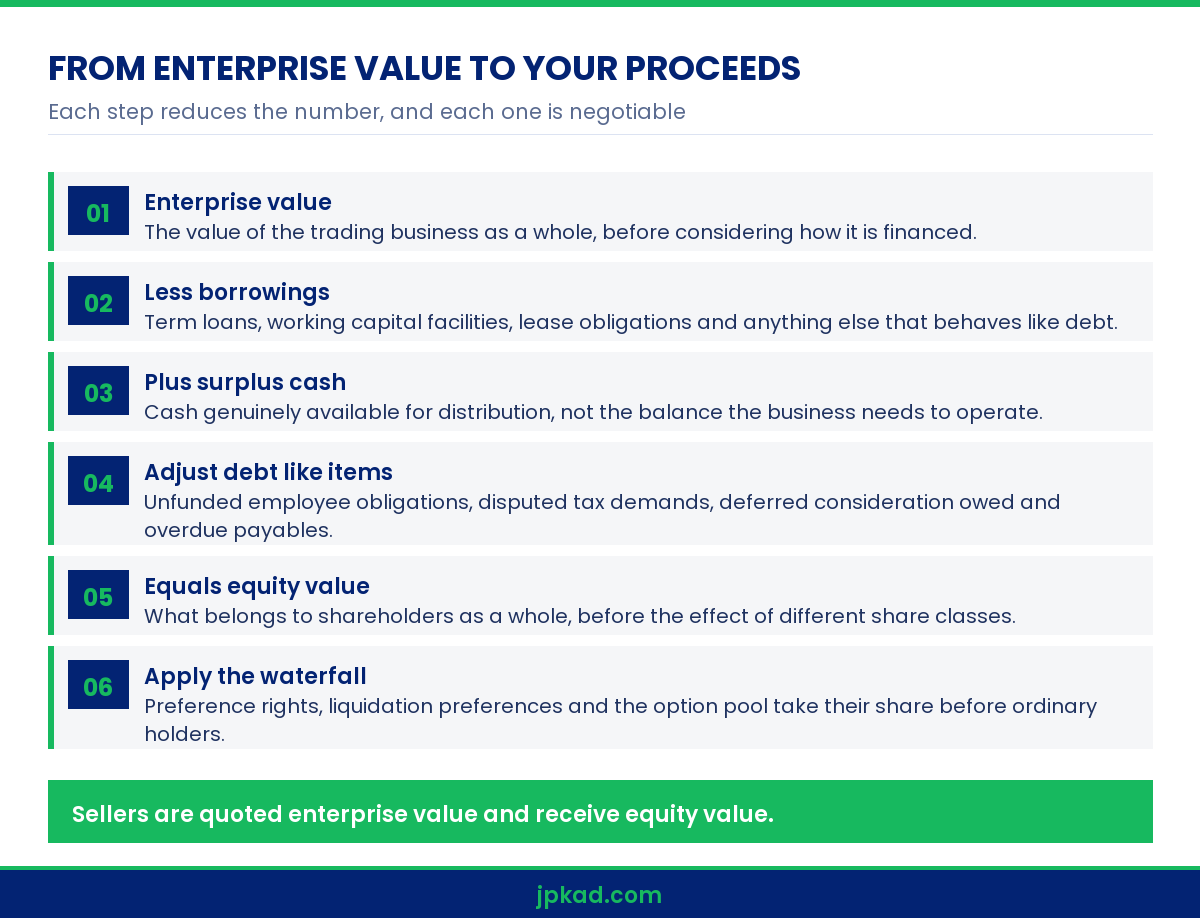
The relationship is straightforward once stated. Start at enterprise value, deduct borrowings, add surplus cash,
adjust for items that behave like debt, and arrive at equity value. Every credible report shows that calculation
explicitly rather than leaving the reader to infer it.
Where there are multiple classes of share, a further step follows. Preference rights, liquidation preferences and
option pools all take their share before ordinary shareholders, so equity value at the company level is not the same
as value per ordinary share.
Debt like items are where the bridge most often surprises people. Unfunded gratuity and leave encashment liabilities,
disputed tax demands, deferred consideration still owed on an earlier acquisition, overdue statutory dues and payables
stretched well beyond terms are all treated as debt by a buyer even though the balance sheet may not present them that
way.
The bridge every credible report sets out explicitly.
The Sections That Carry the Real Information
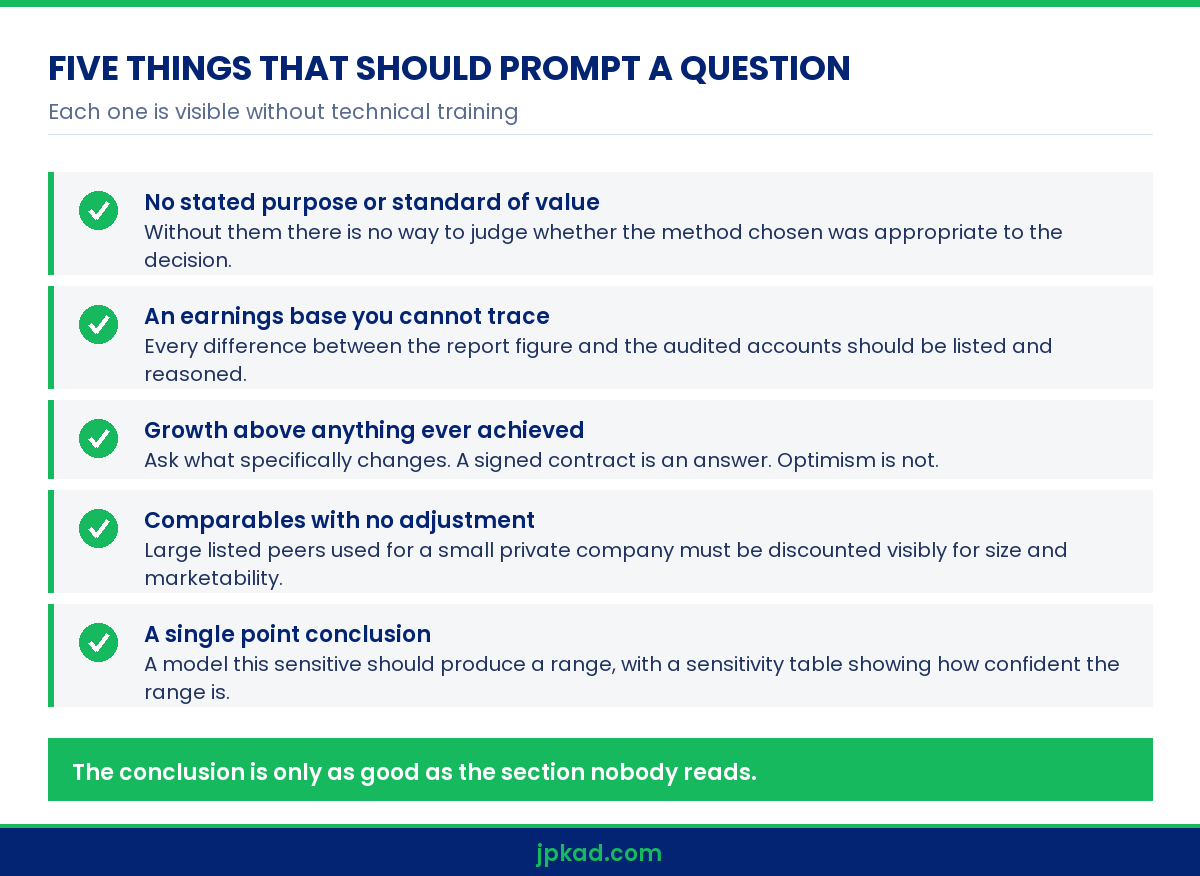
Open a report at the scope and purpose section first. It states what the valuation is for, what standard of value
applies and as at what date. If those are absent or vague, nothing that follows can be relied on, because there is no
way to test whether the method was appropriate.
Read the information relied upon next. Most reports state that management information was not independently verified.
That is normal and honest, but it tells you the report is only as good as the numbers it was given, which is a reason
to care about the quality of the underlying accounts.
Then the normalising adjustments. This is where the earnings figure was constructed, and it is the single most
negotiated part of any valuation. Each adjustment should have a reason and a source. Where a large add back appears
with a one line explanation, that is the first place a counterparty will push.
The methodology section should explain not only what was done but what was rejected and why. A report that considers
three approaches and explains why one carries most weight is far more credible than one that silently applies a single
method.
The sensitivity analysis is where an income based valuation reveals its confidence. A narrow range across plausible
assumptions means the conclusion is robust. A wide one means the answer depends heavily on judgements that nobody can
verify, which is useful to know before relying on it.
Finally, read the limitations. Scope restrictions, information not made available and the purposes for which the
report may not be used are all disclosed there, and they frequently qualify the headline more than anything in the
body does.
Reading the Numbers Critically
Check the earnings base against the audited accounts. If the report starts from a figure you cannot trace to a
statutory statement, find out where the difference comes from. Legitimate normalisation explains most of it. Anything
unexplained is a question.
Test the growth assumption against history. Where a report forecasts sustained growth well above what the business has
ever achieved, ask what changes. Sometimes there is a good answer, such as a signed contract or a completed capacity
expansion. Often there is not.
Look at the working capital treatment in the forecast. Growth consumes cash, and a model that grows revenue without
funding receivables and stock will overstate value. This is the most common technical weakness in owner prepared
models and it is easy to spot.
Check whether the comparables are genuinely comparable. Size, geography, growth rate and margin all matter. A list of
large listed companies used to value a small private business needs visible adjustment, and if none is shown the
multiple is not usable.
Confirm which basis the conclusion is on. Control or minority, marketable or non marketable. A report that does not
say has left out something material, because the difference between those bases can be substantial for a private
company.
Finally, look at the date. Valuations age. A report prepared before a significant change in trading, in the sector or
in the shareholder base is a historical document rather than a current one, however carefully it was written.
What to question before accepting a number.
Using the Report Without Misusing It
A valuation is prepared for a stated purpose and a stated party. Handing a report prepared for internal planning to a
lender or a tax officer is a common and avoidable mistake, and the reliance language in the report usually prohibits
it explicitly.
It is also prepared as at a date. Using a report from eighteen months ago to support a current transaction invites an
obvious challenge, and the cost of refreshing it is far smaller than the cost of having the position rejected.
In a negotiation, use the report as a structure rather than as an authority. The other side will have their own. What
moves the discussion is the reasoning underneath: why this multiple, why this growth rate, why this adjustment. A
party that can defend the reasoning usually prevails over one holding a thicker document.
For internal purposes the report is most useful as a diagnostic. The adjustments show where the accounts are unclear,
the risk premiums show what the business is being penalised for, and the sensitivities show which levers matter. That
information is worth more to an owner than the number itself.
Keep the report and its working file together. If the valuation is questioned later, whether by a buyer, an investor
or an assessing officer, the file is the defence. Our note on
accurate records driving business success
covers the wider discipline.
And commission a refresh when the business changes materially. A significant contract won or lost, a change in the
shareholder base, or a shift in the sector all justify revisiting the conclusion rather than continuing to quote an
older figure.
For cross border readers, one further caution. A report prepared under Indian conventions may treat surplus cash,
related party balances and tax provisions differently from what a foreign parent expects, and the
Indian corporate tax summary published by PwC
is a useful orientation before those items are renegotiated. Ask for the bridge to be restated in the reader’s own
convention rather than assuming the terms mean the same thing.
Conclusion
Reading a valuation report well means reading the sections most people skip. Check the purpose, trace the earnings
base, test the assumptions, understand the bridge from enterprise value to equity value and note the limitations. Do
that and the report becomes a tool rather than a verdict. JPKAD prepares and reviews valuations for owners, boards and
investors. Contact our team for a review of a report you have received.