
Transfer pricing is widely assumed to be a large company problem. It is not. If your Indian subsidiary transacts with its foreign parent at all, arm’s length pricing applies, regardless of size. What changes with size is how much documentation you must keep, not whether the obligation exists. This guide sets out what smaller and mid sized subsidiaries actually need. Experienced corporate tax consultants in india scale the work to the transaction, not to the fear.
Key Takeaways
- The arm’s length obligation has no floor. Documentation requirements scale with transaction value, but the pricing duty itself applies to every intercompany transaction.
- An accountant’s report on international transactions is required where the subsidiary transacts with associated enterprises abroad.
- Contemporaneous documentation is the single strongest protection, and reconstructing it later is far weaker evidence.
Why Small Subsidiaries Are Caught Too
Transfer pricing rules apply to transactions between associated enterprises where one is outside India. A wholly owned Indian subsidiary transacting with its foreign parent is the textbook case. The rules do not contain an exemption for small companies, which surprises groups whose Indian operation is a handful of people.
The transactions caught are broader than most expect. Purchase and sale of goods obviously qualify. So do management charges, technical service fees, royalties, interest on intercompany loans, cost allocations, provision of software or staff, and guarantees given by the parent. A subsidiary that buys nothing from its parent may still be caught by a management charge.
What scales with size is the documentation burden. Larger transaction values pull in more extensive record keeping requirements. Smaller ones require proportionately less, but never nothing. The practical goal for a small subsidiary is proportionate compliance rather than either over engineering or ignoring the issue.
Loss making subsidiaries attract particular attention, which surprises groups who assume no profit means no issue. A routine service provider that consistently reports losses raises an obvious question: why would an independent party continue performing this function at a loss. The answer may be perfectly good, such as genuine start up costs, but it needs to be articulated in the documentation rather than left implicit.
Interest free intercompany balances are another common trap. A loan advanced by the parent on which no interest is charged is still an international transaction, and the absence of a charge is itself a pricing position that requires justification. Groups often treat these as internal funding conveniences rather than transactions, and the balance sits unexamined for years.
which intercompany transactions trigger transfer pricing rules for Indian subsidiaries
What the Documentation Has to Show
At its core the documentation must demonstrate that the price charged between related parties matches what unrelated parties would have agreed. That means describing the transaction, identifying which party performs which functions, which assets each uses and which risks each bears, then selecting an appropriate method and benchmarking the outcome against comparable independent arrangements.
The functional analysis carries more weight than the arithmetic. Two companies can reach the same price by different routes, and the analysis explaining why your Indian entity earns the return it does is what an examiner reads first. A subsidiary performing routine services should earn a routine return, and the documentation should say so plainly.
Where the subsidiary transacts with associated enterprises abroad, an accountant’s report on those international transactions is required alongside the tax return. This is a separate filing obligation from the documentation itself, and missing it is a distinct default. Broader group reporting context is set out in the PwC India group taxation summary.
Method selection is where analyses most often become unconvincing. The chosen method should follow from the functional profile rather than from whichever produces the preferred result. A routine service provider is usually best tested on its cost base, a distributor on its operating margin. Selecting a method that fits the facts and explaining the reasoning is more persuasive than an elaborate calculation resting on an odd choice.
Comparable selection deserves the same honesty. Record the database searched, the filters applied, the companies accepted and the reasons for rejecting those excluded. An examiner who can follow the search and reach a similar set will engage with the conclusion. One who cannot reconstruct how the comparables were chosen will usually substitute their own, and that rarely favours the taxpayer.
Keeping It Proportionate for a Smaller Entity
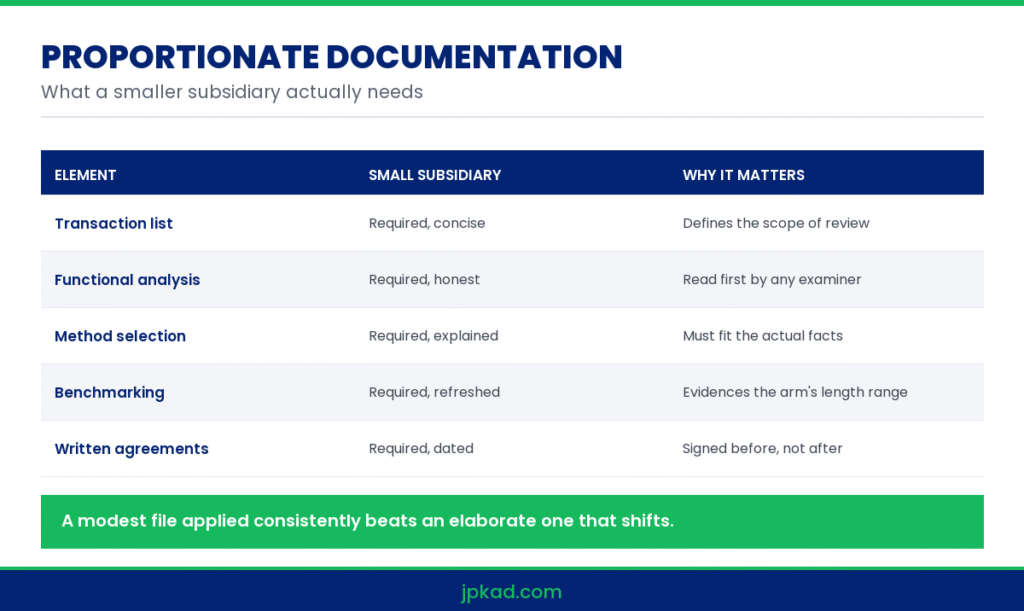
For a subsidiary with a small number of straightforward intercompany transactions, the sensible approach is a concise but genuine analysis rather than a document built for a multinational. Identify each transaction clearly. Set out the functional profile honestly. Choose a method that fits the facts and explain why. Benchmark against available comparables and record the search criteria used.
Consistency matters as much as depth. A modest analysis applied the same way each year is far more defensible than an elaborate one that changes basis whenever the result is inconvenient. Examiners notice changes of method more readily than they notice brevity.
The most common proportionate structure is a simple cost plus arrangement for services and a straightforward margin for distribution, both benchmarked once properly and refreshed periodically. This is usually adequate and defensible, and it keeps professional cost aligned with the actual scale of the transactions.
Be realistic about the safe harbour and dispute resolution options as well. Simplified regimes exist for certain transaction types and value thresholds, offering certainty in exchange for accepting a prescribed margin. These are not right for everyone, since the prescribed return can exceed what benchmarking would support, but for a small subsidiary valuing certainty over optimisation they can be worth evaluating.
Where transactions are substantial and long term, an advance agreement with the authorities on pricing methodology is available. This is a significant undertaking and disproportionate for most smaller subsidiaries, but it is worth knowing the option exists before assuming that annual uncertainty is unavoidable.
minimum transfer pricing documentation elements for small and large Indian subsidiaries
Building the Habit of Contemporaneous Records
Contemporaneous means prepared at the time, not assembled afterwards. Documentation created while the arrangement is being set up carries considerably more weight than a file compiled once a query arrives. The difference in evidential value is significant, and it costs nothing to get right.
Practically this means agreeing intercompany arrangements in writing before the year begins, applying them consistently through the year, and preparing the analysis alongside the year end close rather than months later. Groups that set charges at year end, working back from a desired profit, create precisely the pattern that attracts attention.
Treat it as part of the ordinary finance calendar rather than a separate compliance event. Subsidiaries with steady financial reporting discipline find transfer pricing straightforward, because the underlying records already exist.
Align the transfer pricing file with what the rest of the business says about itself. Marketing material describing the Indian team as a strategic centre of excellence sits awkwardly beside documentation characterising it as a routine low risk service provider. Examiners read public statements, investor materials and websites, and inconsistency between them and the functional analysis is a straightforward line of challenge.
Build the review into the annual close rather than treating it as a separate season. When the year end process already produces intercompany reconciliations, confirmation that agreed rates were actually applied and a check that agreements remain current, the transfer pricing file becomes a summary of work already done rather than a fresh project undertaken months later under time pressure.
One further habit repays the effort. Keep a short record of any change to the intercompany arrangement and the reason for it, written when the change is made. Rates move, functions shift between entities and new services begin, all for perfectly ordinary commercial reasons. A file that explains those changes contemporaneously is straightforward to defend. One that shows unexplained movement invites the assumption that the driver was tax, and rebutting that assumption years later is considerably harder than recording the reason at the time.
Conclusion
Transfer pricing is not optional for small subsidiaries, but it need not be disproportionate either. Document your intercompany arrangements honestly, benchmark them sensibly, apply them consistently and keep the records at the time rather than afterwards. That approach satisfies the requirement without importing costs designed for far larger groups. Talk to our corporate tax team for a proportionate review of your intercompany position.
Frequently Asked Questions
Does transfer pricing apply to a very small Indian subsidiary?
Yes. The arm’s length obligation has no size threshold. If your subsidiary transacts with its foreign parent, the rules apply. Documentation requirements scale with value, but the pricing duty itself does not. Learn more about our audit and assurance services.
What counts as an intercompany transaction?
More than goods. Management charges, service fees, royalties, interest on loans, cost allocations, provision of staff or software, and parent guarantees are all caught. A management charge alone brings you within scope.
What is the accountant’s report on international transactions?
A separate filing required where the subsidiary transacts with associated enterprises abroad. It accompanies the tax return and is distinct from the documentation itself. Missing it is its own default.
How detailed does the documentation need to be?
Proportionate to the transactions. A small subsidiary with a few straightforward arrangements needs a concise but genuine analysis, not a document designed for a multinational group.
What does contemporaneous documentation mean?
Prepared at the time the arrangement is made, rather than assembled after a query arrives. Contemporaneous records carry substantially more evidential weight, and preparing them early costs nothing extra.
Can we set the intercompany charge at year end?
It is possible but unwise. Charges set at year end to reach a target profit create exactly the pattern that attracts scrutiny. Agree the basis before the year begins and apply it consistently.
Which method should a small subsidiary use?
Commonly a cost plus arrangement for services or a straightforward margin for distribution. The right method depends on the functional profile, so choose one that fits the facts and explain the reasoning.
How often should benchmarking be refreshed?
Periodically rather than annually for stable arrangements. What matters more is applying the same basis consistently, since changes of method are noticed more readily than modest documentation.
Does a parent guarantee create a transfer pricing issue?
It can. A guarantee provided by the parent is a service with value, and where it affects the subsidiary’s borrowing terms it may require consideration in the transfer pricing analysis. See our GST compliance for businesses in Kerala for related support.