
Treaty relief is one of the few genuinely large savings available to a GCC investor in India, and one of the most commonly forfeited. The relief is not automatic. It is claimed, and a claim without the right documentation fails. This guide explains how the India treaties with the UAE and Saudi Arabia work in practice, what you must hold to claim relief, and where investors most often lose it. Proper corporate tax services in india secure this before the first payment leaves.
Key Takeaways
- Treaty relief must be claimed with supporting documentation, principally a tax residency certificate from the home jurisdiction.
- Treaty benefits apply to specific income types at specific rates, so the relief depends on how you characterise the payment.
- Residence for treaty purposes is a substantive test, and holding structures without real presence increasingly fail it.
What a Double Taxation Treaty Actually Does
A double taxation avoidance agreement allocates taxing rights between two countries so the same income is not fully taxed twice. It does this in two main ways. It caps the rate the source country may withhold on certain payments, and it provides a mechanism by which the residence country gives credit for tax already paid at source.
For a GCC investor receiving dividends, interest, royalties or service fees from an Indian company, the practical benefit is usually the capped withholding rate. Where the treaty rate is lower than the domestic Indian rate, the treaty rate applies, provided the recipient qualifies and the claim is properly supported.
A taxpayer may generally apply whichever of the treaty or domestic law is more beneficial for that income. That choice is made income stream by income stream rather than as a blanket election, so it is worth testing each payment type separately rather than assuming the treaty always wins.
Treaties also allocate rights over business profits themselves, not only over specific payments. Generally the source country may tax business profits only where the foreign enterprise has a permanent establishment there. That concept matters greatly for GCC groups whose people travel to India frequently or who engage agents locally, because a permanent establishment can be created without anyone intending to establish one.
Where a permanent establishment does arise, the consequences are significant. Profits attributable to it become taxable in India, filing obligations follow, and the analysis is fact heavy. Groups sending senior people to India regularly, or granting local agents authority to conclude contracts, should test this position deliberately rather than assuming that having no Indian entity means having no Indian tax presence.
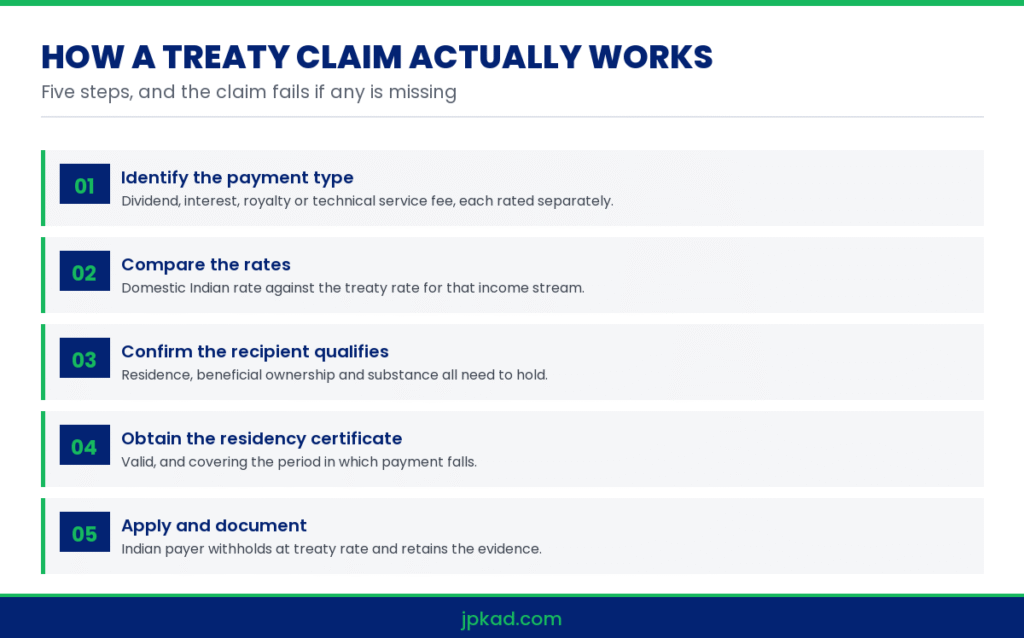
the steps required to claim double taxation treaty relief on payments from India
Documentation That Makes the Claim Stand Up
The central document is a tax residency certificate issued by the home jurisdiction, confirming the recipient is resident there for treaty purposes in the relevant period. Without a valid certificate covering the right period, the claim is exposed. Certificates are usually annual, so a payment made after expiry is a common and avoidable failure.
Alongside it sits a self declaration of the information the Indian payer needs to apply the treaty rate, and supporting evidence of beneficial ownership where the treaty requires it. The Indian company making the payment carries the withholding obligation, so it will and should insist on holding these before paying at a reduced rate.
Build the document cycle into the annual calendar. Obtain the certificate early in the year, confirm it covers the period in which payments will fall, and refresh it before expiry. Groups that request it only when a payment is imminent routinely end up withholding at the higher domestic rate and then attempting recovery.
Alongside the residency certificate sits a further requirement worth planning for. Where treaty benefits are claimed, the Indian payer generally needs certification confirming the nature of the payment and the rate applied, prepared by a qualified professional. Building this into the payment process, rather than treating it as an exception, avoids repeated delays on routine remittances.
Permanent account number status also affects outcomes. A non resident recipient without an Indian tax registration can face a higher withholding rate in certain circumstances, notwithstanding a treaty. Where regular payments are expected, obtaining the registration early is usually the simpler path than managing exceptions on every payment.
Where GCC Investors Most Often Lose the Benefit
The first loss is timing. A payment is made, the higher rate is withheld because no certificate was in hand, and recovering the difference afterwards is slow and sometimes impractical. Prevention here is purely administrative and entirely within the group’s control.
The second is characterisation. Treaties assign different rates to dividends, interest, royalties and technical service fees. A payment described loosely, or invoiced as one thing but substantively another, may attract a different rate than expected. Getting the characterisation right at the contract stage avoids arguing it later.
The third is substance. Treaty residence increasingly depends on genuine presence rather than formal registration. A holding entity in a treaty jurisdiction with no real activity, no local decision making and no employees faces growing difficulty sustaining a treaty claim. Our guide to corporate tax services for UAE investors covers the practical implications for GCC groups.
A fourth loss is worth naming because it is structural rather than administrative. Anti abuse provisions allow authorities to deny benefits where obtaining the treaty advantage was a principal purpose of an arrangement lacking commercial substance. This is not aimed at ordinary commercial structures, but it does mean that a holding entity whose only discernible function is to sit between two jurisdictions is increasingly exposed.
The practical response is to be able to explain the structure commercially without mentioning tax. If a group can describe why an entity exists, what it does, who works there and what decisions are taken there, the treaty position is usually defensible. If the only honest answer is that it improves the rate, the position is fragile regardless of how the paperwork reads.
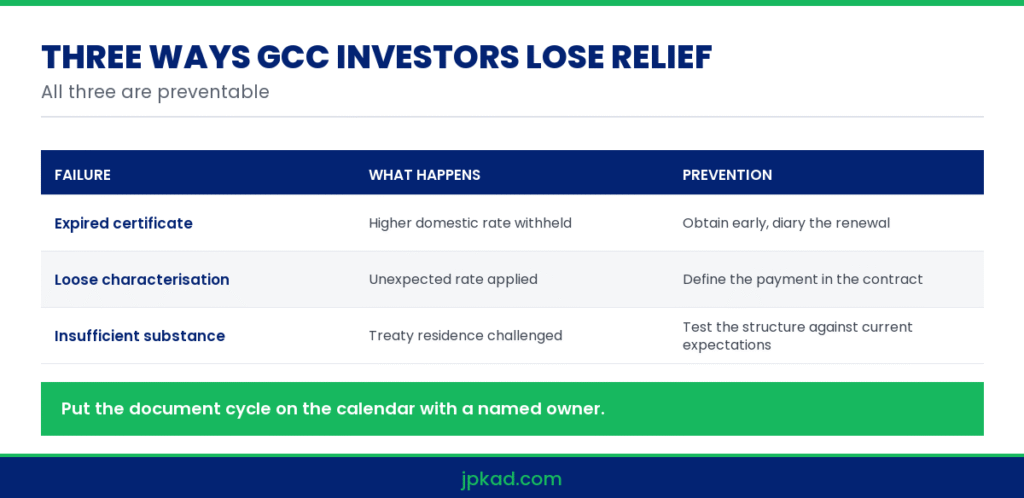
three common reasons GCC investors lose double taxation treaty relief in India
Practical Steps Before Your First Payment
Start by listing every payment type you expect to flow from India to the GCC entity over the coming year. Dividends, service fees, royalties and interest each need separate consideration. For each, identify the domestic Indian rate, the treaty rate and the conditions attached to the treaty rate.
Then confirm the recipient genuinely qualifies. Residence, beneficial ownership and, where applicable, substance requirements all need to hold. If the structure was set up years ago for reasons unrelated to tax, test it against current expectations rather than assuming continuity.
Finally, put the documentation cycle on the calendar with a named owner, exactly as with any other recurring compliance obligation. The comparative rate position by payment type is summarised in the PwC India withholding tax summary, which is a useful starting point before taking advice on your specific facts.
Where the group has flexibility, model the alternatives before fixing the structure. The difference between holding an Indian subsidiary from one GCC jurisdiction rather than another can be material across dividends, interest, royalties and eventual exit, and the right answer depends on where genuine activity already sits. Choosing on substance first and rate second produces a structure that survives.
Revisit the position periodically rather than treating it as settled. Treaties are renegotiated, protocols amend existing agreements and domestic law changes around them. A position confirmed several years ago should be re tested before a significant payment or an exit, particularly given how much has shifted in the treatment of holding structures across the region.
Keep the evidence in one place while you are at it. Residency certificates, beneficial ownership declarations, professional certifications and the correspondence supporting each payment tend to scatter across email and several finance teams. A single maintained folder, organised by year and payment type, turns a future query into a short retrieval exercise. Groups that leave this to memory typically find that the person who understood the arrangement has moved on by the time anyone asks about it.
Conclusion
Treaty relief is valuable, available and routinely lost to administration rather than to any substantive obstacle. Hold a valid residency certificate, characterise payments correctly at the contract stage, and make sure the recipient entity has the substance to support the claim. Do those three things and the relief is generally straightforward. Speak to our GCC desk before your first payment leaves India.
Frequently Asked Questions
Is treaty relief automatic?
No. It must be claimed and supported. Without a valid tax residency certificate covering the relevant period, the Indian payer will generally withhold at the higher domestic rate. Learn more about our NRI investment advisory in India.
What is a tax residency certificate?
A certificate from the home jurisdiction confirming the recipient is tax resident there for treaty purposes. It is usually annual, so a payment made after expiry is a common and entirely avoidable failure.
Can we always use the treaty rate instead of the domestic rate?
You may generally apply whichever is more beneficial for that income stream, subject to qualifying. Test each payment type separately rather than assuming the treaty is better in every case.
Why does the type of payment matter?
Treaties assign different rates to dividends, interest, royalties and technical service fees. Characterising a payment loosely can attract an unexpected rate, so define it correctly at the contract stage.
Does a UAE holding company automatically get treaty benefits?
Not automatically. Treaty residence increasingly depends on genuine substance, including real activity and local decision making. Entities without real presence face growing difficulty sustaining a claim.
What happens if we withhold at the wrong rate?
Withholding too little creates exposure for the Indian payer. Withholding too much means attempting recovery afterwards, which is slow. Confirming the position before payment avoids both outcomes.
Who is responsible for applying the treaty rate?
The Indian company making the payment carries the withholding obligation. It will therefore require the documentation in hand before applying a reduced rate, and it is right to insist on that.
When should we obtain the residency certificate?
Early in the financial year, before payments fall due. Requesting it only when a payment is imminent is the most common reason groups end up withholding at the higher domestic rate.
Does treaty relief apply to capital gains on exit?
Treatment of capital gains varies considerably between treaties and has changed over time. Confirm the current position for your specific treaty well before planning an exit, rather than at the point of sale. See our management consultancy services for related support.