
Two offers with the same headline number can deliver very different amounts to a seller. The difference is structure. Cash at completion is certain. Everything else is a promise with conditions attached. This guide sets out how consideration is built in Indian deals, what each component is really allocating, and where sellers most often give away value they thought they had negotiated. Our note on from first look to signed deal covers the wider process.
Key Takeaways
- Headline price is a negotiating position. What matters is how much is certain, how much is conditional, and who controls the conditions.
- Earn outs transfer performance risk to the seller while transferring control to the buyer, which is why the measurement clause deserves more attention than the percentage.
- Indemnity caps, baskets and limitation periods decide what a warranty is actually worth after completion.
The Components of Consideration
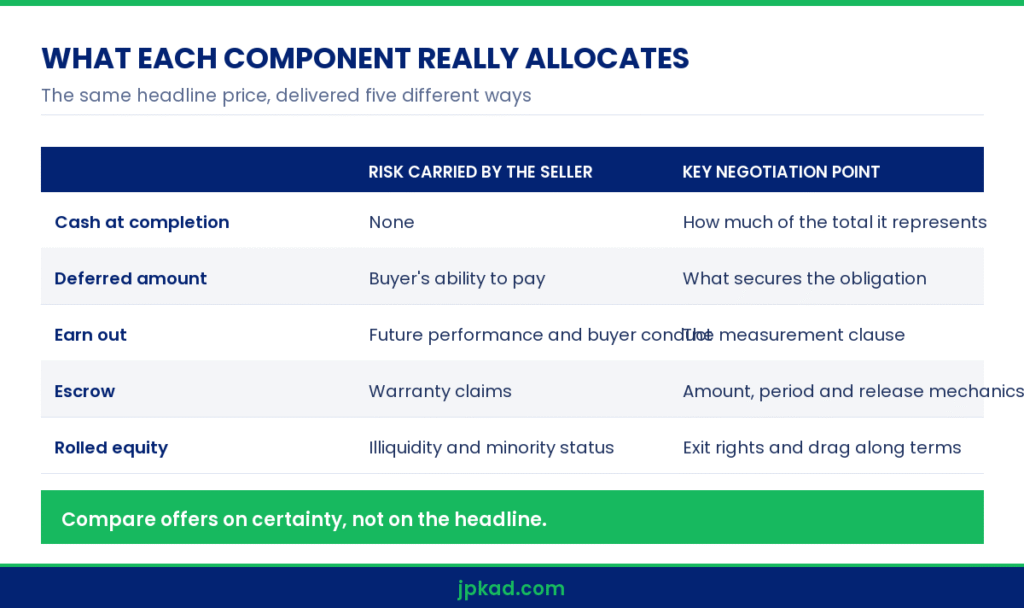
Cash at completion is the only component with no conditions attached. Everything a seller negotiates should be measured against it, because a rupee received on the closing date is worth more than a larger sum promised eighteen months later on terms someone else controls.
Deferred consideration is a fixed amount paid at a fixed later date. It is not conditional on performance, only on time, so the risk is the buyer’s ability to pay. Sellers should ask what secures it. An unsecured promise from a thinly capitalised acquisition vehicle is worth considerably less than the same promise from a parent with a balance sheet behind it.
An earn out makes part of the price conditional on future performance. It exists because buyer and seller disagree about the forecast, and it resolves that disagreement by deferring it. It is the component that generates the most post completion disputes and it deserves the most drafting attention.
Escrow holds part of the price with a third party against warranty and indemnity claims. It converts the seller’s contractual promise into money the buyer can actually reach, which is why buyers press hard for it and sellers press to reduce both the amount and the period.
Rolled equity keeps the seller invested in the combined business. It aligns interests and defers tax in some structures, but it also means the seller becomes a minority holder in an entity they no longer control, with all the illiquidity that implies.
Finally, the working capital adjustment sits across all of these. Almost every deal sets a target working capital, measures the actual position at completion, and settles the difference in cash. Sellers who do not model this carefully find that a favourable headline price is partly returned within ninety days.
Earn Outs and the Measurement Problem
An earn out looks simple. Hit a stated target and receive a stated amount. The difficulty is that the seller no longer controls the business whose performance determines the payment, and the buyer has legitimate reasons to make decisions that reduce the measured result.
Choose the metric carefully. Revenue is easiest to measure and easiest to manipulate through pricing and channel decisions. Operating profit is more meaningful and far more sensitive to allocation, because group overheads charged to the acquired business can eliminate an earn out without anyone acting in bad faith. Gross profit sits between the two and is often the practical compromise.
Define the accounting basis in the agreement, not by reference to whatever policies the buyer adopts later. State the revenue recognition policy, the treatment of intercompany charges, the cost allocations that may and may not be applied, and who prepares the calculation. A schedule with a worked example is worth more than a page of principles.
Add conduct covenants. The buyer should undertake to run the business in the ordinary course during the earn out period, not to divert opportunities to affiliates, and to maintain the resources the plan assumed. Without those, the seller has written an option that the buyer controls.
Keep the period short. Two years is common and three is stretching it, because the longer the period the harder it becomes to attribute performance to the acquired business at all. Integration blurs the boundary quickly, and a metric that cannot be measured cleanly is a dispute waiting to happen.
Finally, agree the dispute mechanism in advance. An independent expert with a defined mandate and a short timetable resolves earn out arguments far more cheaply than litigation, and knowing that mechanism exists makes both sides more reasonable.
Warranties, Indemnities and the Limits That Matter
Warranties are statements of fact about the business. If they turn out to be untrue the buyer has a claim for the reduction in value. Indemnities are promises to reimburse a specific identified risk on a rupee for rupee basis, and they are used for known exposures such as a disputed tax demand.
The disclosure letter is what makes warranties survivable. Anything properly disclosed cannot found a claim, which is why the data room and the disclosure exercise matter so much. Our note on getting the books ready for scrutiny covers the preparation that feeds it.
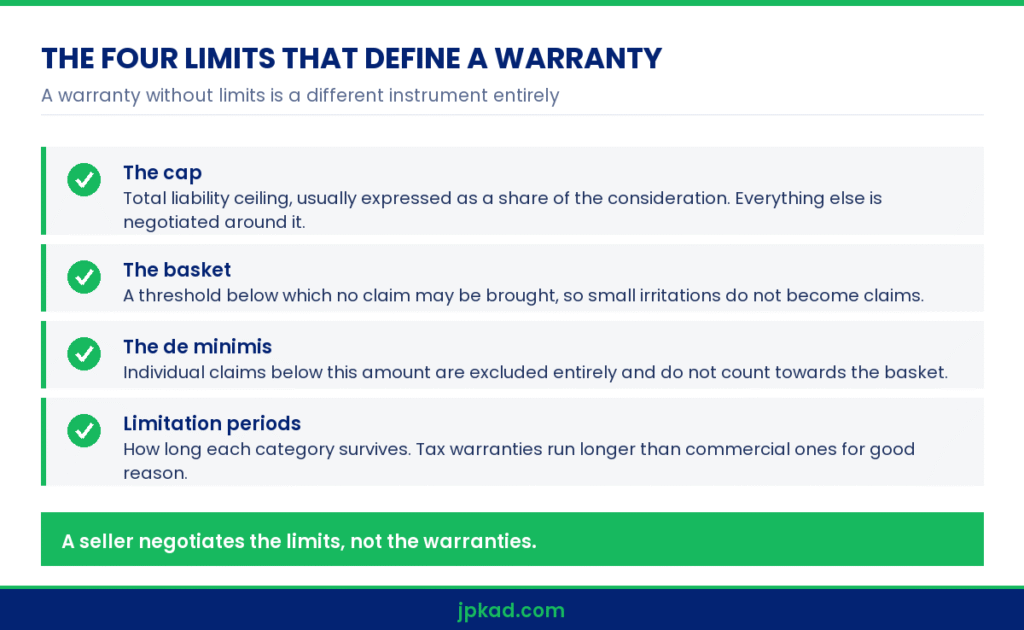
Three numbers decide what a warranty package is actually worth. The cap limits total liability, usually as a percentage of the price. The basket sets a threshold below which claims cannot be brought at all. And the de minimis excludes individual claims that are too small to count.
Limitation periods matter as much as amounts. Commercial warranties typically survive for a shorter period than tax warranties, because tax exposures take longer to surface. A seller who accepts a long tail on general warranties has kept the business risk without keeping the business.
Indemnities should be specific and quantified wherever possible. An open ended indemnity for an unquantified regulatory risk is close to unlimited exposure. Where the risk cannot be quantified, a capped indemnity with a defined period is a fairer allocation than an uncapped promise.
Consider insurance. Warranty and indemnity cover is increasingly available for Indian transactions and can allow a clean exit where the seller wants no ongoing exposure. It costs money and it has exclusions, but for a retiring owner the certainty is often worth the premium.
Structuring for Tax and for Consent
Structure changes the tax outcome for both sides, and the two sides usually want opposite things. A buyer may prefer an asset purchase to obtain a stepped up base for depreciation and to leave historic liabilities behind. A seller usually prefers a share sale for a cleaner exit and a single capital gains computation.
The gap between those preferences is a negotiable amount. Where a buyer gains a real tax benefit from a structure that costs the seller more, the benefit should be shared rather than pocketed. Quantify it rather than arguing about principle. Our comparison of share purchase and asset purchase in India sets out the mechanics.
Withholding is a practical trap in cross border deals. Where a non resident seller disposes of Indian shares, the buyer may carry an obligation to withhold from the consideration, and getting that wrong leaves the buyer exposed. The Indian withholding tax summary published by PwC is a reasonable starting orientation.
Consents drive the timetable more often than tax does. Change of control clauses in customer contracts, lender consents, landlord approvals and regulatory clearances each take their own time, and a deal structured without mapping them will slip. Identify them during diligence rather than during signing.
Where the target has foreign shareholders, exchange control pricing rules apply to the transfer and the event must be reported. This constrains the price rather than merely documenting it, so establish the permitted range before negotiating. Our checklist on FEMA compliance for foreign owned Indian companies covers the reporting side.
Finally, sequence the conditions. A structure with six conditions precedent that must be satisfied in a particular order takes far longer than one with the same six arranged in parallel. That sequencing decision is worth as much as several points of negotiation on price.
Conclusion
Deal structuring is where an agreed price becomes an actual outcome. Compare offers on certainty rather than headline, draft the earn out measurement clause as though it will be disputed, negotiate the limits on your warranties rather than the warranties themselves, and map the consents early. JPKAD supports clients through structuring, diligence and completion. Speak to our transaction team before you sign heads of terms.
Frequently Asked Questions
What is an earn out and should I accept one?
It makes part of the price conditional on future performance. Accept one only with a defined measurement basis, conduct covenants on the buyer, a short period and an agreed expert determination route.
How much of the price is usually held in escrow?
It varies with risk and negotiating strength rather than following a fixed rule. What matters more is the release schedule and whether claims must be notified before the period ends.
What is the difference between a warranty and an indemnity?
A warranty is a statement of fact, and breaching it gives a claim for lost value. An indemnity is a promise to reimburse a specific identified risk on a rupee for rupee basis.
Why does the buyer want an asset purchase?
Usually for a stepped up depreciation base and to leave historic liabilities behind. That preference often costs the seller more in tax, and the difference should be quantified and shared.
What is a working capital adjustment?
A comparison of actual working capital at completion against an agreed target, settled in cash. Sellers who do not model the seasonal pattern often return part of the price within ninety days.
Can I sell without giving warranties?
Rarely in a negotiated sale. You can limit exposure through caps, baskets and short limitation periods, or transfer it using warranty and indemnity insurance where the deal size justifies the premium.
How long should an earn out run?
Two years is common and three is usually too long, because integration blurs the boundary of the acquired business and the metric stops being cleanly measurable.
What delays Indian transactions most?
Third party consents. Change of control clauses, lender approvals and landlord consents each run on their own timetable and should be mapped during diligence, not at signing.
Who should draft the earn out schedule?
Finance and legal together, with a worked example attached. See our paperwork behind a deal and our note on paperwork and good governance.