
Owning a business in India from abroad is a different exercise from managing personal wealth here. The questions
change. Which vehicle can you own, how much of it, and does the money come back out. Most
advisers in this space
answer the personal side well and stop at the entity door. This guide covers the business side: ownership routes open
to a non resident, how repatriability is fixed at the moment of investment, and what running an Indian company from
overseas actually demands of you.
Key Takeaways
-
Repatriability is decided when the investment goes in, not when you want the money out, and the account you fund it
from settles the question. -
An NRI can own an Indian company outright in most sectors, but the vehicle you choose limits how profit can be taken
and how easily you can exit. -
Running the entity from abroad requires a resident director and a working compliance calendar, both of which are
easier to arrange before incorporation than after.
Where Personal Planning Ends and Business Structuring Begins
There are two distinct NRI conversations and they are routinely merged. The first is personal. It covers residential
status, taxation of Indian income, investment in deposits and securities, property, and eventual estate planning. Our
notes on
cross border wealth management for NRIs
and on
simplifying cross border planning
cover that ground and this article does not repeat it.
The second conversation is about an operating business. Here the subject is an entity, not a portfolio. The questions
are which vehicle to use, what the foreign investment rules permit in that sector, how the share capital is funded,
who signs in India, and what happens to the proceeds when the business is sold.
The distinction matters because the two sets of rules interact but do not overlap. Personal remittance allowances have
nothing to do with the pricing guidelines that govern the issue of shares to a non resident. Getting good advice on
one is not the same as being covered on the other.
It also matters commercially. An NRI who structures the entity as an extension of personal investment tends to under
document it. Founders who later want outside capital, a bank facility or a clean sale discover the gap at the worst
possible moment, when a buyer or lender is reading the file.
Treat the venture as a business from the first day. That means a considered choice of vehicle, a properly evidenced
capital route and a compliance calendar someone owns. None of it is expensive at the start. All of it is expensive to
reconstruct later.
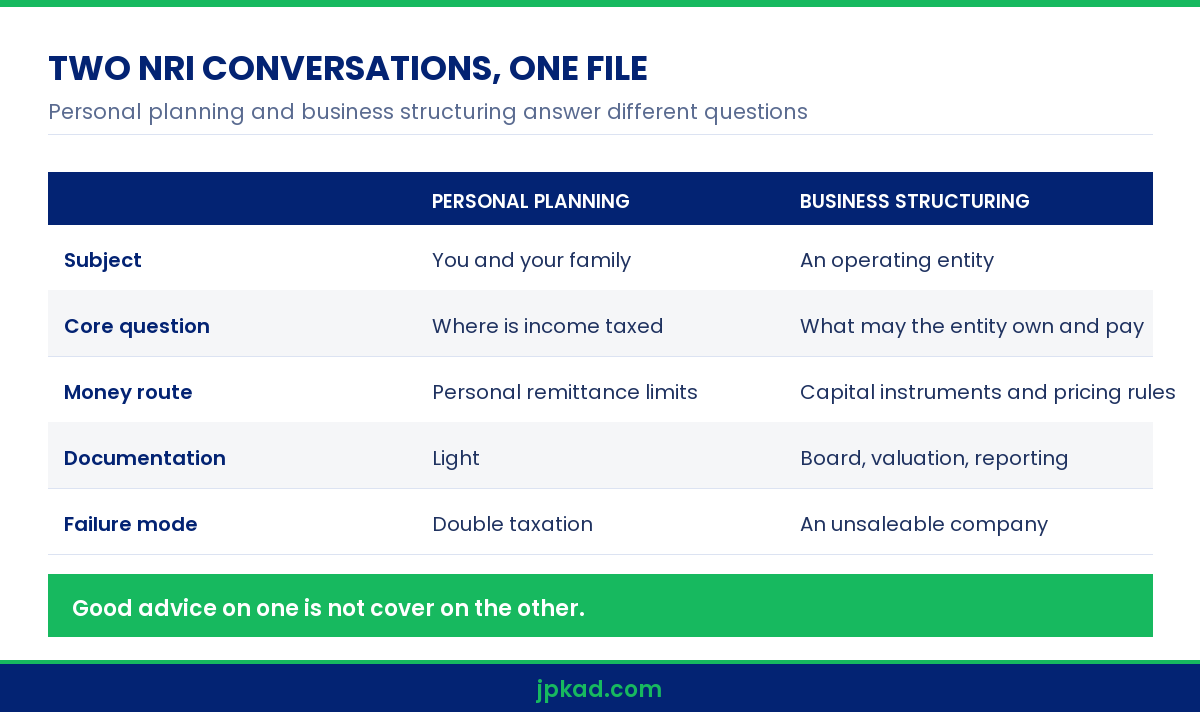
Personal and business advice answer different questions.
Ownership Routes Open to a Non Resident Owner
A private limited company is the default and the most flexible. In most sectors a non resident may hold the entire
share capital under the automatic route, which means no prior government approval is needed, only reporting after the
fact. Sectoral caps and conditions apply in a defined list of activities, and the current position for a given sector
is published among the
foreign direct investment policy material
maintained by the government.
A limited liability partnership is permitted for foreign investment in sectors where the whole activity sits under the
automatic route with no performance conditions attached. It is lighter to run than a company, but it is harder to
bring outside investors into later, and institutional money generally will not subscribe to it. Choose it only if you
are confident the business will not raise equity.
A sole proprietorship or a partnership firm is available to a non resident only on a non repatriation basis. That
single condition disqualifies it for most people reading this. Profits and sale proceeds stay in India. The structure
is cheap and simple and it locks your money in the country.
The comparison between vehicles is broader than ownership alone. Cost to set up, ongoing filing burden, tax treatment
of profit distribution and the difficulty of exiting all move together. Our note on
choosing an India entry vehicle
scores those trade offs for foreign parents and the same analysis applies to an individual NRI owner.
One further point is often missed. Where an NRI already holds shares in an Indian company acquired years ago, the
basis on which those shares were originally acquired governs what can be repatriated on sale today. Establish that
history before you plan an exit, not during one.
Repatriable or Not: The Choice Made at Funding
The most consequential decision in the whole structure is made quietly, at the moment funds are remitted. Investment
funded from abroad or from a rupee account that holds repatriable balances is treated as foreign direct investment.
Profits, dividends and sale proceeds can be sent back out, subject to tax and to the reporting having been done
correctly.
Investment routed through a non resident ordinary account is treated as domestic investment. It carries fewer
conditions going in, no pricing guideline and no sectoral cap, because the regulator treats it as resident money. The
price of that simplicity is that the capital and the gain stay in India.
People choose the wrong one for understandable reasons. The ordinary account already exists, the money is already
sitting in it, and the transfer is one instruction rather than a wire from overseas. The saving of an afternoon costs
the repatriability of the entire investment.
The route also determines what has to be reported. A repatriable investment triggers the share allotment return to the
regulator and, in later years, the annual foreign liabilities return. Both are covered in our guide to
filing the FC GPR and FLA returns. A non repatriable investment does not enter that regime at all, which is another reason the two are so easy to
confuse in a file.
Decide deliberately and document the decision. Keep the inward remittance advice, the account statement showing the
source, and the board and shareholder records for the allotment together in one place. If the business is ever sold,
that bundle is what allows the proceeds to leave the country without argument.
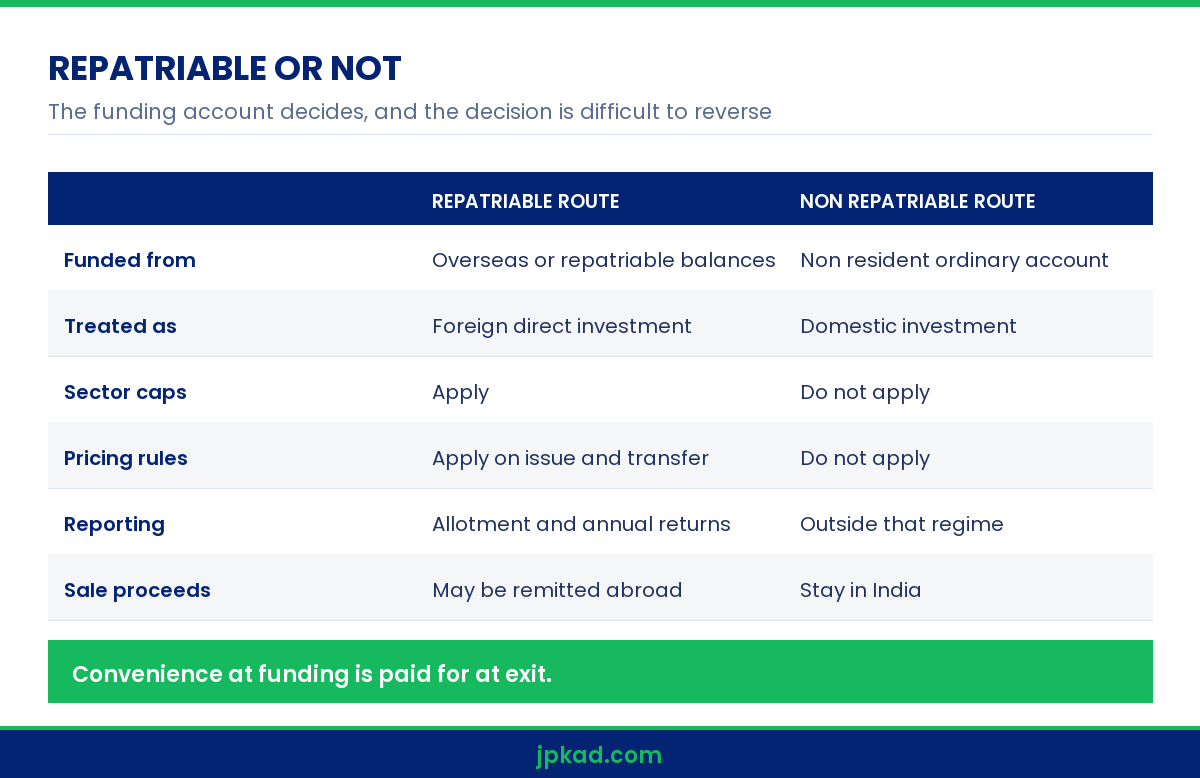
The account the money comes from settles repatriability.
Running the Entity From Abroad
An Indian company must have at least one director who has stayed in India for the prescribed period during the
financial year. For an owner living overseas this is not a formality. That person signs filings, is named in
registers, and carries statutory duties. Appointing a nominee who is unreachable in practice creates a governance
problem that surfaces during audit or diligence.
Banking is the second friction point. Account opening, mandate changes and periodic reverification all expect
documents attested in a particular way and often a physical presence. Plan the signatory structure so that routine
payments do not depend on a person in a different time zone, and keep the authorisations current rather than renewing
them under pressure.
Compliance runs on a calendar that does not pause for distance. Company law filings, tax returns, withholding
obligations and, where applicable, foreign investment reporting each have their own dates. Owners abroad tend to
discover a lapse only when a penalty notice arrives. A named owner and a monthly review prevent almost all of it, and
our note on
tightening a compliance system
sets out how to structure that.
Getting profit out is a design question rather than a year end one. Dividends, a director remuneration package, and
payments for genuine services rendered from abroad each carry different tax and withholding consequences, and the
right mix depends on where you are resident. Our comparison of
the repatriation routes set out in our India entry guide
models those side by side.
Finally, plan the exit while you are building. A company with clean statutory records, evidenced capital and a
documented repatriable basis sells at a better price and completes faster. One without them attracts a discount that
is always larger than the cost of having done the work properly.
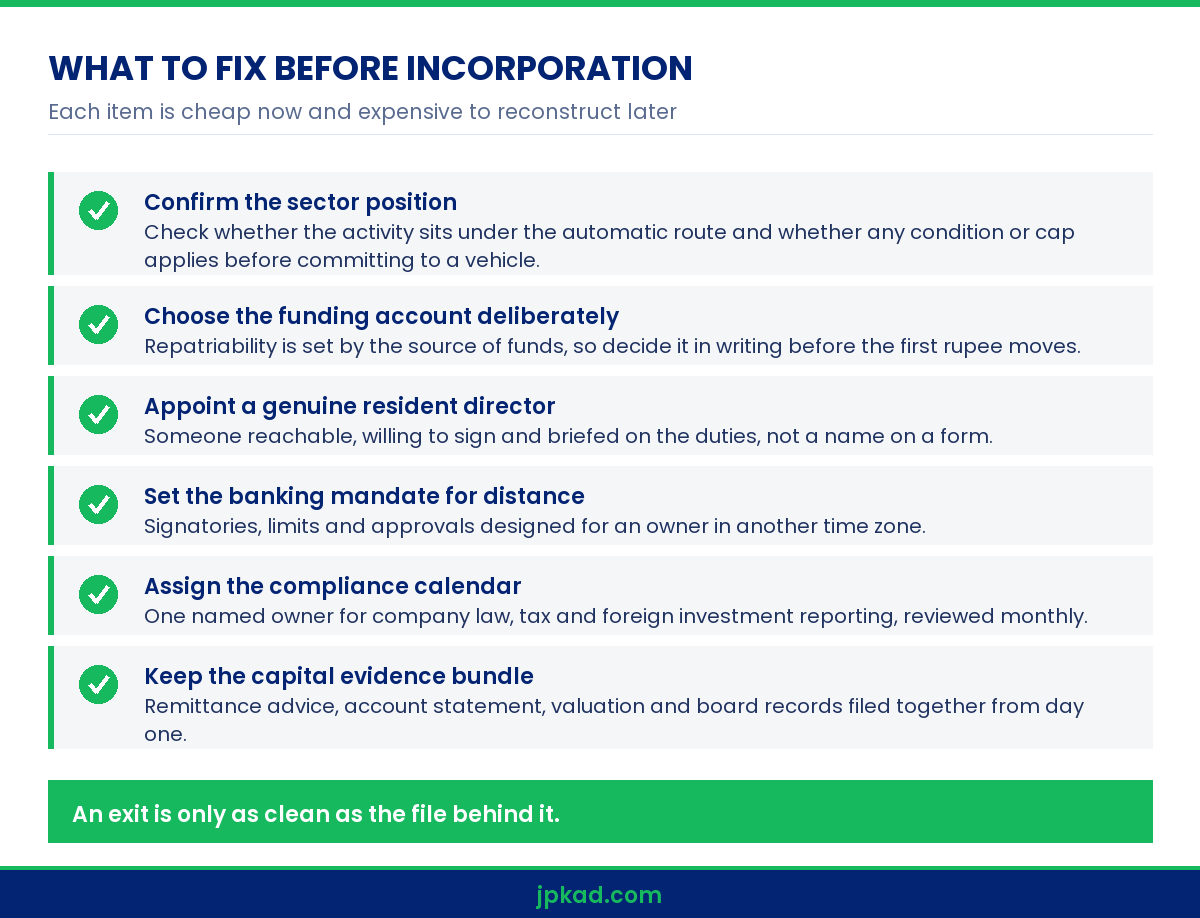
Six decisions that shape every later option.
Conclusion
Structuring an Indian venture from abroad is mostly a sequence of early decisions that are hard to undo. Pick the
vehicle for where the business is going, not for what is quickest to register. Fund it through the route that keeps
your money mobile. Put a real resident director and a real compliance owner in place before you need them. Experienced
nri investment advisors in india will insist on all four before incorporation, and the cost of doing so is trivial
next to the cost of unwinding a structure later. Get in touch for a
structuring review before you commit.