
Foreign investors rarely lose money in India because the market disappoints. They lose it because the entry structure was wrong from day one. Choosing the right entity, filing the right forms and understanding how profits come back out are decisions made in the first ninety days. Good fdi consultants in India make those decisions once, correctly. This guide walks through the full entry process, from route selection to repatriation, so you know what to ask before you commit capital.
Key Takeaways
- India permits most foreign investment through the automatic route, which needs no prior government approval but still carries mandatory reporting obligations.
- Your entity choice, whether a subsidiary, branch or liaison office, determines your tax rate, your compliance load and how easily you can exit later.
- The compliance failures that cost foreign parents the most are reporting failures, not tax failures. FEMA filings carry penalties that compound over time.
Understanding How Foreign Investment Into India Actually Works
India receives foreign direct investment through two channels. The automatic route covers most sectors and requires no prior approval from any government body. The government route applies to a shorter list of sensitive sectors and requires clearance before the investment is made. Most commercial ventures, including software, manufacturing, professional services and trading, sit comfortably in the automatic route.
The distinction matters more than many first time investors expect. Automatic route does not mean unregulated. It means the approval happens after the fact, through reporting, rather than before it, through an application. Miss the reporting and you have an unreported investment, which is a compliance breach even though the underlying investment was always permitted. The Reserve Bank of India administers this reporting layer, and Invest India publishes the current sectoral position.
Ownership is also traced upward, not just recorded at the immediate shareholder. Where an investing entity is itself owned from another jurisdiction, the ultimate beneficial ownership matters for both sectoral eligibility and reporting. Groups with layered holding structures should map the full chain before filing anything, because an incomplete disclosure is harder to correct than a complete one made at the outset.
There is also a distinction between fresh investment and secondary purchase. Subscribing to newly issued shares brings money into the company. Buying existing shares from a current holder moves money to that holder instead. Both are foreign investment, both are reportable, but they use different forms and carry different pricing requirements. Confusing the two is a frequent source of rejected filings.
Sectoral caps and why they change
Each sector carries a cap on how much foreign ownership is permitted. Many sectors allow one hundred percent. Others cap foreign holding at seventy four or forty nine percent, sometimes with conditions attached to the balance. These caps are revised periodically through policy press notes, so a cap confirmed two years ago may no longer be current. Verify the position at the time you invest, not at the time you planned to.
Who counts as a foreign investor
The definition is broader than most people assume. It captures foreign companies, foreign individuals, non resident Indians and entities that are themselves foreign owned. An Indian company with majority foreign ownership making a downstream investment is treated as a foreign investor for that investment. This catches groups who assumed their Indian holding company was simply Indian.
Choosing the Right Entity for Your India Operation
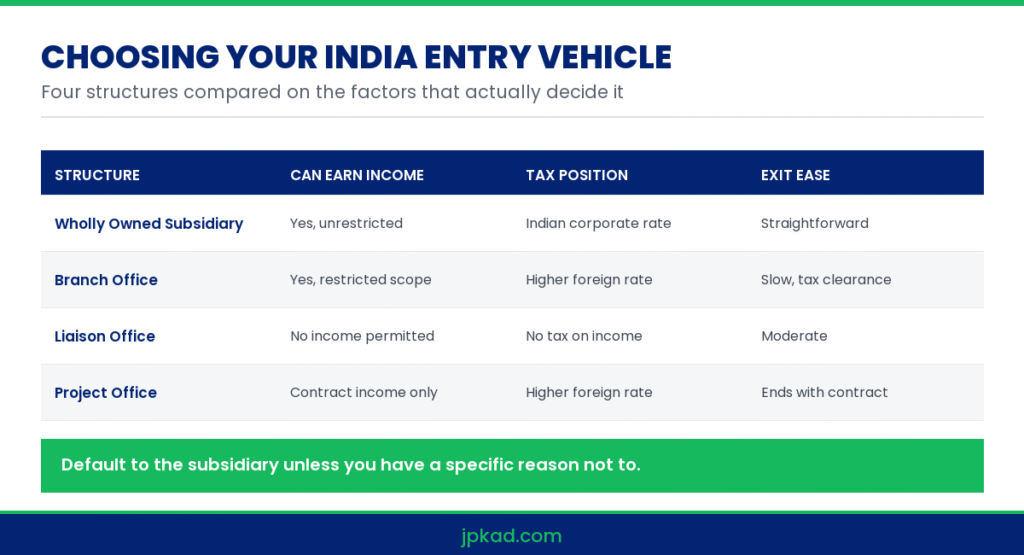
Four structures are commonly used. A wholly owned subsidiary is a separate Indian company, taxed as an Indian resident, able to trade freely and to raise local capital. A branch office is an extension of the foreign parent, permitted to earn income but taxed at higher rates. A liaison office may not earn income at all and exists purely to represent the parent. A project office is tied to a specific contract and ends when the contract ends.
The subsidiary is the default for anyone planning to trade, hire at scale or eventually sell. It carries the lowest tax rate, the widest permitted activity and the cleanest exit. It also carries the heaviest ongoing compliance. A liaison office is far lighter to run but cannot invoice a single rupee, which surprises companies who set one up expecting to test the market commercially. Experienced Foreign Company Setup Consultants In India will push hard on this question before anything is incorporated, because reversing it later is expensive.
Sector eligibility interacts with entity choice more than most entrants expect. Certain activities are open to a subsidiary but not to a branch, and some are restricted regardless of vehicle. Confirm that your intended activity is permitted for the structure you have chosen before incorporating, rather than discovering the mismatch when you apply for a registration or a licence.
Capitalisation deserves early thought too. An Indian company should be funded adequately for its first eighteen months rather than topped up repeatedly, because each fresh injection of foreign capital triggers its own allotment, valuation and reporting cycle. Groups that drip feed capital create administrative work out of proportion to the sums involved, and they generate more opportunities to miss a deadline.
Costs that appear after incorporation
Incorporation fees are the small part. The recurring cost is compliance: statutory audit, annual filings, tax returns, transfer pricing documentation if you transact with the parent, and payroll compliance once you hire. Budget for a full year of professional support rather than a one time setup fee. Groups that budget only for incorporation are usually the ones that fall behind on filings in year one.
Planning the exit at the entry stage
How you will eventually leave should shape how you arrive. Selling shares in an Indian subsidiary is straightforward and well understood by buyers. Winding up a branch office is slower and involves tax clearance. If a trade sale or a group restructure is plausible within five years, that argues strongly for the subsidiary even where a branch looks cheaper today.
The Incorporation Process Step by Step
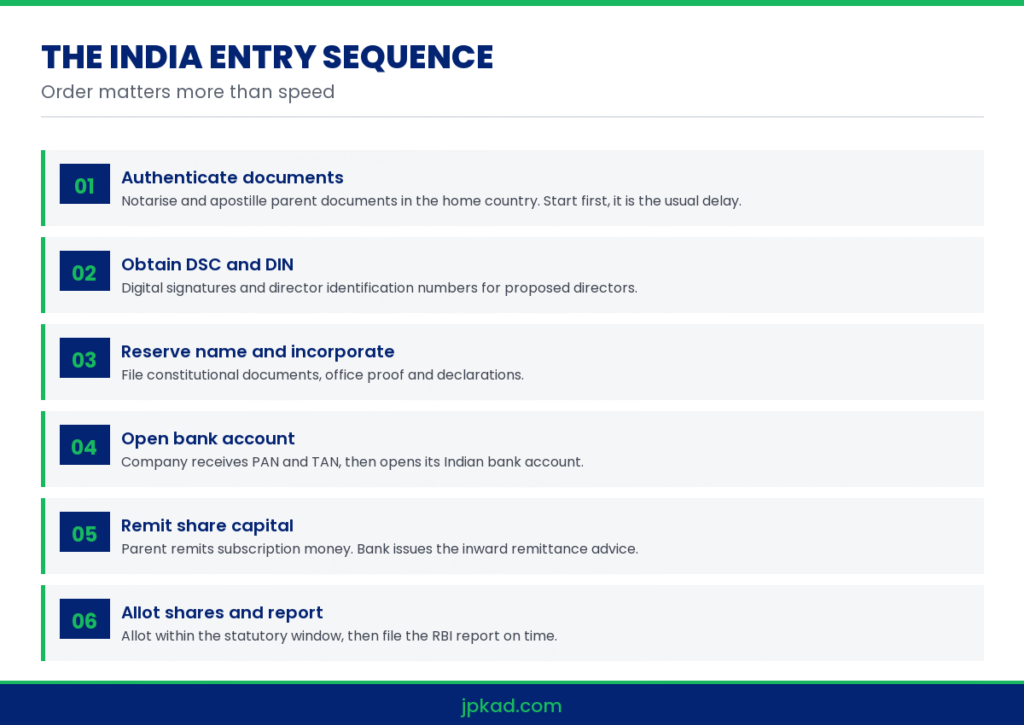
Incorporating an Indian company follows a defined sequence. Directors obtain digital signature certificates and director identification numbers. The proposed name is reserved. The incorporation application is filed with the constitutional documents, registered office proof and subscriber declarations. On approval, the company receives its certificate of incorporation along with its permanent account number and tax deduction account number.
Banking follows incorporation. The company opens an Indian bank account, the foreign parent remits the share subscription money, and the bank issues an advice confirming the inward remittance. That advice is the document the entire reporting chain depends on. Shares are then allotted within the statutory window, and the allotment is reported. Sequence matters here. Remitting money before the company exists, or allotting shares late, creates problems that take months to unwind.
Realistic timelines run four to eight weeks from first document to a functioning bank account, assuming the foreign parent’s documents are properly notarised and apostilled in the home country. Document authentication is the most common cause of delay, and it happens abroad, outside your Indian advisor’s control. Start it early.
Registered office is a practical constraint that catches groups without a local presence. The company needs a genuine Indian address capable of receiving official correspondence, supported by proof of the premises and the owner’s consent. A virtual address may suffice initially in some cases, but banks and authorities increasingly expect a verifiable location, so treat this as a real decision rather than a formality.
Banking has become the slowest step for many foreign owned entities. Account opening involves verification of the foreign parent, its directors and its ultimate beneficial owners, and requirements vary between banks. Starting the banking conversation in parallel with incorporation, rather than after it, routinely saves two to three weeks. Have the parent’s corporate documents, ownership chart and director identification ready in advance.
Finally, plan the first board meeting properly. Appointment of the auditor, adoption of the registered office, authorisation of bank signatories and approval of the share allotment all flow from early board resolutions. Companies that treat these as paperwork to be caught up later frequently find a bank or a registrar asking for a resolution that was never passed.
Getting the banking conversation started early
Account opening is now the most common cause of a delayed launch. Banks verify the foreign parent, its directors and its ultimate beneficial owners, and their requirements differ. Approach two banks in parallel rather than one sequentially, and have the parent’s certificate of incorporation, ownership chart and director identification documents ready before the first conversation.
Reporting Obligations Most Foreign Parents Underestimate
This is where foreign owned companies most often fall down. Receiving investment triggers a reporting obligation to the Reserve Bank of India within a defined window after shares are allotted. A separate annual return covering foreign assets and liabilities is due each year for as long as the foreign holding exists. Neither is optional, and neither is triggered by a reminder. The obligation sits with the Indian company.
Penalties for late reporting are calculated by reference to the amount involved and the delay. They compound. A company that discovers three years of missed annual returns during a due diligence exercise is looking at a compounding application, a professional bill and a delayed transaction. The current framework sits within the Foreign Exchange Management Act, and the operative instructions are issued as master directions.
Beyond the two principal filings sit obligations triggered by ordinary corporate events. Issuing shares to employees under a stock plan where those employees sit overseas, receiving share application money that is later refunded, or converting a loan from the parent into equity each carry their own treatment. None is unusual, and each is missed regularly because it does not feel like a foreign investment transaction at the time.
It is worth distinguishing genuine complexity from mere volume. The rules themselves are not conceptually hard. What defeats companies is the number of small obligations, each with its own trigger and window, spread across a year in which nobody has been given clear responsibility. A single maintained register of foreign investment events, reviewed quarterly, resolves most of this at negligible cost.
Build the calendar before you need it
The practical fix is unglamorous. Build a compliance calendar in month one, assign a named owner at the parent as well as in India, and review it quarterly. Most reporting failures we see are not technical misunderstandings. They are ownership failures, where everyone assumed someone else was handling it.
How a Foreign Owned Indian Company Is Taxed
An Indian subsidiary is an Indian tax resident and is taxed on its worldwide income at Indian corporate rates. Concessional rates are available to companies that give up certain exemptions and incentives, which usually suits a new subsidiary with no legacy tax attributes. A branch office of a foreign company is taxed at a materially higher rate, which is one of the strongest financial arguments for the subsidiary structure.
Payments leaving India attract withholding tax. Dividends, interest, royalties and technical service fees each carry their own rate, and each can often be reduced under a tax treaty. Any transaction between the Indian company and its foreign parent must be priced at arm’s length and documented. The comparative position by country is summarised well in the PwC worldwide tax summary for India, which is a useful starting reference before taking local advice.
Groups that treat Indian tax as a year end exercise tend to overpay. Groups that plan the intercompany arrangements at incorporation, and document them contemporaneously, tend not to. The difference is rarely aggressive planning. It is simply doing ordinary things in the right order.
Withholding obligations arise on domestic payments too, not only on money leaving India. Salaries, professional fees, rent and contractor payments all carry deduction requirements with their own rates and deposit deadlines. Foreign parents accustomed to lighter domestic withholding regimes frequently underestimate this, and the penalties for late deposit accrue quickly.
Indirect tax is a separate regime again. Goods and services tax applies to most supplies, registration is required once thresholds are crossed or in certain circumstances immediately, and returns are periodic rather than annual. Export of services can be zero rated where conditions are met, which matters greatly for software and professional services subsidiaries serving the parent, but the conditions must be satisfied and evidenced.
Advance tax is the detail that most often produces an unwelcome surprise in year one. Indian companies pay tax in instalments through the year based on estimated income, rather than settling in full after the year ends. A subsidiary that becomes profitable faster than forecast can find itself facing interest for underpaid instalments despite having filed everything on time.
Why advance tax catches new subsidiaries
Indian companies pay tax in instalments through the year based on estimated income, not in a single settlement afterwards. A subsidiary that grows faster than forecast can owe interest on underpaid instalments despite filing everything correctly and on time. Review the estimate quarterly against actual performance rather than setting it once at the start of the year.
Getting Money Back Out of India
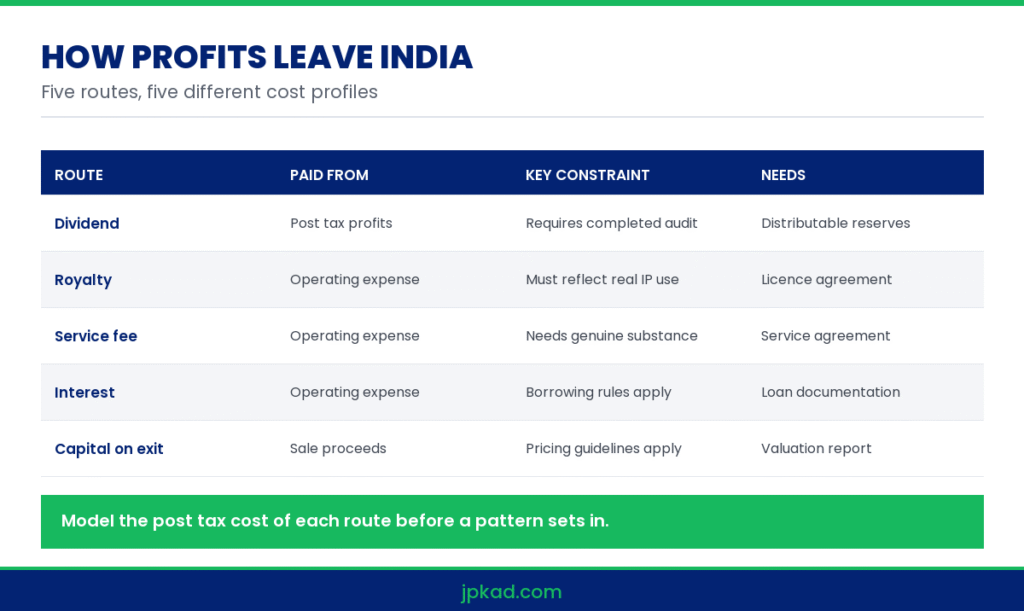
Repatriation is legal, routine and frequently mishandled. Profits leave India through several routes. Dividends are paid from distributable profits after tax. Royalties and technical service fees are paid under agreements for genuine services or intellectual property. Interest is paid on properly constituted borrowing. Capital returns on a share sale or a buyback. Each route carries its own tax cost and its own documentation.
The mistake is not choosing an illegal route. It is choosing an expensive one by default. A group that takes everything out as dividends may be paying materially more tax than one that charges properly documented service fees for work the parent genuinely performs. The reverse is also true, since service fees without substance invite challenge. Model the post tax cost of each route before you commit to a pattern, because patterns are hard to change once established.
Cash flow planning matters alongside tax. Dividends depend on accounting profits, which depend on a completed audit. A parent expecting cash in month three of the financial year needs to understand that the audit timetable, not the tax rate, is the binding constraint. Sound treasury and working capital planning closes that gap.
Timing within the year matters as much as the route chosen. Withholding rates, treaty conditions and the availability of distributable profits all shift with the calendar, and a payment made shortly before or after a year end can carry a materially different cost. Where the amount is significant, model the alternatives before committing to a date.
Documentation should exist before the payment, not after it. A service agreement signed once a query arrives carries far less weight than one signed at the start of the arrangement and applied consistently since. This is the single most common weakness we see in otherwise well run groups, and it costs nothing to fix at the outset.
Model the group position, not only the Indian one
A route that minimises Indian tax may increase tax at the parent, leaving the group no better off. Expense based payments reduce Indian profit but become taxable income elsewhere. Before fixing a pattern, model the combined outcome across both jurisdictions, because optimising one end in isolation is how groups end up with a structure that looks efficient and is not.
Choosing an Advisor and What to Ask Before You Engage
India entry work spans several professions. Chartered accountants handle tax, audit, transfer pricing, FEMA reporting and financial compliance. Company secretaries handle corporate law filings and board governance. Lawyers handle contracts, disputes and regulatory representation. Small entries are often run by a single chartered accountancy firm that coordinates the rest. Larger entries usually need all three.
Ask direct questions before engaging. Who specifically will own the FEMA filings? What is included in the annual fee and what is billed separately? Have you handled entries from my home country, and can you describe one? Who covers the work if the named partner is unavailable? Vague answers at the proposal stage tend to become vague service later.
Local presence carries real weight for banking, registered office matters and dealings with local authorities. Firms such as JPKAD and Associates work with foreign parents from the GCC and beyond entering through Kerala and the wider South India corridor, and a recent US technology market entry in Bengaluru shows the sequence in practice.
Consider how the relationship will work day to day, not just at year end. Someone at the parent will need a counterpart in India who can answer a question within hours rather than days, particularly during audit and filing seasons. Clarify who that person is, what their working hours are, and how escalation works when the named partner is travelling.
Ask also how the firm handles the interaction between disciplines. India entry work regularly requires a tax view, a company law view and a foreign exchange view on the same transaction. A firm that coordinates these internally saves you from becoming the project manager between three advisors who each see only part of the picture.
Finally, agree the reporting rhythm at the outset. A monthly compliance status note, a quarterly review call and an annual planning session cover most groups adequately. Firms offering ongoing management consultancy support will usually propose something similar, and a proposal that mentions no reporting rhythm at all is worth questioning.
Warning signs worth taking seriously
Be cautious with any advisor who guarantees approvals, quotes a setup fee with no mention of ongoing compliance, or is vague about who performs the work. Be equally cautious of a structure recommended before anyone has asked what you actually plan to do in India. The structure should follow the business plan, never the other way around.
Conclusion
India rewards investors who get the boring parts right. The entity choice, the reporting calendar and the repatriation plan are not glamorous, but they determine whether your India operation runs smoothly or consumes management attention for years. Engaging experienced fdi consultants in india before incorporation, rather than after the first missed filing, is the cheapest decision available to you. Talk to our cross border team to review your entry plan before you commit capital.
Frequently Asked Questions
Do I need government approval to invest in India?
Most sectors fall under the automatic route and need no prior approval. Only a limited list of sensitive sectors requires government clearance. Automatic route investments still carry mandatory post investment reporting to the Reserve Bank of India. Learn more about our audit and assurance support.
How long does it take to set up a company in India?
Four to eight weeks is realistic from first document to an operational bank account. Delays usually come from notarisation and apostille of the foreign parent’s documents in the home country, so begin that process early.
Can a foreign company own one hundred percent of an Indian subsidiary?
Yes, in most sectors. Many sectors permit full foreign ownership under the automatic route. Some carry caps or conditions, and these are revised periodically, so confirm the current position for your specific activity.
What is the difference between a branch office and a subsidiary?
A subsidiary is a separate Indian company taxed at Indian corporate rates. A branch is an extension of the foreign parent, taxed at a higher rate, with narrower permitted activity and a slower closure process.
What happens if I miss a FEMA filing?
Late filings attract penalties calculated on the amount involved and the length of delay, and they compound. The position can be regularised through a compounding application, but it is slower and costlier than filing on time.
How do I take profits out of India?
Through dividends, royalties, service fees, interest or capital on exit. Each route carries a different tax cost and documentation requirement. Model the post tax outcome before settling into a pattern, because patterns are hard to change.
Do I need a resident director in India?
Yes. An Indian company must have at least one director who has stayed in India for the required minimum period during the financial year. Plan for this early, as it often shapes the initial board composition.
Is transfer pricing documentation really necessary for a small subsidiary?
If your Indian company transacts with its foreign parent, arm’s length pricing applies regardless of size. Documentation requirements scale with transaction value, but the pricing obligation itself does not have a floor.
Which is better for market testing, a liaison office or a subsidiary?
A liaison office suits pure representation, as it cannot earn income. If you intend to invoice customers or run commercial trials, you need a subsidiary or branch. Many groups discover this only after incorporating.
What ongoing compliance will my Indian company face?
Statutory audit, annual corporate filings, income tax returns, goods and services tax returns if registered, payroll compliance, the annual foreign liabilities return and transfer pricing documentation where the parent transacts with the subsidiary. See our corporate tax services in India for related support.